Module 7 - Ion channels part 3 (non-selective ion channels) - updated
Ion Selectivity and Neuronal Function
Importance of Ion Selectivity
Effect of Ion Selectivity on Neurons at Resting Membrane Potential (RMP):
Na+ Channels: Depolarize the cell, leading to action potential generation.
K+ Channels: Hyperpolarize the cell, making it less excitable and help the membrane potential return to resting state
Ca2+ Channels: Depolarize the cell and drive calcium signaling, crucial for neurotransmitter release.
Cl- Channels: Can either depolarize or hyperpolarize the cell depending on the ion gradient.
Role of Synaptic Receptors
Non-selective Ion Conductance
Refers to ion channels or receptors that allow multiple types of ions to pass through, rather than selectively allowing only one type of ion. When these channels are activated, they can create a change in the membrane potential by allowing various ions to flow, which might lead to depolarization or hyperpolarization of the neuron depending on the ions' concentration gradients.
Example synaptic receptors include iGluRs (ionotropic glutamate receptors) and AChRs (acetylcholine receptors).
These receptors can conduct both Na+ and K+ ions.
Question: Why do they typically conduct Na+ to depolarize cells and generate excitatory postsynaptic potentials (EPSPs) instead of K+ to hyperpolarize cells and generate inhibitory postsynaptic potentials (IPSPs)?
Driving Forces of Ions
Driving Forces at Resting Voltages
At typical resting voltages (~-65 mV):
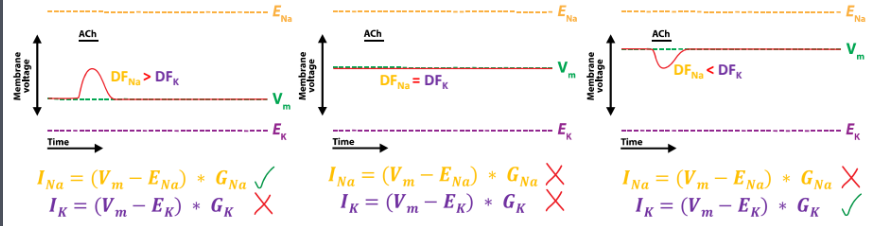
The driving force for Na+ flowing into the cell is significantly greater than that for K+ flowing out.
When the neuron reaches resting membrane potential (approximately -65 mV), the driving force for Na+ is larger due to both the strong concentration gradient and the electrical gradient that actively pulls Na+ into the cell, whereas the driving force for K+ is weaker because of its higher concentration inside the cell and the positive charge outside repulsing it.
Even with equal ability to conduct Na+ and K+, the energy driving Na+ inward is higher than that for K+ outward.
Conclusion: For an ion channel with equal conductance for Na+ and K+, the ion with greater driving force will dominate current flow.
Changes in Driving Forces
Depolarization Effects on Ion Conductance
At depolarized voltages, nAChRs (nicotinic acetylcholine receptors) can conduct hyperpolarizing K+ currents because the driving force for K+ becomes stronger than for Na+.
When driving forces for Na+ and K+ are nearly equal, the net current becomes zero.
Experimental Insights
Takeuchi Studies (1959)
Investigated synaptic AChR currents using two-electrode voltage clamp in frogs.
researchers inserted two electrodes into the frog's muscle or nerve cells to control the membrane potential and measure ionic currents flowing through AChRs as they were activated by synaptic signaling. By manipulating the holding voltage, they could observe how the direction of synaptic potentials varied. they can measure how ions flow through channels in response to the neurotransmitter release and see whether the reaction in the postsynaptic cell is inhibitory (IPSPs) or excitatory (EPSPs).
Observed that the direction of synaptic potentials changed based on the holding voltage. (when holding voltage is very depolarized, K ions flow out but when holding voltage is very polarized/negative Na ions flow in)
Reversal Potential (ERev): Voltage at which inward currents reverse to outward currents or the potential at which the driving forces for inward and outward currents become equal (any more depolarized than this potential will lead to the currents reversing, where the driving force for the outward current is larger than the driving force of the inward current)
Characterizing Ion Selectivity
Reversal potentials can characterize ion selectivity of ion channel types:
Channels highly selective for K+ will exhibit ERev at EK.
Channels highly selective for Na+ will exhibit ERev at ENa.
Non-selective channels will have ERev values between EK and ENa, based on their affinity for Na+ vs. K+ where there is no net flow of either ion.
Recent Research
Senatore Lab Findings
Focused on non-selective Na+/K+ pores, specifically Deg/ENaC channels:
These are ligand-gated and distinct from P-loop channels.
Activation can occur through various ligands, including protons and mechanical stimuli.
Experiments on Cation Selectivity
Used perfusion to manipulate external cation concentrations while keeping internal Na+ constant.
Perfusion involved changing the concentrations of external cations (like Na+, K+, etc.)
Applied voltage clamp techniques to measure currents and determine reversal potentials.
Findings:
The pore demonstrated:
Approximately 7x greater permeability to Na+ than K+.
Similar permeability for Na+ and Li+.
Roughly 30x greater permeability for Na+ compared to Cs+.
Summary of Cation Channel Selectivity
General Trends
Nav, Kv, and Cav channels show high selectivity for respective ions.
Many other cation channels, however, display lesser discrimination among monovalent ions (Na+ and K+):
Notable examples include:
nAChRs (Cys-loop)
iGluRs (P-loop)
TRP channels (P-loop)
Deg/ENaCs
P2X channels (not discussed here)
Conclusion: Non-selective Na+/K+ pores exist with varying selectivity.