Non-Associative Learning
What do we mean by Learning?
Learning is the acquisition of knowledge or skills through experience. Typically learning is revealed by a change in behavioural, physiological and/or neural reactions/response.
Non-Associative Learning
Habituation
Sensitisation
PASS PSYU2236 W2 COMPLETED WS.docx

PSYU2236

Test Your Knowledge Quiz:

As per SLIDO quiz:

QI: Which process best explains why the first

bite of food typically tastes the best?

Q2: What is habituation?

cannot smell our own home, but

we instantly notice the smell of other homes.

*a = sensitization

*c = Associative leaming (classical cond)

Q3: What is sensitization?

_&xamplezmosquito sound

Q4: What is the definition of learning in

psychology?

Q5: Which of the following is an example of

habituation?

*a, b,c = Sensitization

Q6: What is dishabituation?

Exam le.

Habituation to fridge noise addition of a novel

stimulus reorients the perceiver to the

habituated stimulus. ..ü Dishabituation to fridge

noise

Habituation to traffic noise crossing street

0 Siren would alert edestrians to the traffic!

Q7: Which of the following is NOT a level at

which learning can occur?

Q8: According to the dual-process theory what

determines the observable behaviour in

habituation and sensitization?

Q9: Which is untrue of habituation?

*this is sensitisation

*nw; sensitisation generalises to other stimuli

QIO: What is the difference betvveen habituation

and sensory adaptation?

QII: What is this an example of?

"if you jump into a pool of cold

water, after a few minutes you start to

adapt. After about 15 minutes if you

try to get the initial feeling of jumping

into the cool water you can't"

* With Sensory Adaptation you can't

reca ture the initial stimulus

Q12: What is this an example of?

"there is annoying

sound, which you eventually

tune it out, but if you attend

to it, you hear it again"

*With Habituation, you can recapture

the stimulus = dishabituate

**exce t evolutiona u osese. . c in bab

Q13: A stimulus of intermediate intensity often

results in:

*Low intensity stimulus = habituation

*Hi h intensit stimulus = sensitisation

Q14: Why don't we habituate to mosquitos or a

baby crying?

*It is adaptive to sensitise to them

*Evolutionary sig can override intensity

Q15: True or False: "Habituation and

sensitization can co-occur"

Al:

a) Habituation

b) Sensitisation

c Dishabituation

a) An increase in response amplitude or

frequency as a consequence of repeated

experience with a stimulus

b) A decrease in response amplitude or

frequency as a consequence of repeated

experience with a stimulus

c The rocess of associatin two stimuli

a) A decrease in response amplitude or

frequency as a consequence of repeated

experience with a stimulus

b) An increase in response amplitude or

frequency as a consequence of repeated

experience with a stimulus

c The rocess of fo ettin information

a) The acquisition of knowledge or skills through

experience

b) The ability to memorize facts quickly

c) The process of aging and maturing

d The inheritance of traits from rents

a) Jumping at the sound of a loud noise

b) Becoming more alert when hearing a baby

cry

c) Ignoring the smell of your own perfume

d Res ondin stron I toa mos uito buzz

a) Recovery in responsiveness to an already

habituated stimulus

b) The failure to habituate to a stimulus

c) The process of becoming sensitized to a

stimulus

a) Behavioural

b) Physiological

c) Neural

d Genetic

a) The habituation process

b) The habituation process minus the

sensitization process

c) The sum of habituation and sensitization

processes

a) The stronger the stimulus the more

rapid/likely the habituation

b)The weaker the stimulus the more rapid/likely

the habituation

c) Habituation is stimulus-specific

d) Repeated exposure to a stimuli can result in

a decrease in the response elicited

AIO:

a) Habituation is temporary sensory adaptation

is permanent

b) Habituation is a leamed response, sensory

adaptation is physical

c) Sensory adaptation is a learned response,

habituation is physical

d) There is no difference, they are the same

rocess

All:

a) Sensitisation

b) Desensitization

c) Sensory adaptation

d) Habituation

A12:

a) Dishabituation

b) Habituation

c) Sensitization

A13:

a) A period of sensitisation then habituation.

b) Habituation

c Sensitisation

Q14:

a) The stimulus intensity overrides the

evolutionary significance

b) The stimulus is not threatening

The stimulus carries evolutiona si nificance

c

K Terms:

Habituation

Repeated exposure to a

stimuli = decrease in

response

Stimulus specific

Bonus Questions:

Dishabituation

Recovery in responsiveness

to an already habituated

stimulus

A15:

a) True

b False

Sensitisation

Repeated exposure to a

stimuli = increase in

response

Typically not stimulus-

specific

Desensitisation

Repeated exposure to a

stimuli = decrease in

response amplitude

1. What is the difference between classical and o erant conditionin ?

a) Classical conditioning involves voluntary behaviours, operant does not

b) Classical conditioning pairs two stimuli, operant pairs behaviours with consequences

c) Classical conditioning only works with animals, operant works with humans

d) There is no significant difference between the tvvo types of conditioning

2. What is the

ical sha e of the learnin curve in classical conditionin ?

a) Linear, steadily increasing

b) Exponential, rapidly increasing

c) Negatively accelerating, with rapid initial learning that slows over time

(*rate of change decreases over time)

d) U-shaped, with poor performance at the beginning and end

STUDY TIPS:

- Restructure the content in a format that is easy for you to summarise (e.g., tables)

- Familiarise yourself with the key terms each week.

Next Session...

The Neuron

+ Groups activities, quiz, and take-home worksheet!

This material is provided to you as a Macquarie University student for your indlvldual research and study purposes only. You cannot share this material publicly online without

permission. Macquarie University is the copyright ouner of (or has licence to use) the intellectual propeny m this materlal_ Legal and/or disciplinary actions may be taken if this

material is shared without the University's written permission. 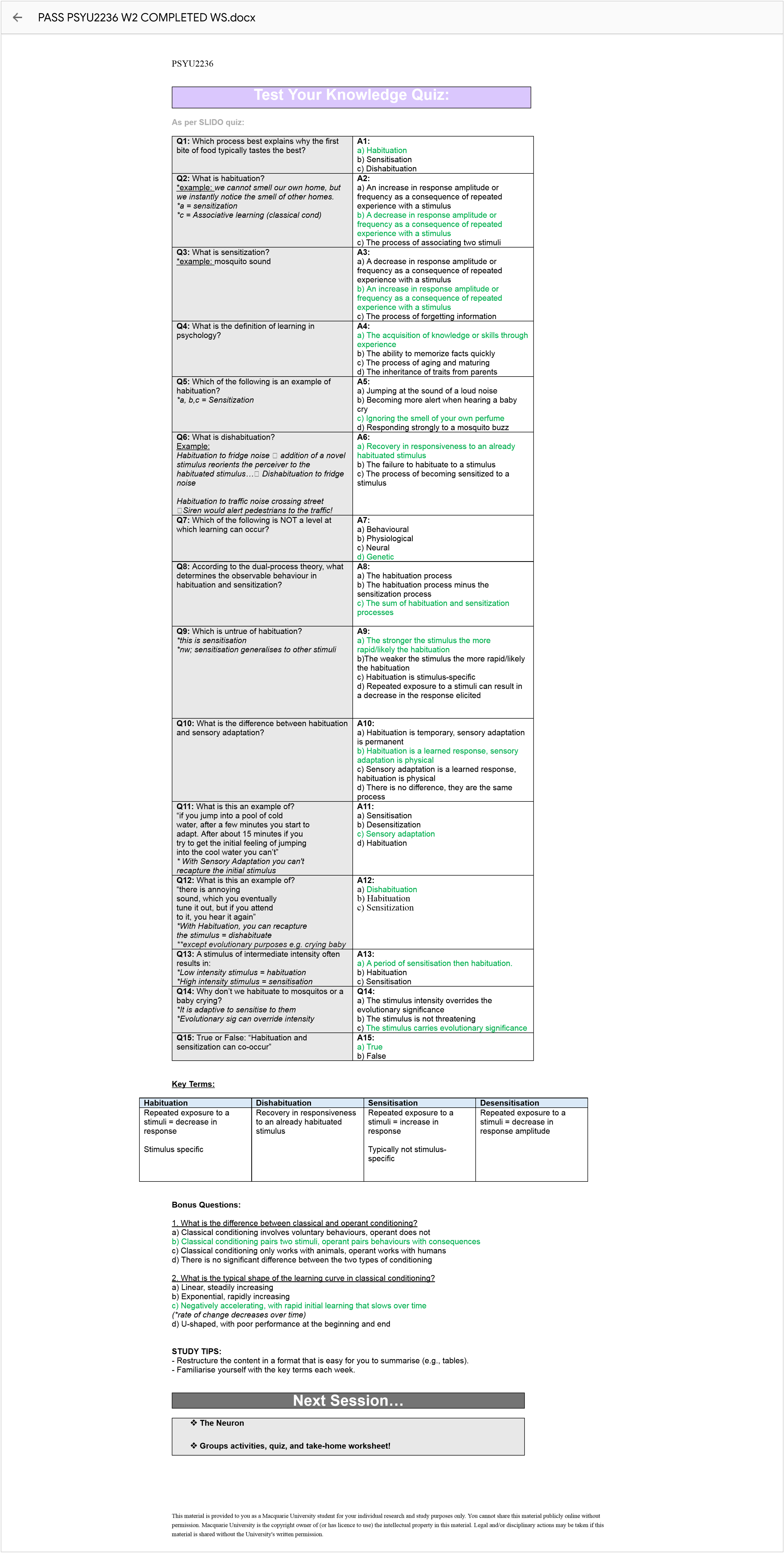
Week 1 Worksheet

- ANSWERS.docx

PASS PSYU2236 Week 2

Terminology

Term

Non-associative Learnin

Orientin Re onse

Habituation

Dishabituation

Senso Ada ation

Sensitization

Desensitization

Associative Learning

Definition

e in behavior e. . ac uisition ofnew skills due to erience

The abili to notice or i ore stimulus based on certain factors

The tenden to attention to anew stimulus

A decrease in the fr uen or intensi ofres ondin to a stimulus

An increase in frequency or intensity of responding to a habituated

stimulus back to baseline

livmen sens

rec torssto res ncl' toa stimulus due to fati ue

An increase in fre uen or intensi ofres ndin to a stimulus

A decrease in frequency or intensity of responding to a sensitized

stimulus back to baseline

earning that involves the associating a response to a particular

L

stimulus

Non-associative Learning

Q: M,'hat factors determine Whether a stimulus is habituated vs. sensitized to?

A: Physical Intensity and Evolutionary Significance

Q: M,'hat is the difference between Habituation and Sensory Adaptation?

A: Habituation is a leaming process whereas sensory adaptation occurs on the level of signal neurons/receptors Behaviourally,

someone can attend to a habituated stimulus, however, because the sensory input is not being sent to the brain someone cannot

attend to a stimulus that is omitted due to sensory adaptation.

Dual Process Theory

Groves, P.M., & Thompson, R.F. (1970). Habituation: A dual-process theory. Psychological Review, 77, 419—450.

doi:10.1037/h0029810.

Q: In your words describe I)ual Process Theory ofHabituation and Sensitization.

A: Habituation and Sensitization are two separate but interconnected processes. wmichever process has the strongest signal will

win out.

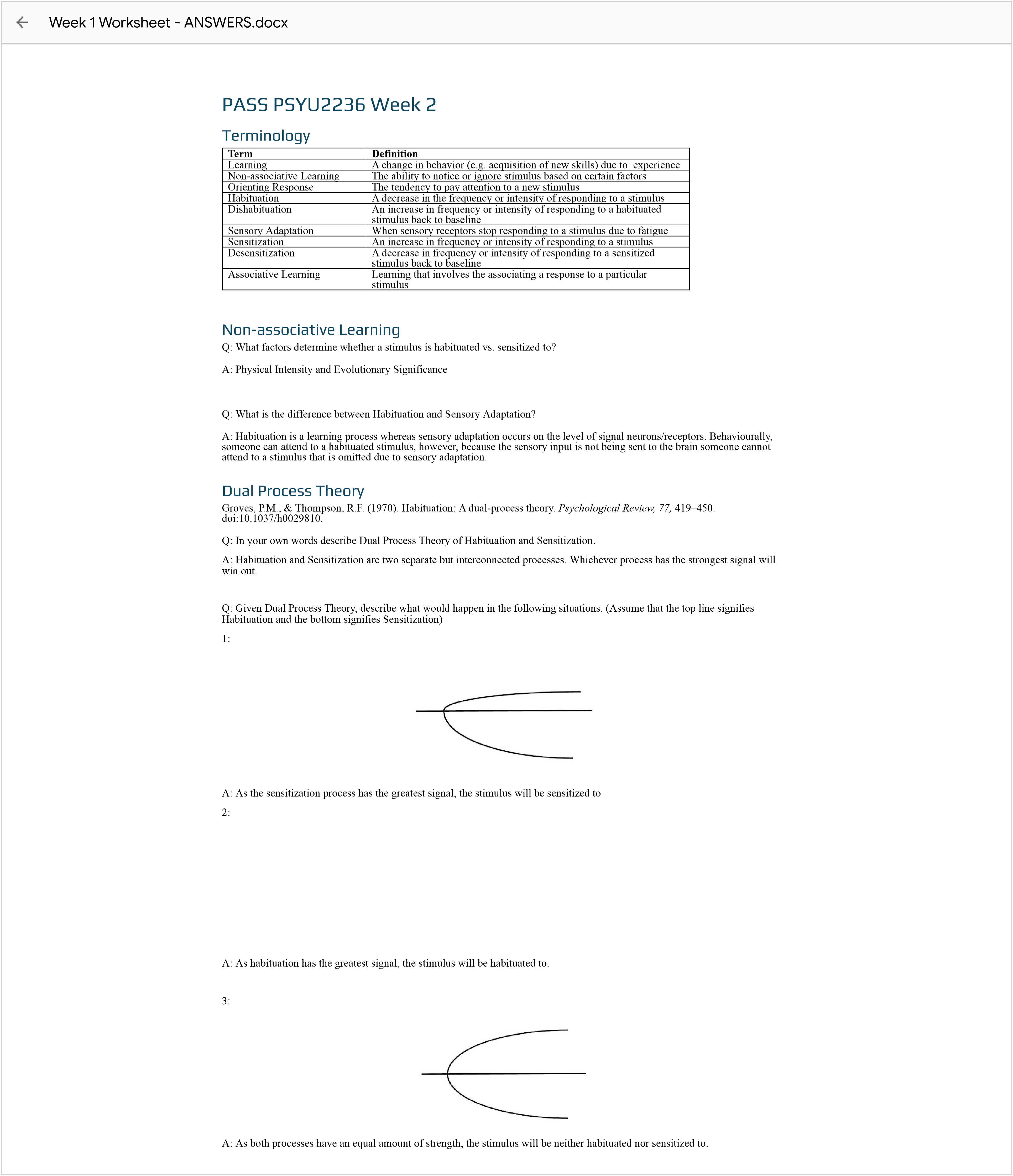
Q: Given Dual Process Theory, describe what would happen in the follouing situations. (Assume that the top line signifies

Habituation and the bottom signifies Sensitization)

A: As the sensitization process has the greatest signal, the stimulus will be sensitized to

2:

A: As habituation has the greatest signal, the stimulus will be habituated to.

3:

A: As both processes have an equal amount of strength, the stimulus will be neither habituated nor sensitized to. 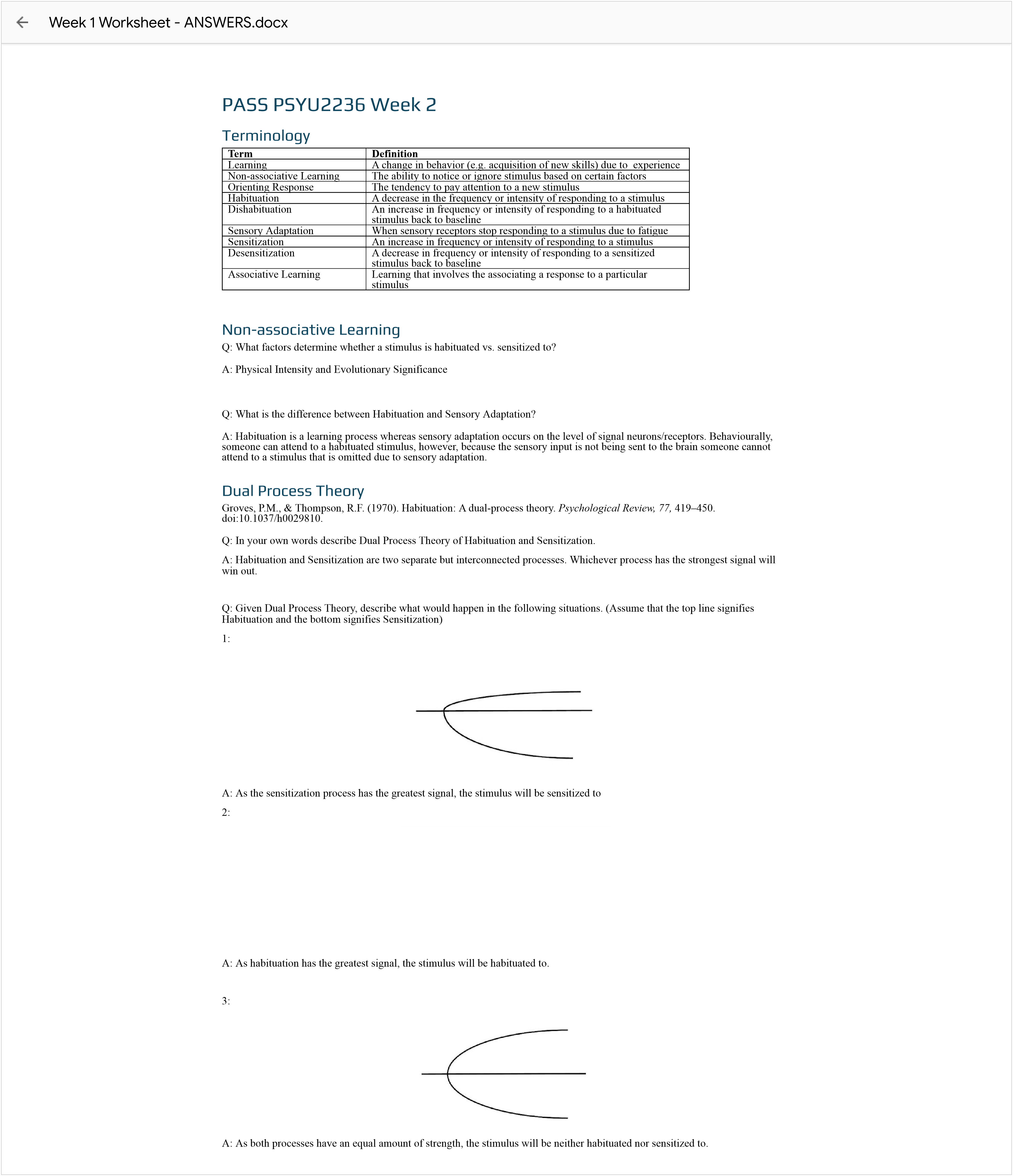
Non-associative Learning:
Definition: Involves changes in the frequency or amplitude of a behavior/response after repeated exposures to a single stimulus.
Types:
Habituation: A decrease in response to a stimulus after repeated presentations. For example, becoming less responsive to the noise of traffic if you live near a busy road.
Sensitization: An increase in response to a stimulus after repeated presentations. For example, becoming more responsive to a light touch in an area where you previously received a painful stimulus.
Characteristics: Does not involve forming associations between different stimuli or events.