ORGANIZING-ORG-MAN
DESIGNING ADOPTIVE ORGANIZATION
Organizing – deployment of organizational resources to achieve strategic goals.
- important because it follows strategy.
■ The deployment of resources is reflected in the organization’s division of labor into specific departments and jobs, formal lines of authority and mechanisms for coordinating diverse organization tasks.
Organization – a social entity that is goal directed and deliberately structured.
- refers to a term “concept” to which a member is assigned specific duties and under the term of which all employees work effectively together within a framework.
Strategy – plan of action that prescribes resource allocation and other activities for dealing with the environment, achieving a competitive advantage, and attaining organizational goals.
Structure – a powerful tool for reaching strategic goals and a strategy’s success.
■ Strategy’s success often is determined by its fit with organizational structure.
Organizational Structure
- Set of formal tasks assigned to individuals and departments.
- Formal reporting relationships, including lines of authority, decision responsibility, number of hierarchical levels, and span of manager’s control.
- The design of systems to ensure effective coordination of employees across departments.
ORGANIZATIONAL CHART
– visual representation of an organization’s structure.
Departmentalization – basis for grouping positions into departments and departments into the total organization.
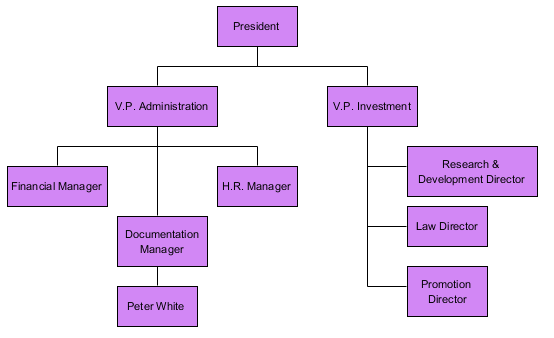
FIGURE 1. Organizational Chart
Types:
1. Vertical Functional Approach
- grouping of positions into departments based on similar skills, expertise, work activities, and resource use.
- managers and employees are compatible because of similar training and expertise.
HOW IT WORKS: information flows up and down the vertical hierarchy and the chain of command converges at the top of the organization. People within the a department communicate primarily with others in the same department to coordinate work and accomplish tasks or implement decisions that are passed down the hierarchy.
FIGURE 2. Vertical Functional Structure
2. Divisional Approach
- also called product structure, program structure or self-contained unit structure.
- occurs when departments are grouped together based on similar organizational outputs.Diverse departments are brought together to produce a single organizational output to a single customer.
- applicable to huge organization that produces products for different markets because each division is an autonomous business.
- encourages decentralization.
HOW IT WORKS: Divisions are created as self-contained units with separate functional departments for each division.
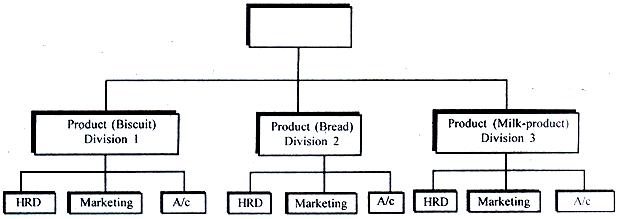
FIGURE 3. Divisional Structure
3. Matrix Approach
- combines aspects of both functional and divisional structure simultaneously in the same part of the organization.
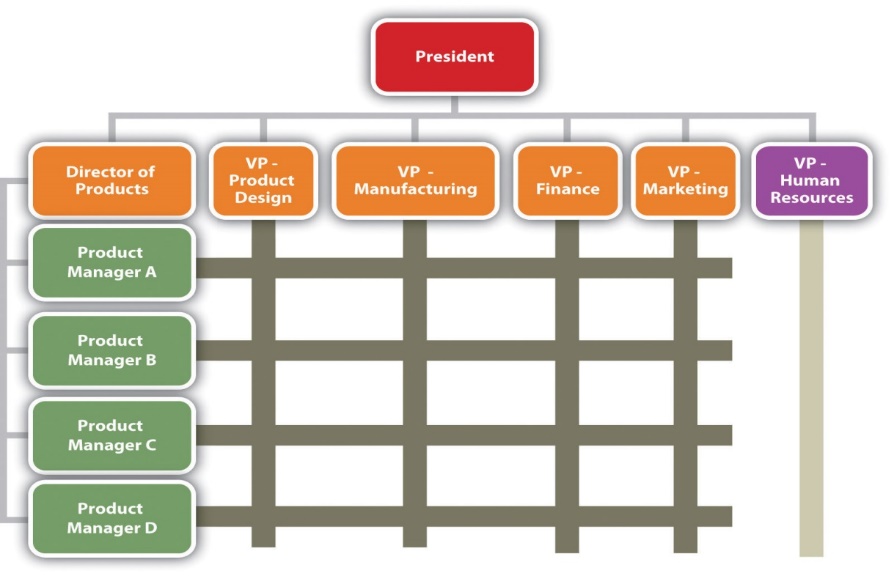 - evolved as a way to improve horizontal coordination and information sharing.
FIGURE 4. Matrix Structure
4. Virtual Network Approach
- most recent approach. The organization subcontracts most of its major functions to separate companies and coordinates their activities from a small headquarters organization.
- used in outsourcing.
Outsourcing – contracting out selected functions or activities of an organization to other organizations that can do the work more cost efficiently.
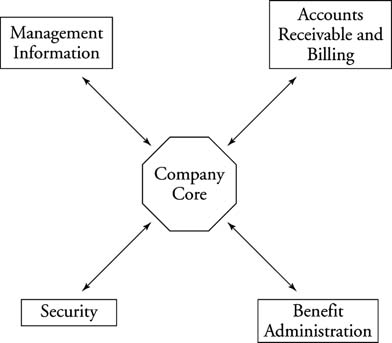
FIGURE 5. VIRTUAL NETWORK STRUCTURE
ORGANIZATIONAL VERTICAL STRUCTURE
Characteristics:
1. Work Specialization – also called division of labor.
Degree to which organizational tasks are subdivided into separate jobs.
■ Fundamental characteristics of vertical organization structure include work specialization, chain of command, span of management, and centralization and decentralization.
2. Chain of Command – unbroken line of authority that links all employees in an organization and shows who report to whom.
Illustrates the authority structure of the organization.
3. Unity of Command – refers to each employee is held accountable to only one supervisor.
Scalar Principle – refers to a clearly defined line of authority in the organization that includes all employees. Authority and responsibility for different tasks should be distinct. All individuals in the organization should know to whom they report as well as the successive management levels all the way to the top.
a. Authority, Responsibility and Delegation
Authority - formal and legitimate right of a manager to make decisions, issue orders and allocate resources to achieve organizationally desired outcomes.
Characteristics:
a.1. Authority is vested in organizational positions, not people. Managers have authority because of the positions they hold, and other people in the same positions would have the same authority.
a.2. Authority flows down the vertical hierarchy. Positions at the top of the hierarchy are vested with more formal authority than are positions at the bottom.
a.3. Authority is accepted by subordinates. Although authority flow top-down, subordinates comply because they believe that managers have a legitimate right to issue orders.
Responsibility – duty to perform the task or activity as assigned.
■ When managers have responsibility for task outcomes but little authority, the job is possible but difficult. They rely on persuasion and luck.
Accountability – means that the people with authority and responsibility are subject to reporting and justifying task outcome to those above them in the chain of command.
Integration – relates how the different areas of the company coordinate their operations.
Delegation – the process managers use to transfer authority and responsibility to positions below them in the hierarchy.
Steps:
1. Identify the key task
2. Delegate each task appropriately
3. Explain each task to your new members
4. Develop a plan for each task assigned
5. Monitor the progress
b. Line and Staff Authority
Line Departments – performs tasks that reflect the organization’s primary goal and mission.
Ex. President, Vice President for Marketing, Vice President for Production
Line Authority – means that people in management postions have formal authority to direct and control immediate subordinates.
Staff Departments –includes all those that provide specialized skills in support of line departments.
Have an advisory relationship with line departments.
Ex. Marketing, Labor Relations, Research, Accounting, and Human Resources.
Staff Authority – narrower span of control than line authority. It includes the right to advise, recommend and counsel in the staff specialist’s area of expertise.
- a communication relatioship; staff speciaists advise managers in technical areas.
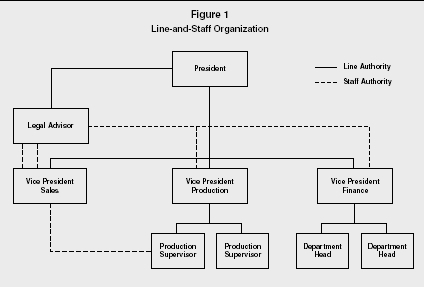
FIGURE 6. Line and Staff Organization
c. Span of Management
- also calld span of control.
- refers to the number of employees reporting to a supervisor and how closely a supervisor can monitor subordinates.
■ Having too many hierarchical levels and narrow spans of control is a common structural problem for organizations.
Structures: EASY
a. Tall Structures – characterized by an overall narrow span of management and a relatively large number of hierarchical levels.
b. Flat Structures – characterized by an overall larger span of management and a relatvely limited number of hierarchical levels.
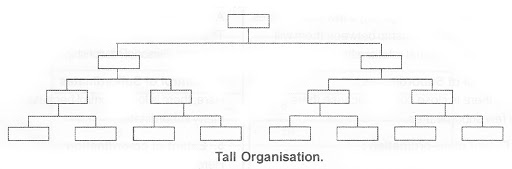
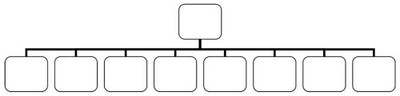
FIGURE 7. Tall and Flat Structure
d. Centralization and Decentralization
Centralization – decision authority is located near the top of the organization.
Decentralization – decision authority is pushed downward to lower organizational levels.
Factors that influence centralization versus decentralization
1. Greater change and uncertainty in the environment are usually associated with decentralization.
2. The amount of centralization or decentralization should fits the firm’s strategy.
3. In times of crisis or risk of company failure, authorityy may be centralized to the top.
TWO TYPES OF ORGANIZATIONAL SYSTEM
1. Formal Organization – composed of the recognized and formalized lines of communication, authority, and control.
- created intentionally by the managers for the achievement of organizational goal.
Ex. Official organizational chart
Advantages:
a. Systematic Working - Formal organization stucture results in the systematic and smooth functioning of an organization.
b. Achievement of Organizational Objectives – structure is established to achieve organizational objectives.
c. No overlapping of Work – work is systematically divided among various departments and employees so there is no chance of duplication of work.
d. Coordination – formal organizatonal structure results in coorinating the activities of various departments.
e. Creation of Chain of Command – formal organizational structure clearly defines the superior-subordinate relationship.
f. Creation of Chain of Command - it clearly defines the superior-subordinate relationship.
g. More emphasis on Work – gives more emphasis on work than interpersonal relations.
Disadvantages:
a. Delay in Action – while following scalar chain and chain of command actions to get delayed in a formal structure.
b. Ignores Social Needs of Empployees – formal structure does not give importance to the psychological and social need of employees.
c. Emphasis on Work Only – gives more importance to work only and ignores human relations, creativity and talents.
2. Informal Organization – normally formed for the purpose of satisfying some social needs.
- exists within the formal organizations or may exist and operate independently.
Ex. Clubs, teams, associates, etc.
■ Existence of informal structure depends upon the formal structure because people working at different job positions interact with each other to form informal structure and the job positions created in a formal structure.
RESULTS OF GOOD ORGANIZATION
1. Pointing out “dead-end” jobs.
2. Helping develop executive ability.
3. Establishing responsibility and preventing “buck passing”.
4. Eliminating jurisdictional disputes between individuals
5. Establishing closer operation and higher morale.
6. Delineating avenues of promotion.
7. Preventing duplication of work.