SLA
Most of the theories of second-language acquisition can be traced to those of first-language acquisition. There are two camps (with a good deal of overlap):
Those who believe that second-language acquisition closely parallels (or should) the way first languages are learned.
Those who believe that learning a second or subsequent language is a qualitatively different undertaking from acquiring one's first language(s).
In the first camp, we find a number of theorists. In particular, people such as Krashen who took the view that deliberate learning of a language is unnecessary and that there is a distinction between acquiring a language (a mostly unconscious process) and learning a language (a conscious, organised and led process). We will also find innovators in this camp including James Asher, the developer of Total Physical Response learning and others.
In the second camp, we find those who assert that learning is a complex cognitive process which requires a focus on the language to be learned, elements of modelling, correction and drilling and a focus on context and scaffolding of learning.
Four Important Concepts
What is newer is the study of how second languages are learned or acquired. To understand the underlying theories, it is useful to have a set of thinking tools to hand and that means understanding four elemental concepts.
Competence vs Performance
Ferdinand de Saussure, in his Course in General Linguistics (1915) distinguished between langue (roughly the internal rules and arrangements of a language) and parole (roughly the spoken and written forms of language seen in everyday settings).
Chomsky, much later (1965 / 2002), made a similar distinction between Competence and Performance.
Competence is the speaker's general, implicit and rarely articulated, knowledge of the grammar of a language and Performance is the speaker's actual use of the language in speaking and understanding it.
Chomsky was not concerned so much with what is actually said but with what can be said.
The difference between the two divisions is that de Saussure was concerned with language in society but Chomsky was more concerned to explain individuals' use of and knowledge about the form of language.
Use vs Usage
This distinction was first proposed by Widdowson (1978) and refers to the difference between the formal structures of the language and the language as it is used in real communication for authentic purposes.
Briefly, the distinction rests on the difference between signification (what, on the face of it, an utterance means) and value (what it means in communication). So for example, if someone says
I have a terrible headache
and the reply is:
It's nearly 6 o'clock in New York
while we know what the words mean (the significance), they carry no communicative value.
If, on the other hand, the reply is:
I'll get you something for it
then the response carries both significance and communicative value.
Much research into second-language acquisition is concerned with usage (how people acquire the formal systems of the language) and less effort has been devoted to how learners acquire the ability to use the language to get things done.
English language teachers are concerned with both significance and value, of course.
Acquisition vs Learning
This distinction is attributed to Krashen (to whom there is a separate guide on this site, linked below).
Acquisition is a process similar to the way in which children acquire their first language(s). It requires meaningful and frequent interaction in the language in which the speakers are not focused on form but on meaning.
Learning is, in contrast, a formal procedure which focuses on the explanation of rules and correction of language form.
It should be noted that Krashen was not explicitly stating that one is necessarily better than the other.
The distinction can be extended to the difference between naturalistic acquisition and instructed acquisition. The former refers to the almost unconscious picking up of a language and the latter to the deliberate choice to study and be formally taught.
Deductive vs Inductive Processing
Deductive processing involves the application of given rules to the data.
For example, once you have been made aware that putting the right ending on a German verb in the second person singular (familiar) is to substitute -st for -en then you can transform any number of infinitive forms in the correct way to get, e.g.,
rauchen – rauchst
bringen – bringst
and so on.
Inductive processing works the other way around.
Given the examples of the transformation above and some more examples, such as
reisen – reist
denken – denkst
etc.
You can figure out for yourself what the rule is.
(You will not, by the way, be right for all the verbs in the language and this won't help you much with meaning but you will, one way or another, have learned a useful rule.)
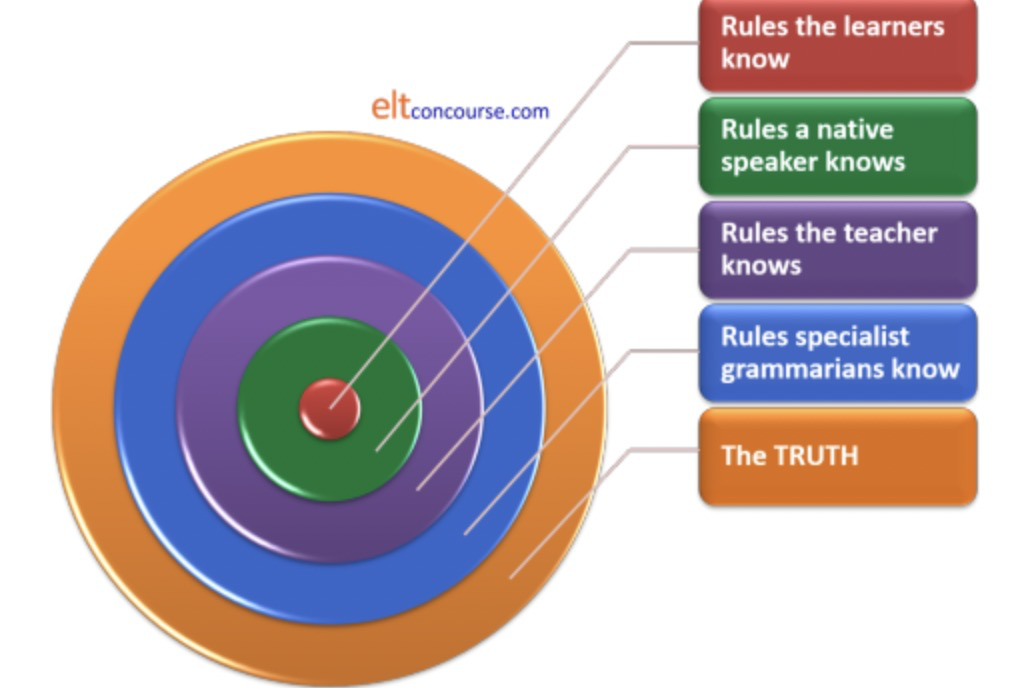
Much nonsense is spoken about taking either an inductive or a deductive approach to learning. This is not an either-or distinction. Even if one starts with a purely inductive approach in the classroom, the aim has to be for the learners to hypothesise a rule (preferably the right one) and then apply it to further examples of the target language. The second procedure is, of course, purely deductive. There is little point in putting learners to the trouble of constructing a rule from exemplification if they are not then encouraged to apply it.
On the other hand, starting with a deductive approach and supplying a rule from the outset nearly always results in the need to refine the rule later to take account of more complex forms. Even if we knew what they are, it would not be possible to supply all the rules for using, say, verb tenses in English so any rule which is presented to learners has to be no more than an approximation.
The situation is a bit like this:
Internal Factors
At the heart of all theories of SLA lie considerations of what the learner brings to the process and what role external factor play in it.
The starting point is the distinction between learning as a cognitive, conscious mental process and learning as a process of acquiring good habits.
Behaviourism
It is well attested that one can teach rats (and all sorts of other creatures) by a process of stimulus and reward. Rats, famously, can be taught complex sequences of behaviour such as finding their way through a maze based purely on rewarding, i.e., positively reinforcing, certain behaviours and punishing, i.e., negatively reinforcing, unwanted behaviour.
The theory relies heavily on work by, inter alia, Skinner (1957: 10) who is often quoted as saying:
We have no reason to assume ... that verbal behaviour differs in any fundamental respect from non-verbal behaviour, or that any new principles must be invoked to account for it.
(Skinner 1957: 10)
Behaviourism is the theory of learning that still underlies how you train your dog or drill your learners' pronunciation. It can be visualised like this:
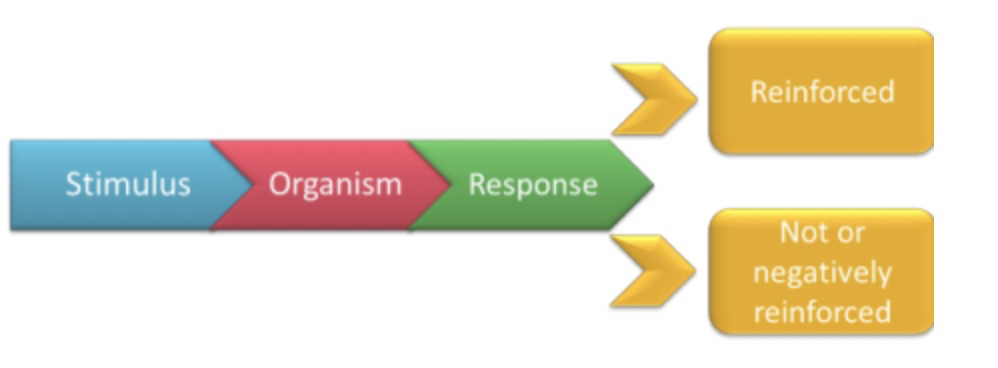
Briefly, and somewhat unscientifically:
The process starts with a stimulus, say, a question from the teacher such as
Where did you go yesterday?
put to the organism (in this case, a learner of English). The stimulus can elicit a variety of responses but only the 'right' one will be reinforced.So, for example, if the organism responds with
I go to the cinema
the teacher will negatively reinforce it with
No, that's wrong
or simply not reinforce it by saying nothing.If, on the other hand, the organism produces the preferred response:
I went to the cinema
the teacher will reinforce it with
Yes, that's right!
(preferably in a loud and enthusiastic voice because the strength of the reinforcement is critical in instilling the correct habit). In this case, the reward is the teacher's approval but it could just as well be a chocolate biscuit. The response does not have to be truthful, just well formed.Enough Stimulus > Response > Reinforcement cycles will see the habit instilled and the language acquired.
These are factors internal to the learner but they have significant implications for external factors such as the approach to teaching. It underlies drilling language in the classroom, setting mechanical (and not so mechanical) exercises, exposing learners to patterns of language, repetition of language, the avoidance of error and much else.
Cognitivism
Much research in the 1970s and later was focused on a determination to refute a behaviourist view of language learning and acquisition. Three main lines of attack emerged.
Language use is unpredictable.
Although it may be the case that turning left and right in a maze in a complex sequence of turns will inevitably lead to a reward, the same cannot be said of language.
Even a response to something as straightforward as
Good afternoon!
could be a similar greeting or it could be a sheepish acknowledgement that one is very late for a morning lesson.Reinforcement is unreliable and variable.
The people we speak to may respond more positively to the interesting content of an ill-formed sentence than to irrelevant or dull data presented in well-formed language.Innovation. Learners, even at early stages, are capable of producing utterances that they have never heard before. If language is a habit structure, acquired by repetition and drilling, they should not be able to do that.
The triumph of a more cognitivist view of language learning led to a number of competing hypotheses concerning how SLA occurs. The initial attempt was to focus on internal factors but they all have significant external implications to do with presumptions concerning how language learning should take place to which we shall come.
In addition to these basic distinctions, it is now necessary to add several other theories and ideas. Most of these concern theories of first language acquisition and are dealt with in a little more detail in the guide to first- and second-language acquisition, linked below.
Error Analysis
The analysis of learners' errors starts with seminal work by Pit Corder (1981) who set out to investigate how the errors that learners make reflect their internal mental processes.
The key concept is interlanguage.
Interlanguage can be visualised like this where the learner's current knowledge lies somewhere on a continuum from knowing nothing about the target language to full mastery:
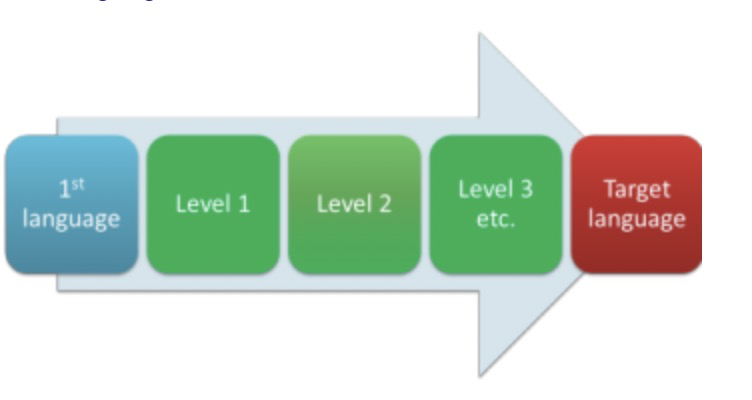
The diagram oversimplifies and hides some interesting ideas concerning the sources of error and the current state of the learners' knowledge.
What studies showed was that although some errors were the result of applying first-language rules to the target language (which would indicate the transfer of language habits), some errors indicated that learners were creatively constructing rules and hypotheses to explain the data to which they were exposed.
If this is the case, then teaching needs to address the positive role of error, the concept of noticing the difference between one's own output and native-speaker models and the supply of adequately rich linguistic data for the learners' cognitive processes to work on.
Acquisition Order
Claims have been made that structural elements of a language are learned or acquired in a sequence which is remarkably stable across learners with a wide range of language and learning backgrounds. Of late, enthusiasm for the idea of a fixed acquisition order has waned although there are some who still hold to it.
The jury is still out but there is undeniably some evidence that the phenomenon is real. What has become clear is that teaching the target structures for which the learners are ready will be more effective than trying to impose a syllabus to beat the system.
Universal Grammar and the Language Acquisition Device
The essentials of these two ideas are covered in the guide to Chomsky so, in brief:
Universal Grammar refers to the idea that all languages exhibit common features which result, some say, from the structure of the human mind. For example, it is averred that all languages have phrase structures in common (i.e., a head and a complement) and that all languages share other characteristics including major word and phrase classes. It is, indeed, difficult to imagine a language which did not use noun phrases, subjects, prepositional phrases (or at least some way of connecting verbs to nouns) and so on.
Unfortunately, there is evidence that there are languages which manage to do without what are considered major word and phrase types in English and many language have word classes unknown in Indo-European languages.The concept of a Language Acquisition Device springs from the observation that children acquire language very efficiently and very quickly even in circumstances in which there is quite poor information for them to work on. The assumption follows that the human brain is hard-wired to learn language and that the process starts at birth or, some say, even before birth. What this means in practice is that, before we even leave the womb, our brains are prepared for the kinds of phrase structures and grammatical rules we will need to process the language we hear.
Some have compared this to a kind of internal switchboard with which we can categorise input making guesses and assumptions.
The key question for language teachers is whether, after a certain age, we retain any access to the device which helped us learn our first language.
Active Construction of Grammar and Connectionist Theory
Because it may be the case that both these mechanisms are functioning simultaneously, we'll consider them together.
Active Construction of Grammar is a cognitive theory of language acquisition which rests on the assertion that learners of both first and second languages are actively hypothesising what its rules are and refining their hypotheses as more data become available. It explains, among much else, the fact that both first and second language learners may apply a newly-acquired rule indiscriminately and, for example, put an -ed ending on all verbs to show past tenses before they refine the hypothesis and link the phenomenon only to regular verbs in English. It will also explain errors such as
*Do you can come?
as evidence that the learner has made a hypothesis that all verbs form questions in this way in English.
Only later will the learner reconstruct the hypothesis to exclude modal auxiliary verbs from the scheme.
The phenomenon exemplified here is known as the U-shaped learning curve.Connectionist Theory is not dissimilar but it explains a problem that has been identified with the theory of Active Construction of Grammar.
The problem is this:
When children are asked to make past tenses or plurals from nonsense words which resemble real but irregular forms, they do not apply the grammar rules but respond in terms of statistical likelihood.
For example (from Bergman et al (2007)), when asked to form the past tense of fring, many children will suggest frang or frought (by analogy with ring and bring etc., respectively) rather than the structurally predictable fringed.
It has been suggested that humans make neural connections in the brain based on the frequency of what they hear rather than making rules based on the structure of what they hear.
It is clear as far as teaching the language is concerned that for either of these theoretical mechanisms to function efficiently, the data presented to learners has to be orderly and rich enough for them to form hypotheses effectively and adapt them appropriately as new data become available.
Social Constructivist Theory
It has sometimes been a criticism levelled at a communicative approaches to language teaching that while the approach has a well worked out theory of language, it is less certain about a theory of learning. Enter social constructivism to the rescue.
Briefly, the theory states that learning is constructed by the learners. This is usually contrasted in educational theory with what is labelled as a transmission model in which knowledge is handed down from above.
The criticism of that is, naturally, that social constructivists are setting up an unrealistic 'traditional' model in order to suggest how social constructivism is superior.
It is, moreover, asserted that learning is primarily a social activity. This means that knowledge and skills are not acquired by individuals operating alone but only through interaction with others.
This makes the theory a good fit with communicative classroom approaches which forefront real communicative tasks and emphasise interaction with peers and others.
Unfortunately, the theory is somewhat silent concerning the mechanisms through which learning takes place (unlike, e.g., connectionist and active construction theories). It may, therefore, be wise to reserve judgement or, at least, to take the view that while social interaction is undoubtedly a useful and motivating factor in second-language acquisition, it cannot be the whole truth or individual silent learning would be impossible. If you are reading this page alone, is it the case that you are unable to learn from it because you are not interacting with others?
Such considerations have not stopped some from asserting that social constructivism is the way in which learning happens.
Here's an example:
We believe that learning is best conceptualised through a social constructivist theory of learning. A key tenet of this is the view that learning is constructed by the learner, as opposed to the traditional, “transmission” model of teaching and learning in which knowledge is passed on to students fully formed, ready to be assimilated. Furthermore, learning is primarily a social activity – knowledge and skills are constructed through interaction with others.
We need, however, to maintain a certain objectivity in this regard, too. Constructivism is not a proven fact or even as yet elevated to the status of a theory. It is one of many hypotheses about how language is learned.
Summary
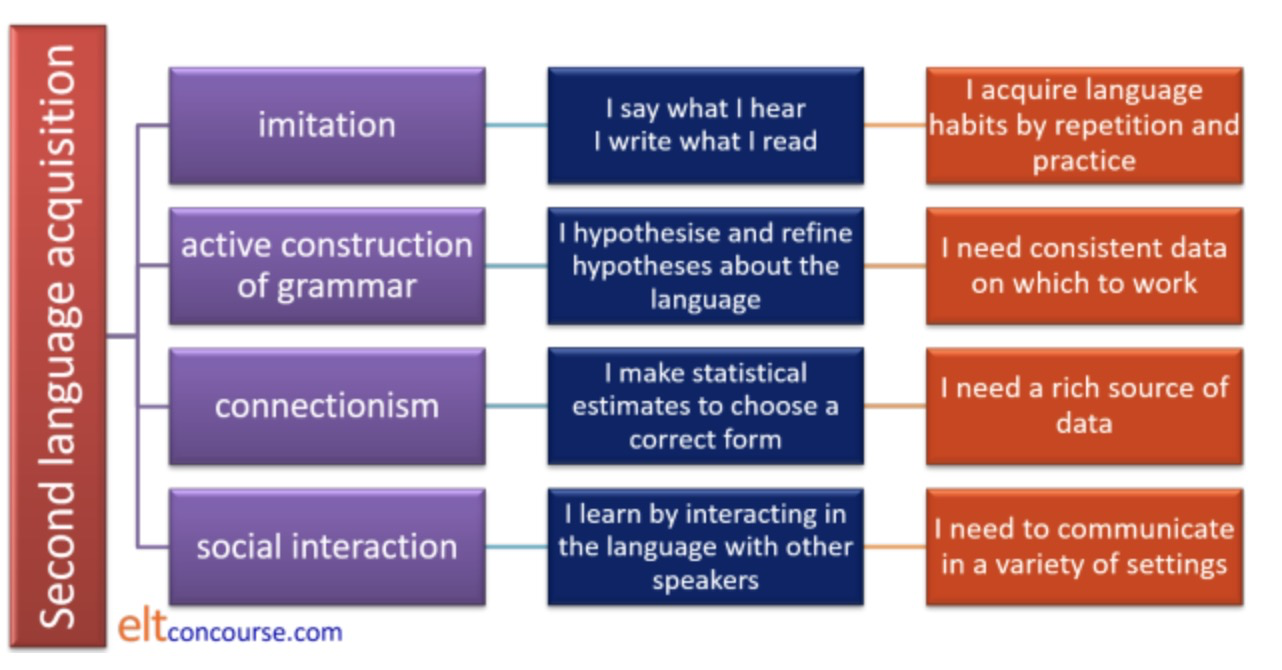
Here's an incomplete summary of four major hypotheses concerning second-language acquisition. It is not meant to show that learners use only one approach. Some may use all four.
External Factors
There are also a number of factors external to the learner which need to be considered, if only briefly.
Social Factors
Much of Communicative Language Teaching lays great stress on natural and appropriate language as the target of instruction.
It follows that in order to be able to acquire pragmatic as well as formal competence in a language, learners need to be exposed to appropriately complex social situations in which the target language is set.
Similar connectionist and active construction mechanisms may also be at work here as the learners refine their hypotheses about what is socially appropriate to realise a particular language function and what is statistically the most frequent way of doing so.
Also in play here are motivational issues. Gardner (1985), for example, emphasises the role of learners' attitudes to the culture in which the second language is set. Those who perceive it as high status and desirable will have greater integrative motivation and be more successful in acquiring the language whereas those who remain isolated from the target-language culture, or even indifferent or antagonistic to it, tend to develop only a very basic competence.
Input
The behaviourist view of input in the language learning process was that the input had to be very carefully tailored to the learners' current competence and, by a process of repeatedly encountering the data and repeating language in bite-sized doses, learning and competence would follow. This is the underlying theory that gives rise to drilling and very controlled oral and written language practice.
The approach has been challenged in two ways:
One of Krashen's 5 famous hypotheses is the Input hypothesis: for optimum effect, the input a learner receives should be
comprehensible and
just above the level of the learner.
This is sometimes abbreviated to INPUT + 1 or just i + 1.
Such input allows the acquisition and learning devices (whatever they are) to operate on sufficiently comprehensible and challenging data.Vygotsky and later writers assert the importance of scaffolding the input to allow learners to achieve more than they could if left to process the data independently. (Vygotsky never used the term scaffolding; it was coined by Bruner in the 1960s.) Vygotsky's contribution concerns the Zone of Proximal Development or ZPD which can be visualised like this:
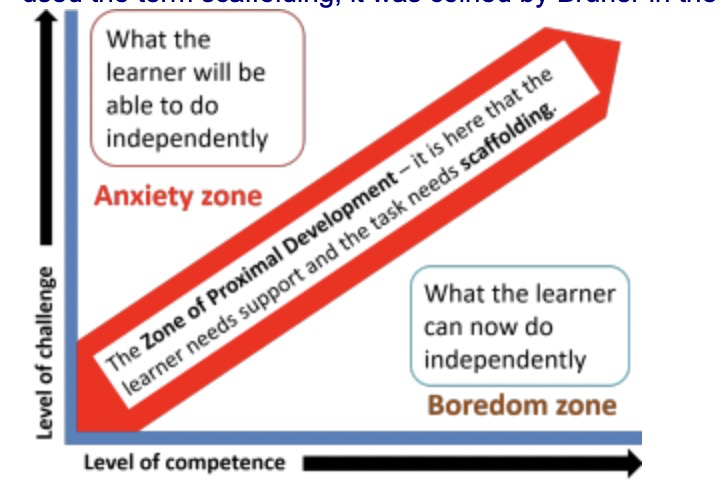
To the top left, a task is over-challenging and learners will become anxious and be overwhelmed by the data.
To the bottom right, a task is under-challenging and learners will learn nothing and may become bored and uninterested.
The underlying assumption here is summarised by Waters as:
... learning occurs when the mind makes connections between what it already knows and new, hitherto unknown items of information
(Waters, 2006:319)
In other words, if the level of challenge is correctly set, learning will occur by extension and connection. Stretched too far, learners will fail to see the connections. Challenged too little and learners will not make new connections at all.
Healthy, Critical Scepticism
This guide has been a brief one and only covered the salient features of a range of popular answers to the question
How do people learn a language?
You will have noticed that some theories are presented as take-it-or-leave-it choices but reality is probably a little more complicated. Humans are complex animals with the capacity for complex behaviour and ways of thinking about the world. To aver that all of them learn all facets of all languages in the same way is much more likely to be wrong than right.
It may turn out to be the case, for example, that we learn grammar in one way, pronunciation in another and lexis in a third way and that has, in fact been suggested. The suggestion, again briefly, is that:
We learn grammar by a process of actively constructing and amending hypotheses about the way the language we have encountered works.
We learn lexis through a process of making connections from the known to the unknown and taking the trouble to see how meaning is used in the language we encounter.
We learn to pronounce the target phonemes in a language by a process of habituating ourselves to making certain (to us) unusual sounds and imitating what we hear.
We learn to communicate using appropriate styles and registers in a process of constructing meaning socially with other humans.
If this is the case or even part of it is true, looking for a theory which explains all learning is a doomed undertaking. Worse, it will constrain teachers' behaviours and planning to a degree which will not be helpful to the learners.