U1L13 Spontaneous Reactions
Metabolism
All processes of life require energy (growth, reproduction, etc.)
Energy: ability to do work
Organisms must capture, store, and use energy to function
Reactions that transform matter and energy in out cells occur in step by step sequences called metabolic pathways
Spontaneity of Reactions
Spontaneous reaction: reaction that will continue to completion without further energy input once initiated
Ex. oxidation of glucose
C6H12O6 + 6O2 → 6CO2 +6H2O
Reverse reaction is not spontaneous
Non-spontaneous reaction: reaction that can only continue as long as it receives a continual energy input
Ex. electrolysis of water (using an electric current to break down water into oxygen and hydrogen gas)
When electricity is turned off, reaction stops
Spontaneous reactions require less energy than non-spontaneous
Determining Spontaneity
Many chemical reactions that are exothermic (give off heat) occur spontaneously
3 factors determine is a reaction is spontaneous or not
Enthalpy (H): total value of energy of a system
Decreases in H tend toward spontaneity
When ΔH is positive, reaction is endothermic
When ΔH is negative, reaction is exothermic


Entropy (S): a measure of randomness of a system
Increase in S tend toward spontaneity
Temperature (T): A measure of molecular motion
Increase in T tend toward spontaneity
Gibbs free energy (G): energy in system that can do useful work
Ex. before combustion, free energy in gasoline is higher than products of combustion
Gasoline can do more useful work than carbon dioxide and water
ΔG decreases in this reaction
Spontaneity can be determined mathematically with the Gibbs free energy equation:
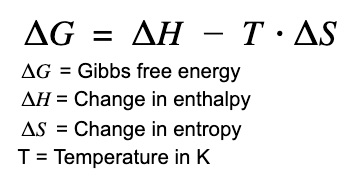
When ΔG is positive → reaction is non-spontaneous
When ΔG is negative → reaction is spontaneous
Biochemical Coupling
Non-spontaneous reactions require continual input of energy
Metabolically expensive
To conserve energy, spontaneous reactions used to “drive” non-spontaneous reactions
Ex. synthesizing an ATP molecule is a non-spontaneous reaction (ΔG = +31 kJ)
Reaction can be coupled to a spontaneous reaction (ΔG = -49 kJ)
ΔG = -49 +31 kJ = -18 kJ
Biochemical coupling of reactions occurs on surface of enzyme