Slides Ch.1-Ch.4
Chapter 1:
Universe: Totality of all space, time, matter, and energy
Astronomy: Study of the universe
Light-year: the distance light travels in a year
About 10 trillion miles
Speed = Distance/Time
Constellations: groupings of stars in the sky. Constellations are groupings of stars on the celestial sphere.
• Stars that appear close in the sky may not actually
be close in space.
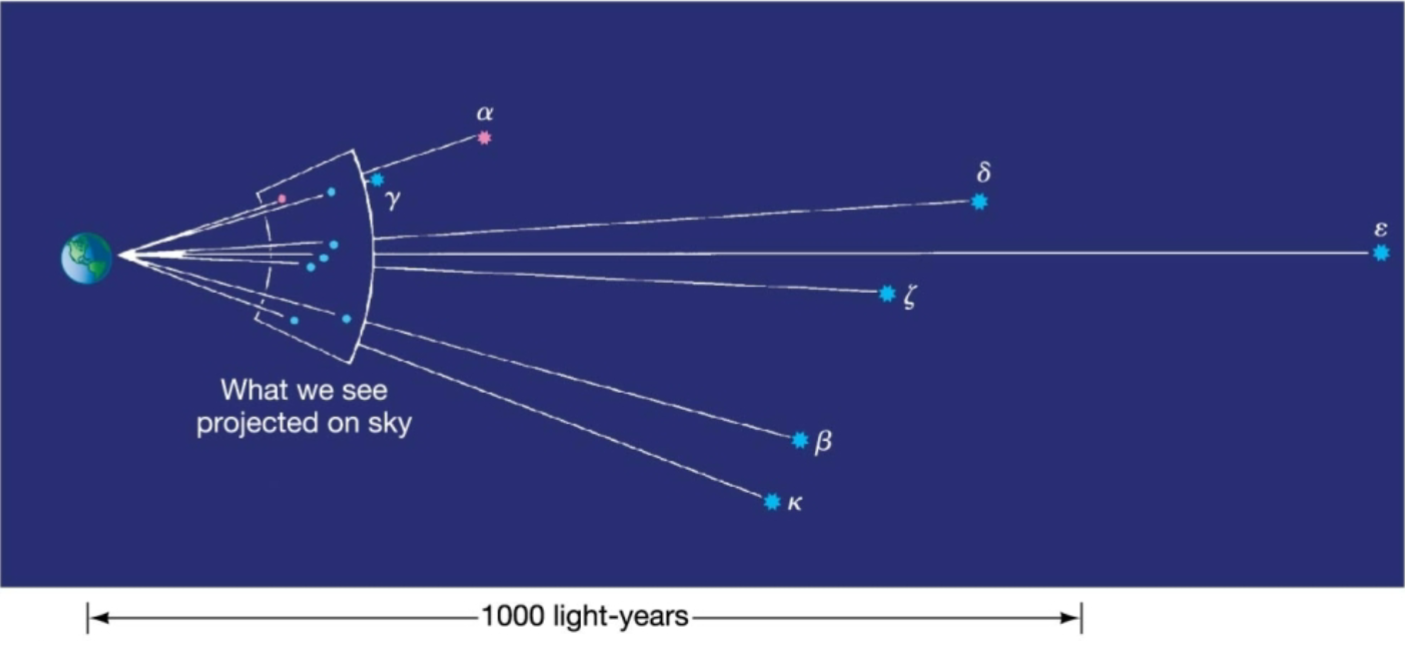

Celestial Sphere: Stars seem to be on the inner surface of a Celestial Sphere surrounding the Earth.
Declination: Degrees north or south of celestial
equator
• Right ascension: Measured in hours, minutes, and
seconds eastward from position of the Sun at vernal
equinox
Zodiac: The 12 constellations the Sun moves through during the year are called the zodiac
Ecliptic: The Sun’s apparent path on the celestial sphere is
called the ecliptic. The moon and planets move along the celestial
sphere near the ecliptic.
Chapter 2:
Seasons on earth: Sun’s Apparent Path
• Northernmost point (above the celestial equator) is the summer solstice
• Southernmost is the winter solstice
Equinoxes: Point where the Sun crosses the celestial equator are equinoxes.
Vernal (Spring) Equinox
Autumnal Equinox
Precession – Change in direction of poles relative to the celestial sphere
• Rotation of Earth’s axis itself
• Complete circle in about 26,000 years.
Motion of the moon:
The Moon takes about 29.5 days (1 month) to go through the whole cycle of phases.
• The Moon is always half lit (you can only see one side)

• Phases are due to different amounts of the sunlit portion being visible from Earth.

Eclipses don’t occur every month because Earth’s and the Moon’s orbits are not in the same plane.
Lunar eclipse:
– Earth is between the Moon and Sun.
– A partial eclipse occurs when only part of the Moon is
in shadow.
– A total eclipse occurs when all is in shadow.
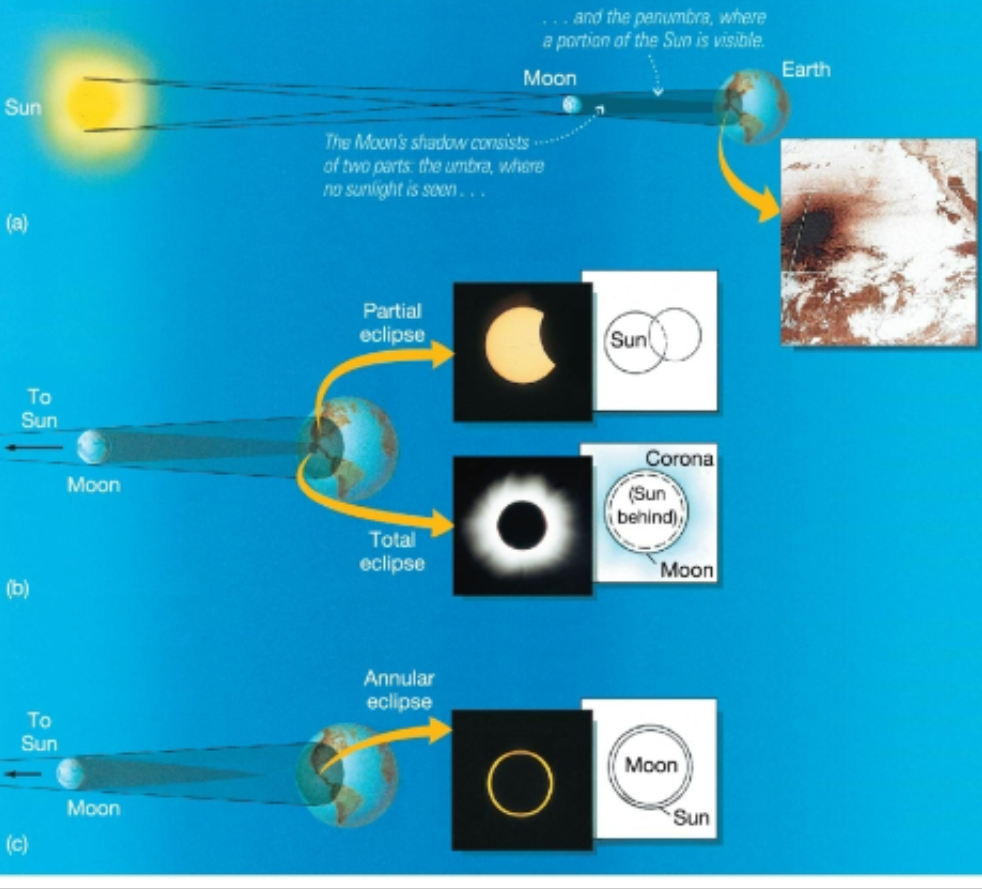
Solar eclipse: The Moon is between Earth and the Sun.
• Partial when only part of the Sun is blocked
• Total when all is blocked
• Annular when the Moon is too far from Earth for
total
Tides:
Tides: are primarily due to gravitational force on Earth from the Moon
• The force on near side of Earth is greater than force on far side
• Water can flow and bulge in response
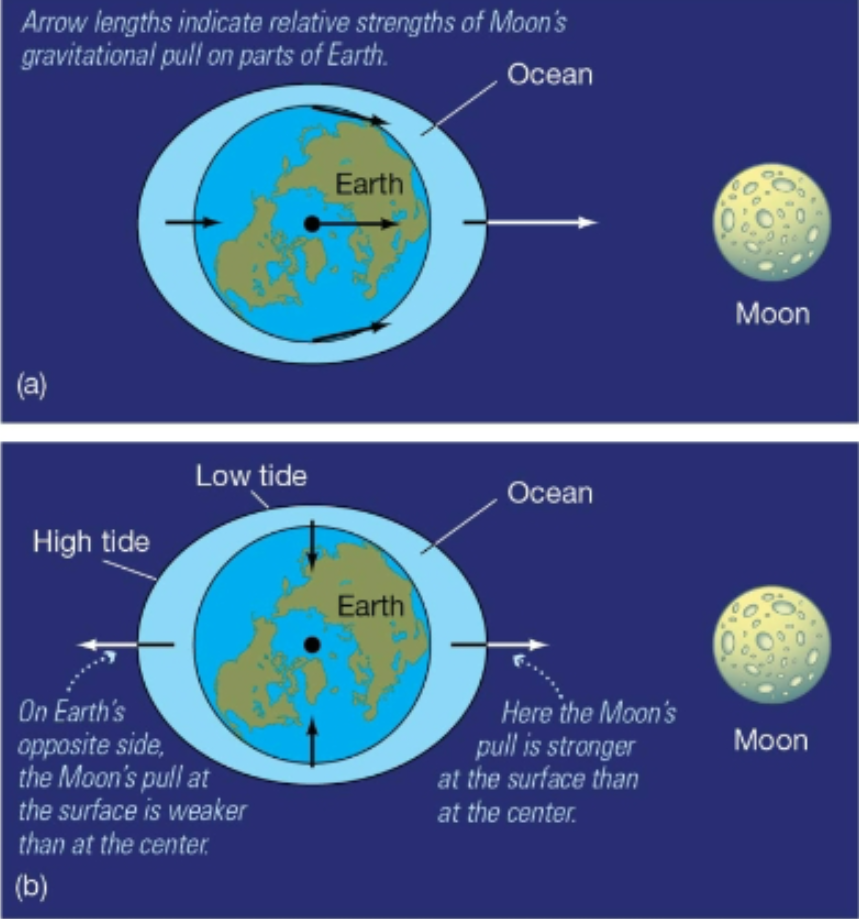
The Sun has less effect, but it does modify the lunar tides.

Tides tend to exert a “drag” force on Earth, slowing its rotation.
• Will continue until Earth rotates synchronously with
the Moon
• Same side of Earth always points toward the Moon

Chapter 3:
Kepler’s laws:
Planetary orbits are ellipses, with the Sun at one
focus.
The dimensions of the solar system
• The distance from Earth to the Sun is an
astronomical unit (AU).
• Its actual length may be measured by bouncing a
radar signal off planets and measuring the signal’s
travel time

Kepler’s law:
Imaginary line connecting Sun and planet sweeps
out equal areas in equal times.
Square of period of planet’s orbital motion is
proportional to cube of semimajor axis.
Newton:
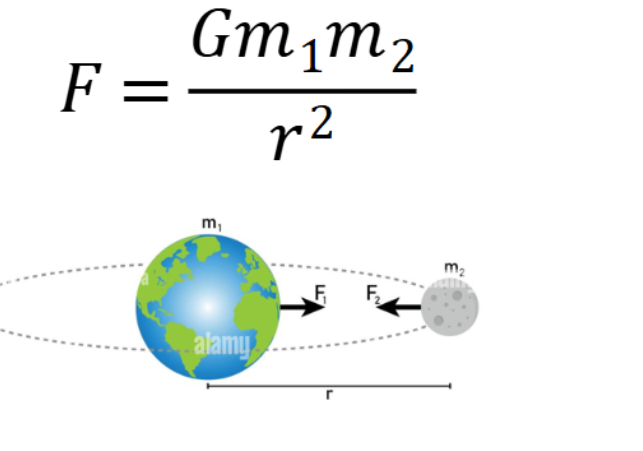
What affects the gravity?
• Greater distance between, r.
• More mass, m1 and m2
Universal Law of Gravitation
Waves:
Light is an electromagnetic wave
• Wave motion: Transmission of energy without the
physical transport of material
• For light, amplitude is like the brightness

Frequency (f): Number of wave crests that pass a given
point per second
Period (P): Time between passage of successive crests
Relationship:
Equation: P = 1 / f
Wavelength (λ) : Distance between successive crests
Velocity: Speed at which crests move
Relationship: velocity = wavelength / period or v = λf
Electromagnetic waves: are oscillating electric and
magnetic fields
• changing electric field creates magnetic field and vice
versa
Water waves, sound waves, string waves travel in a
medium (water, air, string)
• Electromagnetic waves don’t need a medium
• Created by accelerating charged particles
Visible light: is only a small part of the total
electromagnetic spectrum
Different colors of light come from their frequency and
wavelength

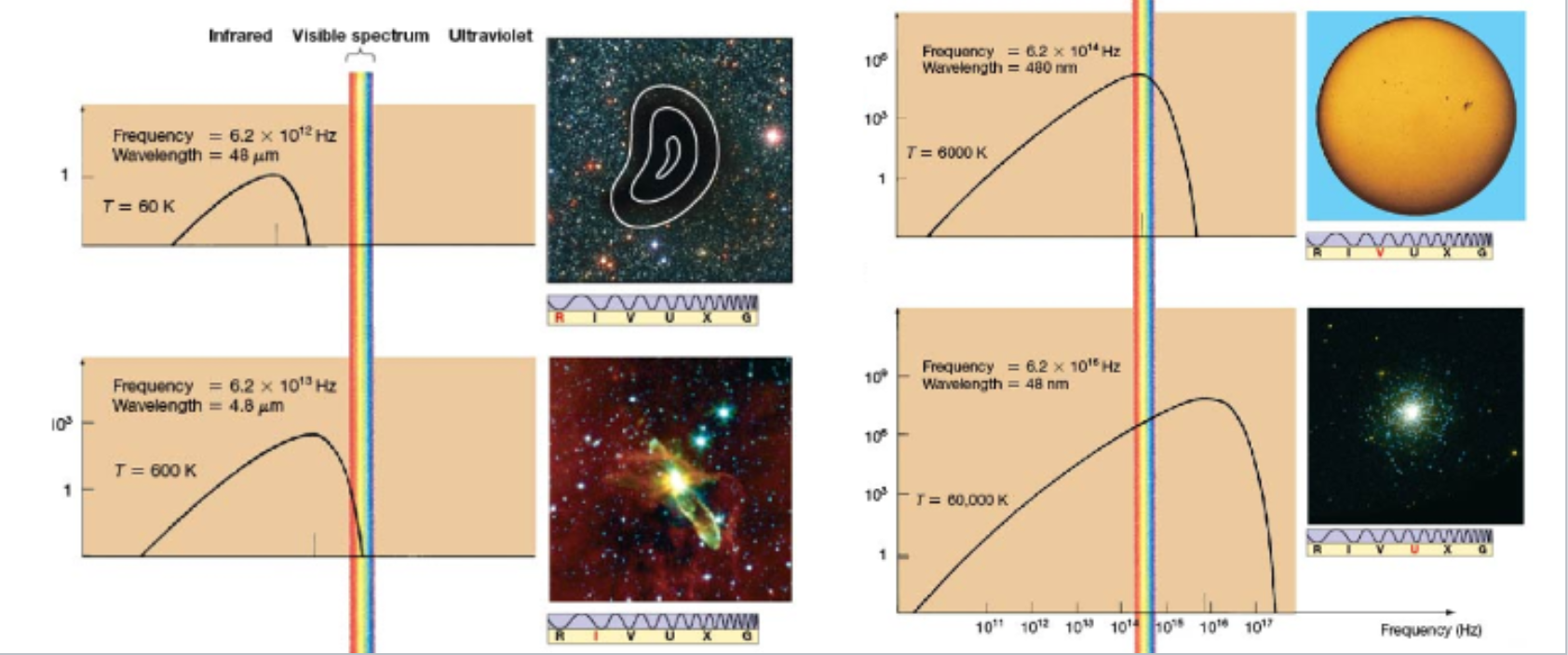
Blackbody (Thermal) Radiation: Light emitted by any
heated object
Spectrum: (light distribution) depends on the
temperature, T, in Kelvin (K)
Higher T → higher frequency (bluer light)
Higher T → MUCH more total energy emitted (T⁴ relationship)

Thermal Radiation Laws:
• Peak frequency is proportional to temperature
• Total energy emitted is proportional to fourth power of
temperature
Chapter 4:
Two primary ways to produce light
• Heating up an object
• Exciting Atoms or Molecules
Spectroscope: Splits light into component colors

Emission lines: Single frequencies emitted by
particular atoms

Absorption spectrum: If a continuous spectrum
passes through a cool gas, atoms of the gas will
absorb the same frequencies they emit.

Kirchhoff’s Laws
• Heated solid, liquid, or dense gas produces
continuous spectrum (thermal radiation)
• Low-density hot gas produces emission spectrum
• Continuous spectrum going through a cool, thin gas
produces absorption spectrum.

Emission energies correspond to energy differences
between allowed orbitals (energy levels) in atoms
Molecular spectra: are much more complex than
atomic spectra, even for hydrogen

Focal Length: Distance from lens/mirror to Focus
(point where incoming rays are focused)

Modern Telescopes mostly Reflectors
WHY?
1. Light traveling through lens is refracted differently
depending on wavelength.
2. Some light traveling through lens is absorbed.
3. A large lens can be very heavy and can only be
supported at the edge.
4. A lens needs two precise optical surfaces
Telescope: Two Main reasons bigger is better
• Light-gathering ability
• Resolution
Light Gathering increases with the area of the lens
or mirror(s)
• Light Gathering proportional to Diameter2 (or
Radius2)
• Double the diameter = 4x Light gathering
Atmosphere poses problems for astronomy
TWO main reasons:
• Blurring
• Blocking certain wavelengths
Interferometry: Combining light from multiple
telescopes
Primary goals:
• Gather more light
• AND drastically increase resolution