volmetres+ ammeters
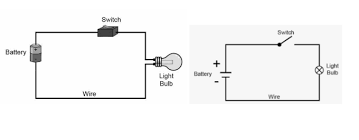
An electrical circuit is a closed loop through which electricity can flow. It typically consists of several key components:
Power Source: This provides the electrical energy (voltage) to the circuit.
Examples: Batteries, generators, power outlets.
It creates a potential difference that drives the flow of charge.
Conductor: These are materials that allow electric current to flow easily through them.
Examples: Copper wires, aluminum wires.
They connect the components of the circuit, forming a path for electrons to travel.
Load: This is any component or device that consumes electrical energy and converts it into another form of energy (e.g., light, heat, motion).
Examples: Light bulbs, resistors, motors, speakers.
The load opposes the flow of current, causing a voltage drop across it.
Switch (Optional): A device used to open or close a circuit, thereby controlling the flow of current.
When the switch is closed, the circuit is complete, and current flows
When the switch is open, the circuit is broken, and current stops.
In a simple series circuit, these components are connected end-to-end, forming a single path for current. In parallel circuits, components are connected across the same two points, providing multiple paths for current flow.
Ammeters are essential instruments designed to measure the electric current (in Amperes, ) flowing through a circuit or a specific component. To ensure an accurate measurement without significantly altering the current, an ammeter must always be connected in series with the part of the circuit where the current is to be measured. They are built with very low internal resistance to minimize their impact on the overall current flow and prevent a substantial voltage drop across themselves.
Voltmeters are utilized to measure the potential difference, or voltage (in Volts, ), between two points in an electrical circuit, typically across a component. For precise readings, a voltmeter is invariably connected in parallel across the component or section of the circuit whose voltage is being measured. These devices feature a very high internal resistance, which ensures that only a negligible amount of current is diverted through the meter itself.
Ammeter: Used to measure the current in a series circuit