Ch 10 Muscle Identification and Mechanics
The human body has approximately 600–650 skeletal muscles.
The commonly cited number is about 600 muscles, although the exact count varies depending on how muscles are classified and counted.
Muscle Identification
Four Functional Groups of Muscles
The four functional muscle groups in the human body are commonly classified by the movements they produce:
1. Agonists (Prime Movers) – Muscles primarily responsible for producing a movement.
Example: Biceps during elbow flexion.
2. Antagonists – Muscles that oppose or reverse the action of the agonists.
Example: Triceps during elbow flexion.
3. Synergists – Muscles that assist the prime movers in performing a movement.
Example: Brachialis assisting the biceps.
4. Stabilizers (Fixators) – Muscles that hold a body part steady so another movement can occur efficiently.
Example: Core muscles stabilizing the spine during a lift.
**Easy way to remember:
Agonist = Moves
Antagonist = Opposes
Synergist = Assists
Stabilizer = Holds steady
Muscles never move in isolation - each muscle plays its respective role to ensure effective and coordinated motion.
Critera for Naming Muscles
The seven criteria used for naming muscles in anatomy are:
1. Location – Where the muscle is found.
Example: Temporalis (located near the temporal bone).
2. Shape – The shape of the muscle.
Example: Deltoid (triangular-shaped).
3. Relative Size – The size of the muscle compared to others.
Example: Gluteus maximus (largest gluteal muscle).
4. Direction of Muscle Fibers – The direction the fibers run.
Example: Rectus abdominis (straight fibers).
5. Number of Origins – How many attachment points or heads the muscle has.
Example: Biceps brachii (two heads); triceps brachii (three heads).
6. Location of Attachments – The bones or structures the muscle attaches to.
Example: Sternocleidomastoid (attaches to the sternum, clavicle, and mastoid process).
7. Action – The movement the muscle produces.
Example: Flexor carpi radialis (flexes and abducts the wrist).
Fascicle Arrangements

a) Circular: Fascicles arranged in concentric rings (e.g., orbicularis oris).
b) Convergent: Fascicles converge toward a single tendon insertion (e.g., pectoralis major).
c) Parallel: Fascicles run parallel to the long axis of a straplike muscle (e.g., sartorius).
f) Fusiform: Spindle-shaped muscles with parallel fibers (e.g., biceps brachii).
d, e, g) Pennate: Short fascicles attach obliquely to a central tendon running the length of the muscle:
d) Unipennate: e.g., extensor digitorum longus.
e) Bipennate: e.g., rectus femoris.
g) Multipennate: e.g., deltoid.
Muscle Mechanics
Components of Lever Systems
Lever: Rigid bar (bone) that moves on a fixed point.
Fulcrum: Fixed point (joint or pivot) upon which the lever moves.
Effort: Applied force supplied by muscle contraction to move a resistance.
Load: Resistance (bone, tissues, plus any added weight) moved by the effort.
Classes of Lever Systems
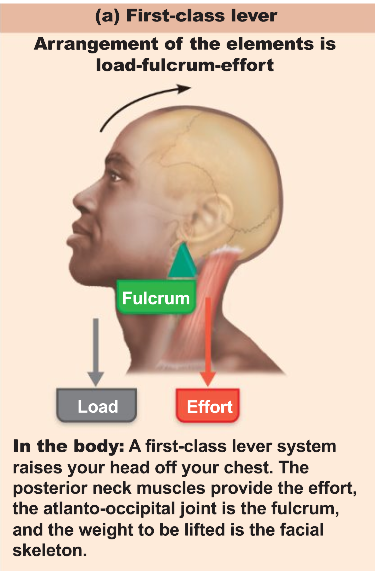
First-Class Lever:
Arrangement: Fulcrum positioned between load and effort (load–fulcrum–effort).
Mechanical Example: Scissors.
Anatomical Example: Raising the head off the chest (fulcrum: atlanto-occipital joint; effort: posterior neck muscles; load: facial skeleton).
Second-Class Lever:
Arrangement: Load positioned between fulcrum and effort (fulcrum–load–effort).
Mechanical Example: Wheelbarrow.
Anatomical Example: Standing on tip-toe (fulcrum: joints of the ball of the foot; effort: calf muscles pulling upward on the heel; load: weight of the body).

Third-Class Lever:
Arrangement: Effort applied between fulcrum and load (load–effort–fulcrum).
Mechanical Example: Tweezers or forceps.
Anatomical Example: Flexing the forearm with the biceps brachii (fulcrum: elbow joint; effort: muscle force on proximal radius; load: hand and distal end of the forearm).
