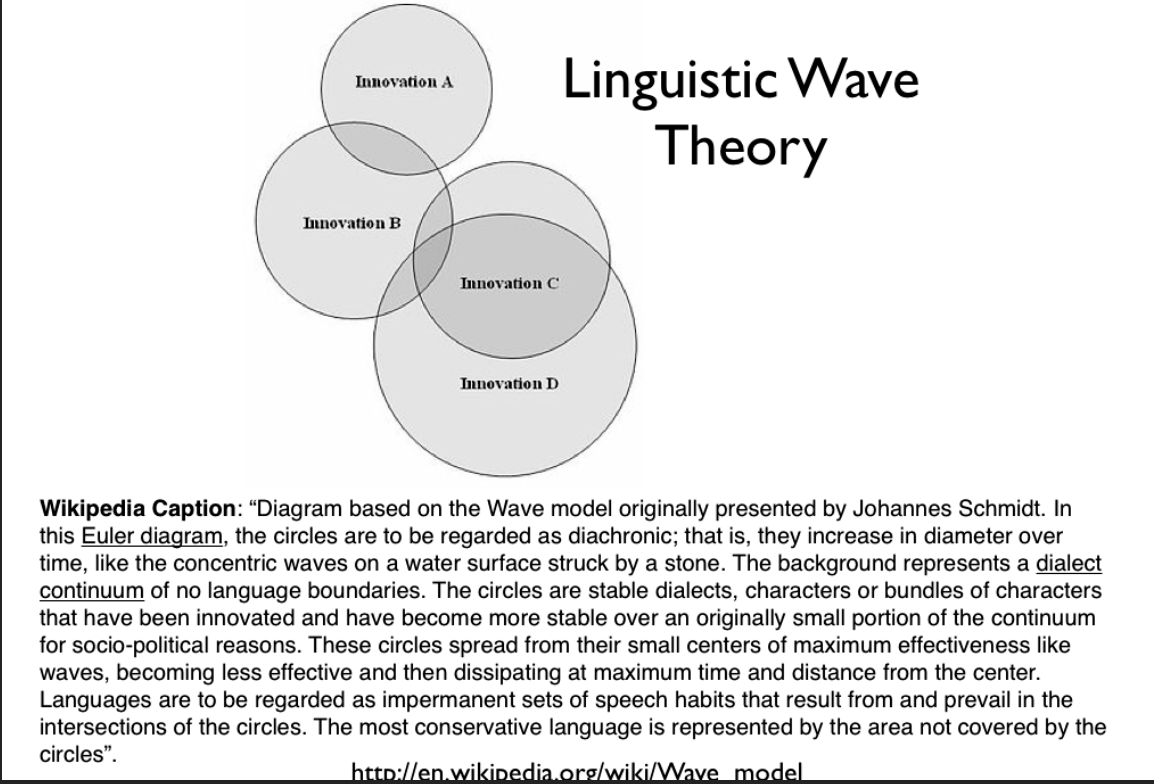
the wave model model
Wave models of language change developed in the late 19th century as an alternative to family tree models in Indo-European historical linguistics.
Wave models illustrate ambiguous relationships through overlapping shared innovations, while tree models depict clear, distinct shared changes.
This entry outlines the historical progress and advancements in wave model theory and methodology.
Early contributors include:
- Johannes Schmidt
- August Leskien
- Karl BrugmannInnovations to the classic wave model include:
- Charles-James N. Bailey's dynamic wave model:
- Clarifies isogloss bundles and timelines of innovations using implicational hierarchies, suitable for unidirectional internal changes.
- Malcolm Ross's linkage model:
- Explains gradual, multidirectional diversification of closely related dialects through dialect continua.Recent developments discussed in sections 4 and 5:
- ‘Historical Glottometry’: a quantitative method that incorporates relative weight and quality of shared innovations into wave model diagrams.
- ‘Hinge diversification’: a concept requiring both tree and wave models for historical ancestry reconstruction.The discussion in sections 3 to 5 references three case studies:
- Two from Tibeto-Burman languages in China and Vietnam
- One from Oceanic languages in Vanuatu.
strengths of the wave model
The wave model in English linguistics helps visualize language change as dynamic, interactive waves, illustrating how linguistic features spread and evolve through social, cultural, and historical interactions, aiding in the understanding of dialect development and language evolution.
captures the diffusion and variation of language
weaknesses of the wave model
lack of predictive power for the speed or direction of linguistic innovations, overemphasis on diffusion which can obscure deep-time genetic relationships, and difficulty in interpreting overall patterns.