Moles-reacting masses
Key vocabulary
Mole – a measure of the amount of substance; unit is mol.
Relative atomic mass – the mass of one mole of an element's atoms, found on the periodic table.
Formula mass – total of all atomic masses in a chemical formula.
Molecular mass – another name for formula mass, used with molecules.
The limiting reagent is the reactant with fewer moles than needed for the reaction ratio, so it gets used up first.
The reagent in excess is the one with more moles than needed, so some of it is left over after the reaction.
Balanced Chemical Equations
Balanced equations show the ratio of species in a chemical reaction.
The big number in front of a chemical formula shows how many moles of that substance react or are produced.
Example: H₂SO₄ + 2NaOH → Na₂SO₄ + 2H₂O
This shows a 1:2 → 1:2 mole ratio.
If you had 1 mole of H₂SO₄, it would need to react with 2 moles of NaOH.
You would expect to make 1 mole of Na₂SO₄ and 2 moles of H₂O.
Question:
How many moles of NaOH are needed to react with 0.5 moles of H₂SO₄?
The ratio is 1:2, so 0.5 × 2 = 1 mole of NaOH.
How many moles of water will form from 0.5 moles of H₂SO₄?
Ratio of H₂SO₄ : H₂O is 1:2 → 0.5 × 2 = 1 mole of H₂O.
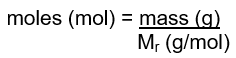
Moles equation:
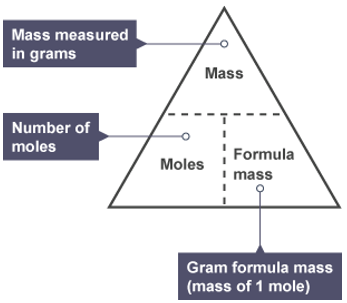
The expression can also be presented as a triangle:
What mass of magnesium chloride could be formed when 3 moles of magnesium is reacted with excess hydrochloric acid?
Equation:
Mg(s) + 2HCl(aq) → MgCl₂(aq) + H₂(g)
Step 1:
Underline the two substances being considered: Mg and MgCl₂.
Ratio = 1:1 → 1 mole of Mg produces 1 mole of MgCl₂.
Therefore, 3 moles of Mg will produce 3 moles of MgCl₂.
Step 2:
Use the moles expression with the calculated Mr (molar mass):
Mr (MgCl₂) = 24 + (2 × 35.5) = 95 g/mol
Mass of MgCl₂ = moles × Mr = 3 × 95 = 285 g
If given 4.8 g of magnesium instead:
Equation:
Mg(s) + 2HCl(aq) → MgCl₂(aq) + H₂(g)
Step 1:
Calculate the moles of magnesium:
Mr of Mg = 24 g/mol
Moles = mass / Mr = 4.8 ÷ 24 = 0.2 moles
Step 2:
Deduce the moles of magnesium chloride formed:
Ratio is 1:1 → so 0.2 moles of MgCl₂ formed.
Step 3:
Calculate the mass of magnesium chloride:
Mass = moles × Mr = 0.2 × 95 = 19 g
General Process (for similar questions):
Find the moles of the given substance using moles = mass / Mr.
Use the ratio in the balanced equation to find moles of the other substance.
Calculate the mass using mass = moles × Mr.
MASSES OF REACTANTS AND PRODUCTS CALCULATIONS
NB: Mass must be in grams in the expression:
moles = mass (g) ÷ Ar or Mr
(Remember: 1 kilogram = 1 × 10³ g; 1 tonne = 1 × 10⁶ g)
1) What mass of ethanol is formed when 4.50 g of glucose is fermented?
Equation:
C₆H₁₂O₆ → 2C₂H₅OH + 2CO₂
(Working with glucose and ethanol.)
mole ratio | 1 : 2 |
|---|---|
mass / g | 4.50 g (glucose) |
Ar/Mr | C₆H₁₂O₆ = 180, C₂H₅OH = 46 |
moles | 4.50 ÷ 180 = 0.025 mol (glucose) |
0.025 × 2 = 0.05 mol ethanol |
mass of ethanol = 0.05 × 46 = 2.3 g
2) In blast furnaces, iron(III) oxide is reduced to iron by carbon monoxide. What mass of carbon monoxide is needed to reduce 16 kilograms of iron(III) oxide?
Equation:
Fe₂O₃ + 3CO → 2Fe + 3CO₂
(Working with iron(III) oxide and carbon monoxide.)
mole ratio | 1 : 3 |
|---|---|
mass / g | 16 kg = 16,000 g (Fe₂O₃) |
Ar/Mr | Fe₂O₃ = 160, CO = 28 |
moles | 16,000 ÷ 160 = 100 mol (Fe₂O₃) |
100 × 3 = 300 mol CO |
mass of CO = 300 × 28 = 8,400 g = 8.4 kg
3) What mass of aluminium can be obtained by the electrolysis of 60 tonnes of pure aluminium oxide?
Equation:
2Al₂O₃ → 4Al + 3O₂
(Working with aluminium oxide and aluminium.)
mole ratio | 2 : 4 |
|---|---|
mass / g | 60 tonnes = 60,000,000 g (Al₂O₃) |
Ar/Mr | Al₂O₃ = 102, Al = 27 |
moles | 60,000,000 ÷ 102 ≈ 588,235.29 mol (Al₂O₃) |
moles Al | (588,235.29 × 4) ÷ 2 = 1,176,470.59 mol (Al) |
mass of Al = 1,176,470.59 × 27 ≈ 31,764,705.88 g = 31.8 tonnes
1) What mass of magnesium chloride is formed when 1.92 g of magnesium reacts?
Equation:
Mg + 2HCl → MgCl₂ + H₂
mole ratio | 1 : 1 |
|---|---|
mass / g | 1.92 g |
Ar/Mr | Mg = 24, MgCl₂ = 95 |
moles | 1.92 ÷ 24 = 0.08 mol (Mg) |
0.08 mol MgCl₂ formed |
mass of MgCl₂ = 0.08 × 95 = 7.6 g
2) What mass of barium chloride is required to precipitate 11.65 g of barium sulphate?
Equation:
BaCl₂ + MgSO₄ → BaSO₄ + MgCl₂
mole ratio | 1 : 1 |
|---|---|
mass / g | 11.65 g (BaSO₄) |
Ar/Mr | BaSO₄ = 233, BaCl₂ = 208 |
moles | 11.65 ÷ 233 = 0.05 mol (BaSO₄) |
0.05 mol BaCl₂ needed |
mass of BaCl₂ = 0.05 × 208 = 10.4 g
3) What mass of calcium oxide is formed when 10 kg of limestone is decomposed?
Equation:
CaCO₃ → CaO + CO₂
mole ratio | 1 : 1 |
|---|---|
mass / g | 10 kg = 10,000 g |
Ar/Mr | CaCO₃ = 100, CaO = 56 |
moles | 10,000 ÷ 100 = 100 mol (CaCO₃) |
100 mol CaO produced |
mass of CaO = 100 × 56 = 5,600 g = 5.6 kg
4) What mass of hydrogen is evolved when zinc reacts with 7.30 g of hydrogen chloride?
Equation:
Zn + 2HCl → ZnCl₂ + H₂
mole ratio | 2 : 1 |
|---|---|
mass / g | 7.30 g (HCl) |
Ar/Mr | HCl = 36.5, H₂ = 2 |
moles | 7.30 ÷ 36.5 = 0.2 mol (HCl) |
moles H₂ | 0.2 ÷ 2 = 0.1 mol |
mass of H₂ = 0.1 × 2 = 0.2 g
5) What mass of sodium is required to produce 1 tonne of titanium?
Equation:
TiCl₄ + 4Na → Ti + 4NaCl
mole ratio | 1 : 4 |
|---|---|
mass / g | 1 tonne = 1,000,000 g (Ti) |
Ar/Mr | Ti = 48, Na = 23 |
moles Ti | 1,000,000 ÷ 48 ≈ 20,833.33 mol |
moles Na | 20,833.33 × 4 = 83,333.33 mol |
mass of Na = 83,333.33 × 23 ≈ 1,916,666.59 g ≈ 1.92 tonnes
Extension: Reaction of sodium with water
Equation:
2Na + 2H₂O → 2NaOH + H₂
mole ratio | 2 : 1 |
|---|---|
mass / g | 0.46 g (Na) |
Ar/Mr | Na = 23, H₂ = 2 |
moles Na | 0.46 ÷ 23 = 0.02 mol |
moles H₂ | 0.02 ÷ 2 = 0.01 mol |
mass of H₂ = 0.01 × 2 = 0.02 g
PERCENTAGE YIELD
The yield of a reaction refers to the amount of a product made.
We have shown how the amount can be calculated from the balanced equation.
This is the theoretical amount that could be made – it represents the maximum amount, therefore 100%.
However, in experiments, this may not always be reality – you may not end up with 100% of your intended product.
Experiment 1: Heating magnesium to form magnesium oxide
Equation:
2Mg(s) + O₂(g) → 2MgO(s)
Steps |
|---|
1. Weigh an empty crucible. |
2. Add a piece of magnesium into the crucible and reweigh. |
3. Heat the crucible with a Bunsen burner, intermittently lifting the lid to allow in oxygen. |
4. Allow the crucible to cool and reweigh. |
Why might the yield be less than 100%?
Some magnesium might not react fully with oxygen.
Some magnesium oxide might escape when lifting the lid.
Incomplete reaction if not enough oxygen gets in.
Incomplete reaction-not all the magnesium has reacted.
To ensure all completely reacted, keep heating and cooling until a constant mass has been reached.
Experiment 2: Reaction of limestone (calcium carbonate) with hydrochloric acid
Equation:
CaCO₃(s) + 2HCl(aq) → CaCl₂(aq) + H₂O(l) + CO₂(g)
Steps |
|---|
1. Place the calcium carbonate chips in a conical flask. |
2. Add the acid. |
3. Collect the carbon dioxide produced in a gas syringe. |
Why might the yield of carbon dioxide be less than 100%?
Some carbon dioxide gas may escape before it is collected.
Incomplete reaction if all the calcium carbonate does not fully react.
Gas syringe may leak or not capture all of the gas.
Impurities present in the limestone chips - they contain calcium carbonate but may also contain other things that do not react with acid to produce carbon dioxide.
This will lower the amount of carbon dioxide produced
PERCENTAGE YIELD CALCULATIONS
Calculations from chemical equations give the theoretical (maximum) product yield.
In reality, few reactions reach 100% yield due to:
Incomplete reactions.
Loss of product during handling.
Side reactions forming other products.
Formula:
% yield = (actual mass or moles ÷ theoretical mass or moles) × 100
1) A student calculates that a certain reaction will yield 7.0g of a salt. Her product weighs 6.3g. What percentage yield has she obtained?
Find the % yield.
Step | Working |
|---|---|
Actual mass | 6.3 g |
Theoretical mass | 7.0 g |
% yield | (6.3 ÷ 7.0) × 100 = 90% |
2) When 6.35g of copper were heated in air, 7.6g of copper(II) oxide, CuO, were obtained.
a) Calculate the mass of copper(II) oxide formed, if the copper reacted completely.
b) Calculate the percentage yield that was actually obtained.
Equation:
2Cu + O₂ → 2CuO
Part | Value |
|---|---|
Mole ratio | Cu : CuO → 1 : 1 |
Mass (g) | 6.35g Cu |
Ar/Mr | Cu = 63.5, CuO = 79.5 |
Moles | 6.35 ÷ 63.5 = 0.1 mol Cu |
Moles CuO | 0.1 mol |
Mass CuO | 0.1 × 79.5 = 7.95g |
Step | Working |
|---|---|
% yield | (7.6 ÷ 7.95) × 100 ≈ 95.6% |
3) In an experiment, 5g of calcium oxide was formed from the decomposition of 10g of calcium carbonate.
Equation:
CaCO₃ → CaO + CO₂
Part | Value |
|---|---|
Mole ratio | CaCO₃ : CaO → 1 : 1 |
Mass (g) | 10g CaCO₃ |
Ar/Mr | CaCO₃ = 100, CaO = 56 |
Moles | 10 ÷ 100 = 0.1 mol CaCO₃ |
Moles CaO | 0.1 mol |
Mass CaO | 0.1 × 56 = 5.6g |
Step | Working |
|---|---|
% yield | (5.0 ÷ 5.6) × 100 ≈ 89.3% |