Meiosis and Genetic Diversity
Heredity
Genetics: The study of heredity and hereditary variation
Traits are passed from parent to offspring through genes
Segments of DNA that code for basic units of heredity
Offspring acquire genes from parents by inheriting chromosomes
Asexual VS Sexual Reproduction
Asexual
Single individual
No fusion of gametes
Clones: offspring are exact copies of parent
Mutations are the only source of variation
Can produce asexually through mitosis
Sexual
Two parents (male/female)
Offspring are unique combinations of genes from parents
Genetically varied from parents and siblings
Homologous Chromosomes
Homologous chromosomes: a pair of chromosomes (same size, length, centromere position) that carry the same genetic information
One homologous chromosome is inherited from mom and one is inherited from dad
Karyotypes
Karyotypes: A display of chromosome pairs ordered by size and length
Note: in actual karyotypes it is difficult to see the sister chromatids in each pair
Cells and Chromosomes
Somatic (body) cells
Diploid, or 2n: Two complete sets of each chromosome
Humans: 2n=46
Gametic (sex) cells:
Haploid, or n: one set of each chromosomes
Humans (sperm and eggs): n=23
Cells and Chromosomes
Eukaryotes have DNA that is packaged in chromosomes
There are two types of chromosomes
Autosomes: chromosomes that do not determine sex (in humans 22 pairs)
Sex chromosomes: X and Y
Eggs: X (humans 22+x)
Sperm: X or Y (Humans 22+x or 22+y)
Life Cycles
Life cycle: Sequence of stages in the reproductive history of an organism from conception to its own reproduction
Fertilization and meiosis alternate in sexual life cycles
Fertilization is when a sperm cell (haploid) fuses with an egg (haploid) to form a zygote (diploid)
Meiosis
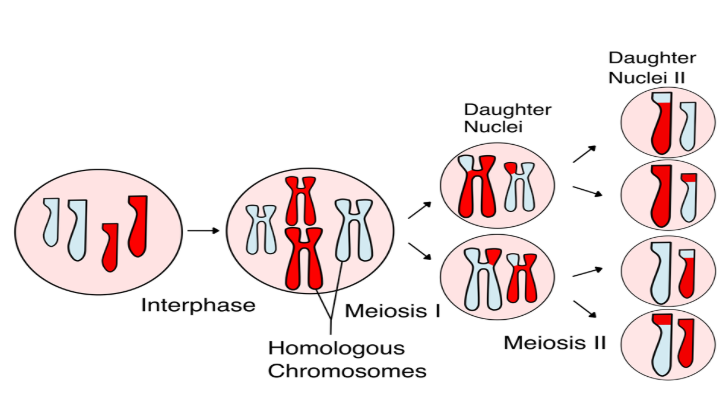
Meiosis: a process that creates haploid gamete cells in sexually reproducing diploid organisms
Results in daughter cells with half the number of chromosomes as the parent cell
Example: humans
Diploid: 2n= 46
Meiosis produces sperm and eggs that are haploid: n=23
Involves two rounds of division
Meiosis I and Meiosis II
Mitosis vs Meiosis
Although Mitosis and Meiosis are similar, they have key differences
Mitosis
Occurs in somatic cells
1 division
Results in two diploid daughter cells
Meiosis
Forms gametes
2 divisions
Results in 4 haploid daughter cells
Each daughter cell is genetically unique
Key Events in Meiosis
Meiosis I
Prophase I: Synapsis and crossing over
Metaphase I: Tetrads (homologous pairs) line up at the metaphase plate (middle)
Anaphase I: Homologous pairs separate
Telophase I and Cytokinesis: Nuclei and cytoplasm divide; There is now a haploid set of chromosomes in each daughter cell.
How does crossing over lead to genetic diversity?
Ans: Crossing over allows homologous chromosomes to randomly exchange information between each other, allowing certain traits to be swapped randomly, creating a new combination of alleles.
Meiosis II
Prophase II: (Unlike P1, there's no DNA replication) The nuclear membrane disintegrates, spindle fibers go to opposite poles of the cell
Metaphase II: The chromosomes line up at the equator and attach to the spindle fibers
Anaphase II: Sister chromatids separate and move to opposite poles of the cell
Telophase II and Cytokinesis: Spindle fibers disappear and the nuclear membrane reforms. Finally, the cells separate into four haploids.