3 Types of Factorising
Factorise by Grouping
We have seen the distributive law: .
We have also seen how the distributive applies when the first term is a binomial expression: .
This means that if we have an expression such as , we can write it as a product of two brackets: .
Factorise using Perfect Squares
We’ve seen how to expand perfect squares and use a model to visualise it:
Model:
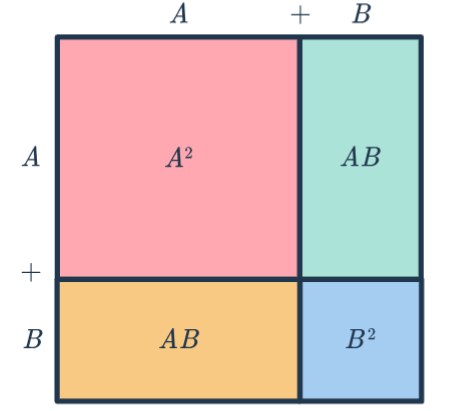
When factorising an expression of the type :
Look for a common factor to both terms first as this can simplify the expression for the remaining steps.
Identify values for A and B that satisfy this form.
Write in factorised form using the rule .
In our work in quadratics, the first term , is often the variable , so for the expression , we would identify and , because . The middle term holds true as .
Factorise using Difference of Two Squares
We know that the difference of two squares looks like this: .
When factorising an expression of the type :
Look for a common factor to both terms first as this can simplify the expression for the remaining steps.
Identify the terms that are the squares and .
Write in factorised form using the rule .