Chapter 6: Elasticity, Consumer Surplus, and Producer Surplus
- Price elasticity of demand - Responsiveness of consumers to a price change
- Relatively elastic - Modest price changes cause large changes in quantity purchased
- Relatively inelastic - Substantial price changes cause small changes in quantity purchased
- Elasticity of demand = Percent change in quantity demanded of product X / Percent change in price of product X
- Midpoint formula - Averages the 2 prices and the 2 quantities as reference points for computing percentages

- Why use percentages?
- Choice of units can arbitrarily affect impression of buyer responsiveness
- Can correctly compare consumer responsiveness to changes in prices of different products
- Ignore minus sign + present absolute value of elasticity coefficient to avoid ambiguities
- Interpretations of elasticity of demand
- Elastic - Specific percent change in price results in a larger percent change in quantity demanded; elasticity of demand greater than 1
- Inelastic - Specific percent change in price results in a smaller percent change in quantity demanded; elasticity of demand less than 1
- Unit elasticity - Percent change in price is equal to resulting percent change in quantity demanded; elasticity of demand equals 1
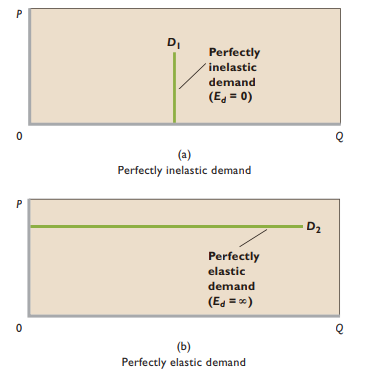
- Perfectly inelastic - Price-elasticity coefficient equals 0; no response to change in price
- Perfectly elastic - A small price reduction causes buyers to increase purchases from 0 to all they can obtain; price-elasticity coefficient equals infinity
- Total revenue - Total amount seller receives from sale of a product in a particular time period; price * quantity sold
- Total-revenue test - Test to infer whether demand is elastic or inelastic
- Elastic - Decrease in price → Increase in total revenue
- Inelastic - Decrease in price → Decrease in total revenue
- Unit elastic - Increase or decrease in price → Total revenue unchanged
- Price elasticity along a linear demand curve
- Price elasticity coefficient for a demand curve declines as we move from higher to lower prices
- Changes from more elastic to more inelastic
- Slope cannot be used to judge elasticity
- Determinants of price elasticity of demand
- Substitutability - More substitute goods available → Greater price elasticity of demand
- Proportion of income - Higher the price of a good relative to consumers’ incomes → Greater price elasticity of demand
- Luxuries vs. necessities - Good considered to be luxury rather than necessity → Greater price elasticity of demand
- Time - Longer time period → Greater price elasticity o demand (consumers have more time to adjust to changes in price)
- Applications of price elasticity of demand
- Large crop yields - Demand for farm products is highly inelastic; increases in output → lower prices of farm products + total revenues of farmers
- Excise taxes - Levying excises on products w/ inelastic demand
- Decriminalization of illegal drugs - Legalization → Would reduce drug trafficking by taking the profit out of it (would reduce street prices)
- Price elasticity of supply - How easily/quickly producers can shift resources b/w alternative uses
- Elastic - Quantity supplied by producers relatively responsive to price changes
- Inelastic - Quantity supplied relatively insensitive to price changes
- Elasticity of supply = Percent change in quantity supplied of product X / Percent change in price of product X
- Market period - Period that occurs when the time immediately after a change in market price is too short for producers to respond with a change in quantity supplied
- Short run - Period of time too short to change plant capacity but long enough to use the fixed-sized plant more or less intensively
- Ex. Farmer cannot change land or machinery, but can change amount of labor + fertilizer
- Long run - Period of time that is long enough for firms to adjust plant sizes + for firms to enter or leave the industry
- Ex. Farmer has time to acquire more land and machinery + more farmers may be attracted to tomato farming by higher prices
- Applications of price elasticity of supply
- Antiques + reproductions - High prices of antiques result from strong demand + limited, highly inelastic supply
- Volatile gold prices - Price of gold increases sometimes, decreases other times; inelastic supply of gold → small changes in demand produce large changes in price
- Cross elasticity of demand - How sensitive consumer purchases of one product are to a change in the price of another product
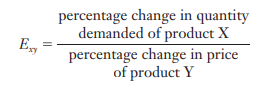
- Cross price elasticity = Percent change in quantity demanded of product X / Percent change in price of product Y
- Substitute goods - Increase in price of good X → Increase in demand for good Y
- Complementary goods - Increase in price of good X → Decrease in demand for good Y
- Independent goods - 2 products being considered are unrelated
- Income elasticity of demand - Degree to which consumers respond to a change in their incomes by buying more or less of a particular good
- Income elasticity = Percent change in quantity demanded / Percent change in income
- Normal goods - Income rises → Demand increases
- Inferior goods - Income rises → Demand decreases

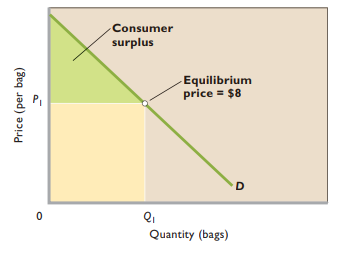
- Consumer surplus - Benefit surplus received by consumers in a market
- Difference between the maximum price a consumer is willing to pay and the actual price
- Arises b/c all consumers pay equilibrium price even though many are willing to pay more than that
- Add together individual consumer surpluses → Obtain collective consumer surplus in market
- Consumer surplus + price are inversely related
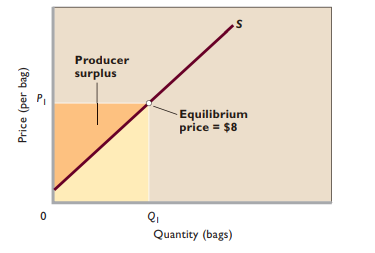
- Producer surplus - Benefit surplus received by producers in a market
- Difference between the actual price a producer receives and the minimum acceptable price
- Arises b/c most sellers willing to accept lower-than-equilibrium price if that’s required to sell the product
- Add together individual producer surpluses → Obtain collective producer surplus in market
- Producer surplus + price are directly related
- Efficiency
- Productive efficiency - Competition forces producers to use best techniques + combos of resources
- Allocative efficiency - Correct quantity of output produced relative to other goods + services
- When consumer surplus + producer surplus is at maximum size
- MB = MC
- Maximum willingness to pay = minimum acceptable price
- Competitive markets produce equilibrium prices + quantities that maximize consumer + producer surplus
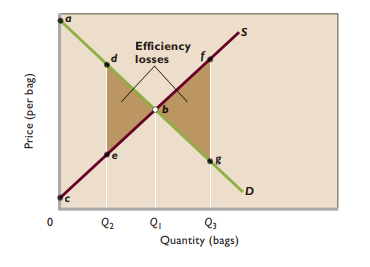
- Efficiency losses - Reductions of combined consumer + producer surplus
- Deadweight loss - Efficiency loss to society
- Example: Producing an item for which the maximum willingness to pay is $7 and the minimum acceptable price is $10 subtracts $3 from society’s net benefits