1.2 The Structure of DNA and RNA
DNA (Deoxyribonucleic Acid)
- A polymer made of individual nucleotides that carries genetic information.Components of Nucleotides
Each nucleotide consists of:
- Sugar: Deoxyribose
- Phosphate Group
- Nitrogenous Base
Linking of Nucleotides
- The 5’ carbon bonds with the phosphate group.
- Nucleotides are linked by covalent bonds between the sugar and phosphate groups to form a single strand of DNA.Orientation of Nucleotides in DNA
Connection occurs between:
- 3’ carbon atom of the first nucleotide
- Phosphate group of the second nucleotide
Thus, the orientation of the DNA polymer or, the way DNA is read is referred to as 3’ to 5’.
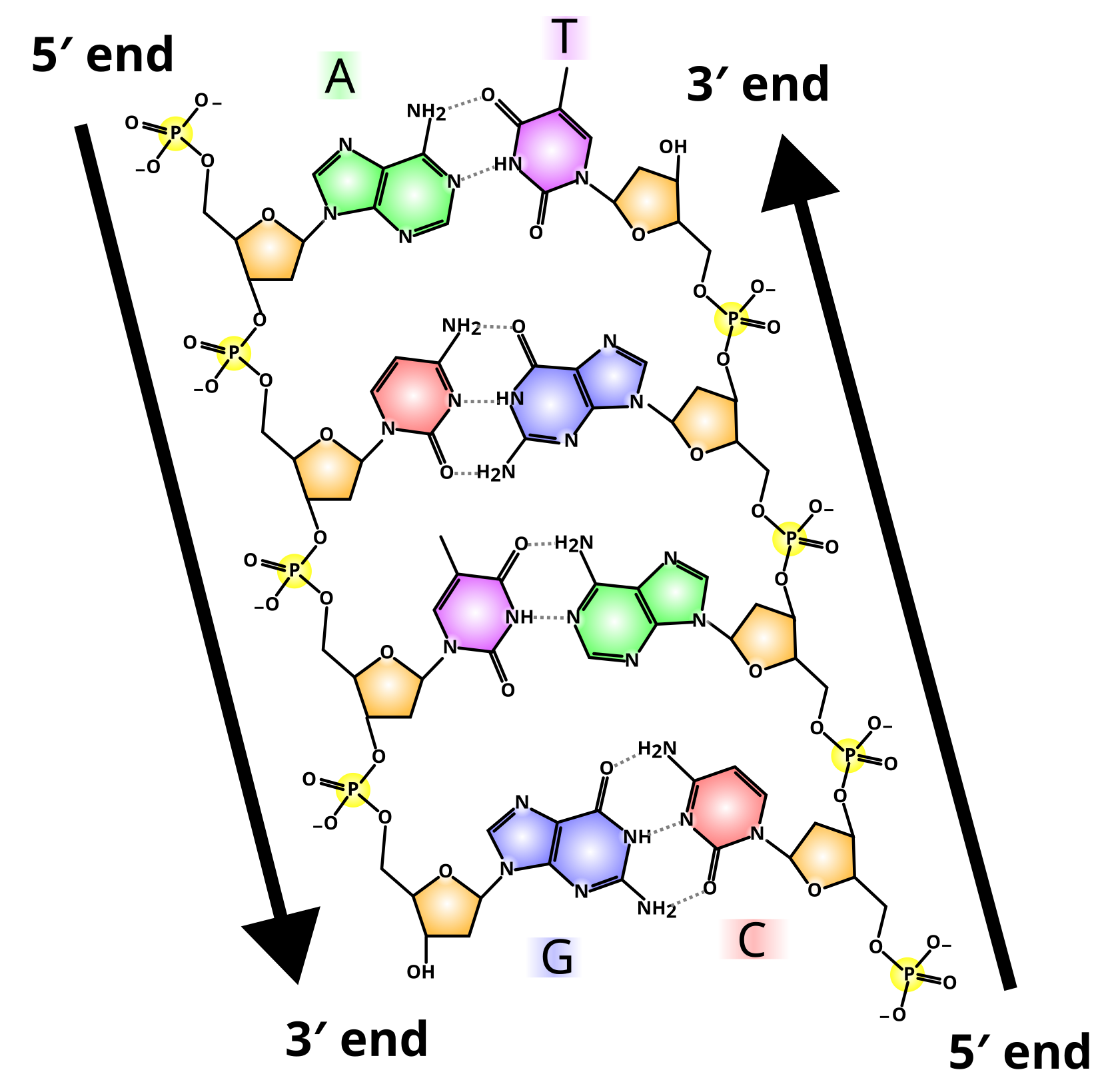
DNA Structure
DNA Nucleotides
bases:
- Adenine (A)
- Thymine (T)
- Guanine (G)
- Cytosine (C)
In RNA, uracil (U) is used instead of thymine.Purines and Pyrimidines
Purines:
Characteristics: Double nitrogenous rings
- Adenine (A)
- Guanine (G)
Pyrimidines:
Characteristics: Single nitrogenous rings
- Cytosine (C)
- Thymine (T)
- Uracil (U)
Base Pairing and Hydrogen Bonds
Two strands of DNA form a double helix through:
- Complementary base pairs linked with hydrogen bonds
Pairing rules:
- Cytosine (C) - Guanine (G) with three hydrogen bonds
- Adenine (A) - Thymine (T) with two hydrogen bonds
In RNA: Adenine (A) - Uracil (U)
DNA Structure
Backbone composed of:
- Sugar and phosphate groups linked together
- Nucleotides in the center
- Phosphodiester bonds connect phosphate groups and sugars
Strands of DNA are antiparallel:
- One strand has 3’-5’ directionality
- Second strand is oriented in 5’-3’ direction
RNA, ribonucleic acid, is similar to DNA but has ribose as the sugar group and has uracil (U) instead of thymine. Unlike DNA, RNA is usually found in nature as a single strand rather than a double strand.