Accident and Sport Injuries
Burns and Scalds
Burns (sun, chemicals or electricity) and scalds (water or steam) are damage to the skin usually caused by heat. Both are treated in the same way.
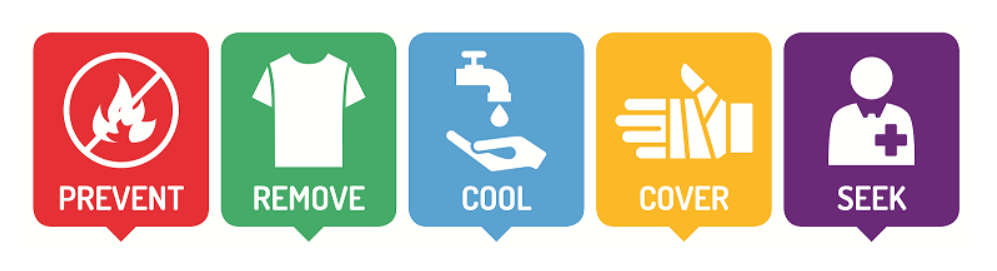
Treatment:
In order to treat a casualty suffering from a burn or scald, work through the following steps:
Follow DRSABCD
If patient has hot water or oil burns, you may need to remove the affected clothing if covered in liquid.
Cool the burnt area under cool running water for 20 minutes. **If the burn is to the eye, flush it with water for 20 minutes.
Remove any jewellery from the burnt area, UNLESS it is sticking to the burn, at which point you leave it on. This may mean you must cut clothing around the stuck area.
Place sterile non-stick dressing or wet dressing over the cooled burn.
Seek medical aid and reassure the patient.
Choking
Choking is the result of an object obstructing a person's airway, therefore limiting the amount of oxygen being consumed.
There are two forms of choking: Partial Airway Obstruction, and Complete Airway Obstruction
Partial Airway Obstruction Symptoms | Complete Airway Obstruction Symptoms |
Coughing | Unable to breathe, speak or cough |
Wheezing | Grips throat |
Difficulty Breathing | Rapid loss of consciousness |
Noisy Breathing | Cyanosis (blue skin colour) |
Treatment for Adult/Child:
In order to treat an adult or child casualty who is choking, work through the following steps:
Encourage the patient to relax and cough to remove object.
Call 000 if coughing does not remove the blockage.
Bend patient forward and give 5 back blows with the heel of the hand between the shoulder blades.
If unsuccessful, give 5 chest thrusts by placing one hand in the middle of the patient's back, and the heel of the other hand in the CPR compression position.
If blockage does not clear, continue alternating between 5 back blows and 5 chest thrusts.
If the patient becomes unconscious, remove any physical obstructions from mouth and commence CPR.
Treatment for Infant:
In order to treat an infant casualty who is choking, work through the following steps:
Immediately call 000.
Place infant with head downwards on your forearm while supporting the head and shoulders on your hand.
Give 5 back blows with the heel of one hand between the shoulder blades.
Turn infant onto back, open mouth and remove any foreign material with your fingers.
If unsuccessful, give 5 chest thrusts using two fingers in the CPR compression position.
If infant becomes unconscious commence CPR.
Cuts and Grazes
Most cuts and grazes are minor and can be easily treated at home.
In order to do this effectively, you should look to stop the bleeding, thoroughly clean the wound and cover with a dressing.
Treatment:
In order to treat a casualty with a cut or graze, work through the following steps:
1.Stop the bleeding.
Apply pressure to the area using a clean and dry absorbent material - such as a bandage, towel or handkerchief.
If the cut is to the arm or hand, encourage the patient to raise it above their head to reduce the flow of blood.
If the injury is to a lower limb, allow the patient to lie down and raise the affected area above the level of the heart.
2.Clean the wound and apply a dressing.
When the wound has stopped bleeding, clean it with sterile water and antiseptic to help stop it from becoming infected.
Wrap firmly in a dressing.
Fractures, Sprains and Strains
Sporting injuries can include sprains, strains fractures, and dislocations.
The difference between Sprains and Strains:
Sprains are the result of the ligaments surrounding a joint twisting, so as to cause pain and swelling.
In contrast a strain involves an injury to a muscle or to the band of tissue that attaches a muscle to a bone.
For example, an ankle sprain could be caused by landing awkwardly after completing a layup in Basketball or sharply changing direction in Touch Football. Whereas, a hamstring or quadricep strain could be caused by not warming up and rapidly accelerating.
Treatment:
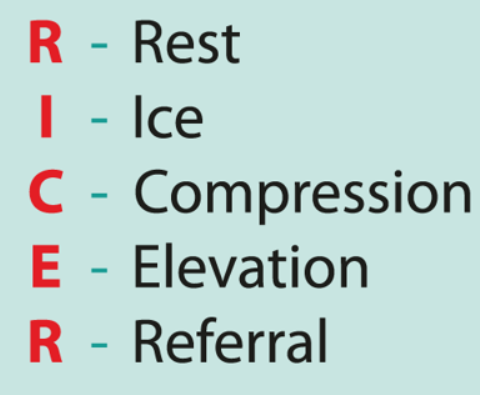
To treat a sprain or strain, the treatments are the same, whereby the RICER framework should be followed:
Fractures and Dislocations:
A Fracture is any form of break within a bone in the body, whereas a dislocation is an injury in which the ends of your bones are forced from their normal positions.
Do: | Do Not: |
|---|---|
Support the limb | Move patient unless they are in immediant danger |
Place padding around the injury | Try to straighten broken bone |
Cover the wound | Raise injured leg (fractured) |
Secure with bandage | |
Apply pressure around the wound | |
Call 000 | |
Support injured area |
Asthma
Sometimes, exercising can induce asthma attacks.
Asthma is a medical condition that affects the airways (the breathing tubes that carry air into our lungs).
From time to time, people with asthma find it harder to breathe in and out, because the airways in their lungs become narrower - like trying to breathe through a thin straw.

Treatment:
If you suspect someone is suffering from an asthma attack, complete the following:
Sit the patient upright
Shake the blue puffer, place 1 puff into the spacer, hold mask/spacer on for 4 breaths, repeat until 4 puffs have been administered.
Wait 4 minutes and repeat the process. Call 000 if the condition worsens.
1 × 4 × 4 ×4 Treatment 👆