The Plant Cell
Concepts (1 of 4)
• All organisms are composed of cells.
• Plant cells consist of a box-like cell wall surrounding a mass of protoplasm.
• The protoplasm contains organelles, such as
− Nuclei
− Mitochondria
− Chloroplasts
Concepts (2 of 4)
• Cells are the physical framework within which a plant’s metabolism occurs.
• Water and salts are absorbed from soil by root cells. They are transported throughout the plant by cells of the vascular tissues.
• The energy of sunlight is used in leaf cells to convert carbon dioxide and water to carbohydrates.
• Plant reproduction is also based on cells and cell biology.
Concepts (3 of 4)
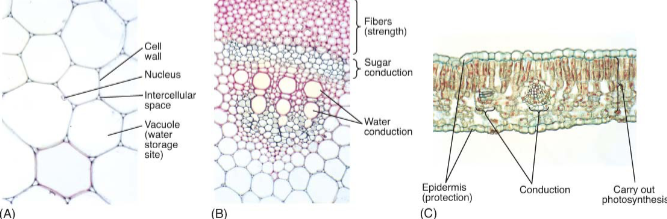
• Although multicellular organisms are complex, there are only a few types of cells.
• It is the interaction among these cell types that leads to distinctions among tissues and organisms.
Concepts (4 of 4)
• Cells in various parts become adapted for specific tasks, known as cell specialization.
• Division of labor allows the entire organism to become more efficient.
− Negative consequence, damage to part of the organism may lead to death of all cells.
Membranes
• Membranes perform many important tasks in cell metabolism.
− They regulate the passage of molecules into and out of cells and organelles.
− They divide the cell into numerous compartments, each with its own specialized function.
− They act as surfaces that hold enzymes.
Membrane Composition (1 of 3)
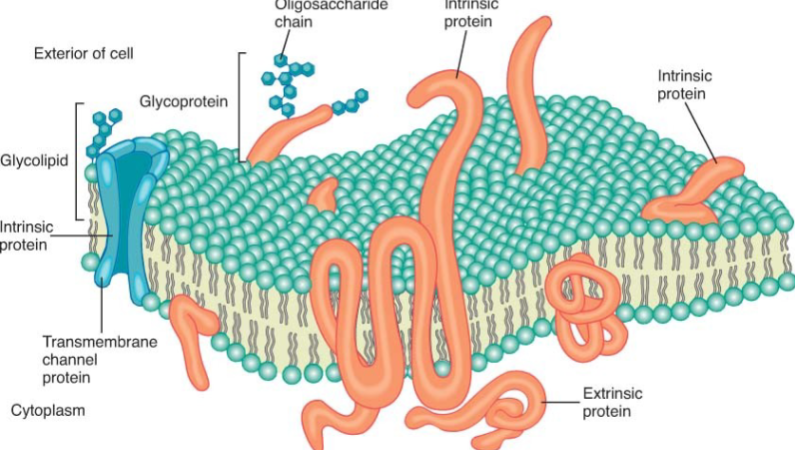
• Biological membranes are composed of proteins and a phospholipid bilayer.
− Intrinsic proteins are at least partially immersed in the lipid bilayer.
− Extrinsic proteins are located outside the membrane.
Membrane Composition (2 of 3) (3 of 3 is the graph below)
• In the fluid mosaic membrane, some proteins diffuse laterally and others are bound to adjacent proteins.
• Oligosaccharides can be bound to intrinsic proteins, converting them into glycoproteins.
Membranes: Properties of Membranes (1 of 3) (2 & 3 of 3 are the graphs below, respectively)
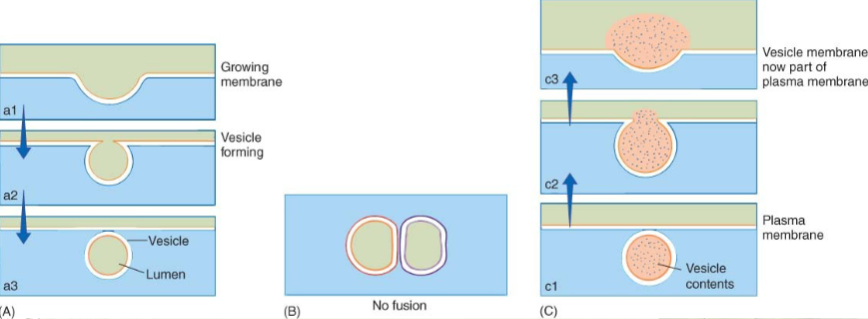
• Growth—additional membrane molecules can be incorporated into existing membranes.
• Transport of material
− Vesicles—membrane “bubbles” that can carry materials with the cytoplasm
− Exocytosis and endocytosis
• Permeability—all biological membranes are selectively permeable.
− Allows for compartmentalization
• Dynamic—constantly changing in response to age and environment
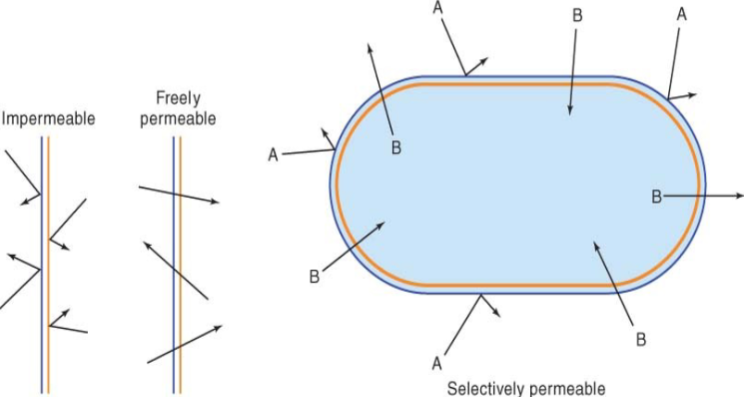
Membrane Permeability
• Membranes are more permeable to hydrophobic substances than anything carrying an electric charge.
• Movement of charged substances is assisted by large intrinsic proteins that span the membrane.
− Facilitated diffusion
• Molecular pumps bind to a molecule on one side of the membrane, change shape, and release the molecule on the other side—requires energy.
− Active transport
Basic Cell Types
• All cells are either prokaryotic or eukaryotic.
• Prokaryotic cells are structurally more simple than eukaryotic cells.
− They are found in domains Bacteria and Archaea.
• Eukaryotic cells contain a membrane-bound nucleus and organelles.
− They are found in plants, animals, fungi, and protists.
Plant Cells: Structures (1 of 2) (2 of 2 is the graph below)
• Protoplasm
− A mass of proteins, lipids, nucleic acids, and water within a cell
− Includes organelles but not the cell wall
• Plasma membrane
− The selectively permeable membrane that covers the protoplasm
− Located inside of the cell wall
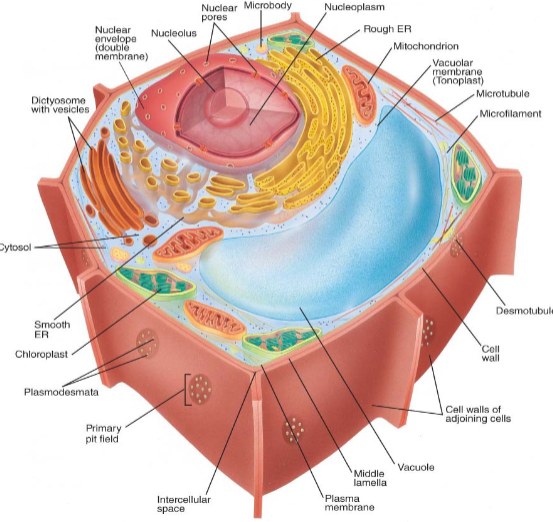
Plant Cell: Nucleus
• The nucleus stores the organism’s genetic information.
• Is surrounded by the nuclear envelope.
− Composed of two membranes: outer and inner membranes.
− Contains small holes called nuclear pores.
• The nucleus holds nucleoplasm, consisting of DNA, enzymes, histone proteins, RNAs, and water.
− Contains nucleoli, where ribosomes are made and partially assembled.
− Occupies up to 50% of the cell volume.
Plant Cell: Central Vacuole
• The central vacuole has a single membrane, the tonoplast.
− Stores water, salts, crystals, starch, protein bodies, and other granules.
− Critical for cell enlargement.
− Recycles monomers by taking in old, impaired organelles and using digestive enzymes to break them down.
Plant Cell: Mitochondria (1 of 2) (2 of 2 is the graph below)
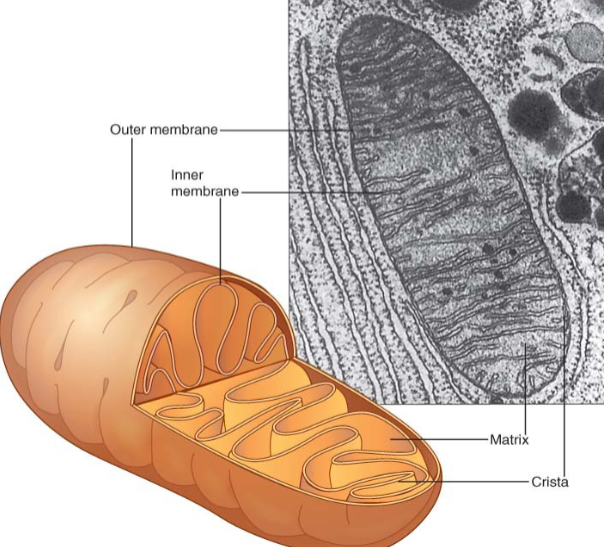
• Mitochondria are the site of cellular respiration.
− Have an outer and inner membrane.
− Inner membrane folds forming cristae increasing surface area.
− Have their own circular DNA resembling that of prokaryotes.
− Can divide or enlarge as needed.
Plant Cell: Plastids
• Plastids have an inner and outer membrane and an inner fluid called the stroma.
− Includes chloroplasts.
− Diverse metabolisms take place in other plastid classes.
− Contain their own circular DNA resembling that of prokaryotes.
Plant Cell: Chloroplasts
• Chloroplasts are responsible for photosynthesis and contain chlorophyll.
− Membrane sheets called thylakoids project into the stroma.
− They can form stacks of vesicles called grana.
Plant Cell: Amyloplasts
• Amyloplasts are starch-storing plastids.
• Occur in non-photosynthetic areas of the plant.
Plant Cell: Other Plastids
• Chromoplasts store bright lipid pigments found in some fruits and flowers.
• Leucoplasts are large, unpigmented plastids involved in fat and lipid synthesis.
• Phytoferritin is a plant protein attached to stored iron that is almost exclusively stored in plastids.
Plant Cell: Ribosomes
• Ribosomes are the site of protein synthesis.
− Occur in the cytoplasm.
− Are aggregates of 3 molecules of ribosomal RNA and ~50 types of protein.
− Bound together by the messenger RNA, forming a cluster called a polysome.
Plant Cell: ER
• Endoplasmic reticulum (ER) is a system of narrow tubes and sheets of membrane within the cytoplasm.
• Important in both manufacture and transport of molecules.
• Two forms:
− Rough (covered with ribosomes)
− Smooth (involved in lipid synthesis and membrane assembly)
Plant Cell: Dictyosomes
• Dictyosomes (you know these as golgi apparatus) are stacks of thin vesicles held together in an array that processes materials to be secreted.
− Have a forming face where ER vesicles accumulate.
− And a maturing face where vesicles are released after the contents are processed.
Plant Cells
• Endomembrane system consists of all the cell membranes except for the inner membranes of mitochondria and plastids.
• Cytosol is the clear substance of the cytoplasm and is composed of water, enzymes, and other chemicals.
Plant Cells: Microbodies
• Microbodies are small, spherical bodies that isolate reactions that produce or use hydrogen peroxide (H2O2).
− Peroxisomes detoxify by-products of photosynthesis.
− Glyoxysomes are involved in converting stored fats into sugars.
Plant Cells: Cytoskeleton (1 of 2)
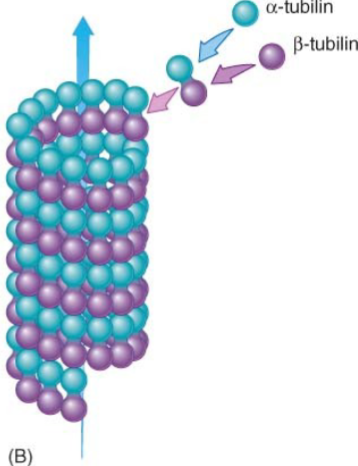
• Microtubules are structural elements of the cell that act as a “cytoskeleton.”
− The means of motility for organelles and whole cells.
− Composed of two types of protein with a globular tertiary structure: alpha-tubulin and beta-tubulin.
− Separate chromatids during cell division.
Plant Cells: Cytoskeleton (2 of 2)
• Microfilaments are another component of the cytoskeleton.
• Assemblies of a globular protein called actin.
− Involved in structure and movement
Plant Cells: Storage Products
• Plants store a variety of products.
− Starch is sometimes converted into lipids and stored as large oil droplets.
− Crystals of calcium oxalate or calcium carbonate.
− Silica, tannins, or phenols.
− Since there is no excretory mechanism, some of these products are simply stored waste.
Plant Cells: Cell Wall (1 of 3)
• Majority of plant cells have cell walls (except some sperm cells).
• Not only provides strength and protection but is also a site of considerable metabolism.
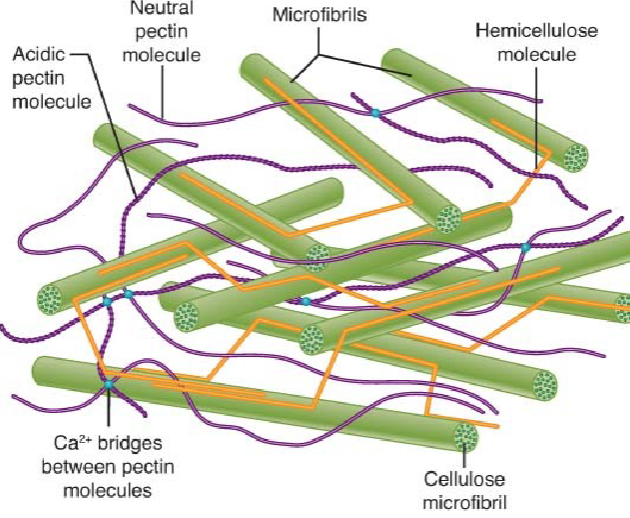
• Primarily composed of
− Cellulose
− Hemicellulose
− Pectins
Plant Cells: Cell Wall (2 of 3)
• Parallel cellulose molecules crystallize into microfibrils, which cover the plasma membrane.
− Cellulose microfibrils are bound together by other polysaccharides called hemicelluloses.
− The wall of one cell is glued to the walls of adjacent cells by the middle lamella composed of pectins.
• Plant cells have a thin primary cell wall.
• Cells requiring more strength may form a secondary, lignified cell wall between the primary wall and the plasma membrane.