Chapter 11 - Photosynthesis (2/16)
Introduction
Definitions:
Phototrophs: can convert solar E → chemical E like ATP/NADPH
Photoheterotrophs: need organic sources (macromolecules) for carbon
Photoautotrophs: need solar E + CO2 to synthesize organic molecules
Overview
Photosynthesis contains the processes
Energy Transduction - (Occurs in the Thylakoid Membrane)
Light is converted to ATP/NADPH
In Oxygenic Phototrophs: H2O is oxidized (split) into Oxygen
Water is used as a e- donor
Carbon Fixation - (Occurs in the Stroma)
Where carbs are formed by CO2 and H2O
(During the Calvin Cycle)
The Rxn’s are light dependent on the E produced from the 1st set of rxn’s (basically needs ATP/NADPH).
Reaction: Light + 6CO2 + 6H2O → C6H12O6 + 6O2
Chloroplasts
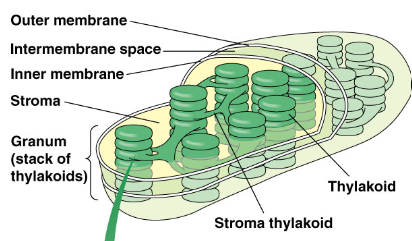
Chloroplast has a Outer and Inner Membrane. The 3rd membrane is called the Thylakoid membrane. Where light reactions take place.
The Chloroplast also includes:
Porins for molecules w/ a MW <5000
Matrix around the Thylakoids called Stroma
Gases like Oxygen and Carbon Dioxide can diffuse across it’s membrane.
First Phase: Energy Transduction - Captures Solar E to convert to Chemical E
Light Energy is a form of Electromagnetic Radiation, Where E in a photon is inversely proportional to the wavelength (shorter wavelength = more E)
In Photosynthesis, Light E is obtained from visible light.
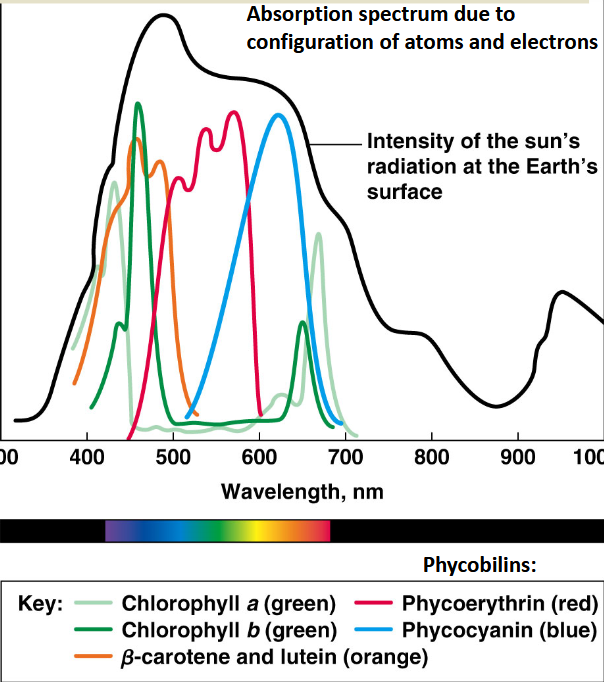
Molecules that absorb E from visible light are called Pigments
Why are Chlorophyll a + b in plants mostly green? They reflect green light instead of absorb it like other colored light.
Pigments have different Abs. rates because they have their own unique configuration of atoms and e-.
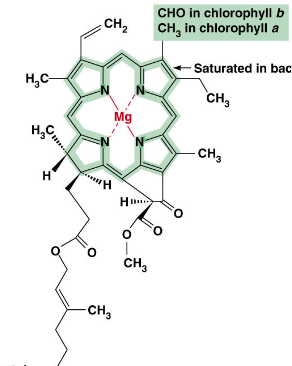
Chlorophyll Structure:
A porphyrin ring attached to a hydrocarbon side chain
Importance: Allows chlorophyll to be embedded in the thylakoid membrane. The ring structure also helps with light E absorption from the sun.
In the Picture Chlorophyll’s a and b share a similar structure.
But, their different Abs. rates causes variations in structure (the R groups)
a has a methyl group CH3
b has a formal group CHO
Main Pigments = Chlorophyll’s; Accessory Pigments = All Others
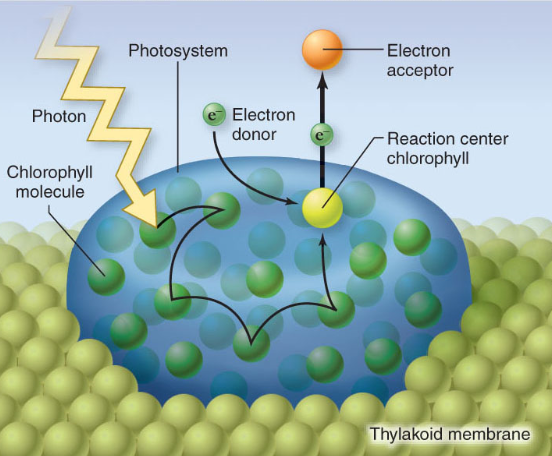
The Photosynthetic Pigments are organized into Photo-systems. This includes:
Chlorophylls
Accessory Pigments
Binding Proteins - not shown, these stabilize/anchor pigments
There’s also…
Antenna Pigments: Captures wavelengths of light. When it’s hit by a photon of a correct wavelength, it causes pigments to undergo photo-excitation (excites e-).
Resonance Transfer: When e- gets excited, it bounces from one chlorophyll molecule to another enter ground state too. This transfers E from one pigment to another
Reaction Center: (Contains 2 Chlorophyll a molecules) Converts Light E → Chem. E because of the transfer of electrons. After “bouncing around” the e- ends up here, where its transferred to the e- acceptor when Chem. E is created.
The Rxn Center is Oxidized
The e- Acceptor is Reduced
the e- is also replaced by another via e- donor. (For Oxygenic Phototrophs, this is H2O)
Photosystem l & Photosystem ll, AKA P700 and P680 ← (Names based on the wavelengths best absorbed by them)
Energy Transduction
(Absorbs light energy w/ pigments to convert it to ATP & NADPH to fix CO2 in the Calvin Cycle)
The Main Players in this Cycle are…
Photosystems ll (P680) and Photosystems l (P700)
Cytochrome b6f complex
ATP Synthase
The Z scheme, AKA noncyclic electron flow: Shows flow of e- from water to NADPH and changes in Reduction Potential.
Overview PSll:
Starts at PSll, excited e- are transferred from the reaction center chlorophyll (P680) → initial e- acceptor: pheophytin →
It’s then reduced to Plastoquinone A → Plastoquinone B →
H+ are pulled from the Stroma become Plastoquinol
The electrons are taken to the Cytochrome b6f complex. as e- are transported to Plastocyanin, H+ are pumped into the lumen.
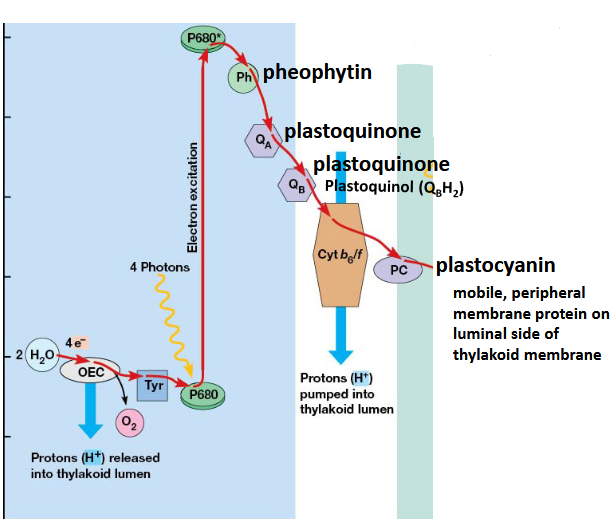
Now the transferred electrons have to be replaced! This can be done by water splitting.
Oxygen Evolving Complex (used by oxygenic phototrophs)
Mn ions facilitate the extraction of the electrons from water (oxidization)
** This splits 2 Water molecules to make 1 Oxygen molecule
Cytochrome b6f complex
This acts as a ETC.
Protons are also pumped into lumen, which creates steep proton gradients → used to drive ATP synthesis via ATP Synthase
MAIN IDEA: Photosystem ll is associated with the making of ATP. Gets electrons transferred in noncyclic flow to the c-b6f-complex, so protons can be pumped into lumen to make proton gradient in order to drive ATP synthesis.
Overview PSl:
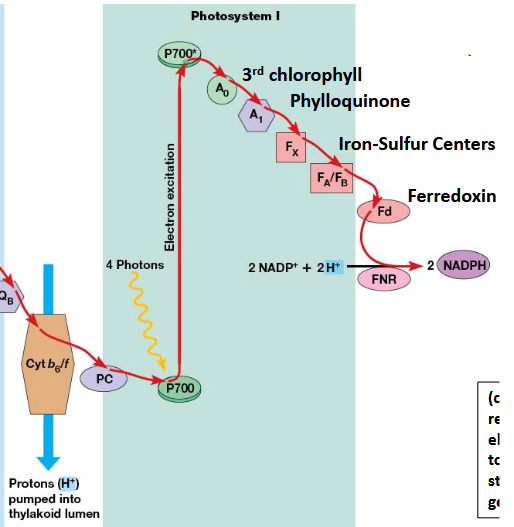
From PC to the PSl (P700) reaction center, electrons get excited again →
Transferred from ETC to Ferredoxin: This reduces NAD+ to NADPH (this is catalyzed by ferredoxin-NADP+-reductase)
The lost electrons soon get replaced via Plastocyanin
MAIN IDEA: Photosystem l is associated with the making of NADPH
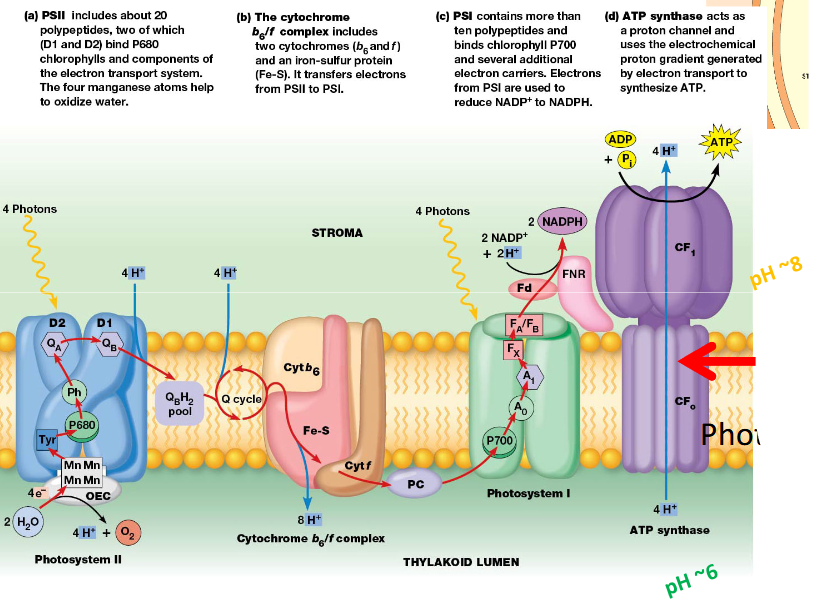
With c-b6f-complex, the proton gradient of the lumen becomes more Acidic than the stroma.
This helps generate ATP through ATP Synthase used to drive Carbon Fixation.
It takes 14 protons to make 3 ATP’s (through photophosorylation)
1 run through the cycle makes 2 ATP and 2 NADPH’s from the Noncyclic flow
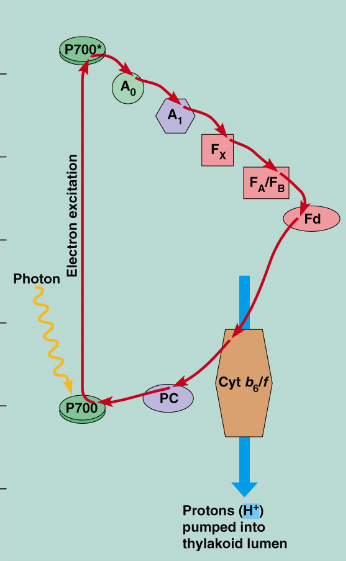
Cyclic electron Flow:
Another way to make additional ATP and can also occur when NADPH consumption is low.
PSl’s excited electrons goes through ETC → Ferredoxin → Back to c-b6f-complex → Plastocyanin which takes it back to reaction center P700. The cycle then repeats.
Carbon Fixation - Calvin Cycle
(Occurs in the Stroma, incorporates CO2 to organic molecules)
Consists of 3 phases…
Carbon Fixation
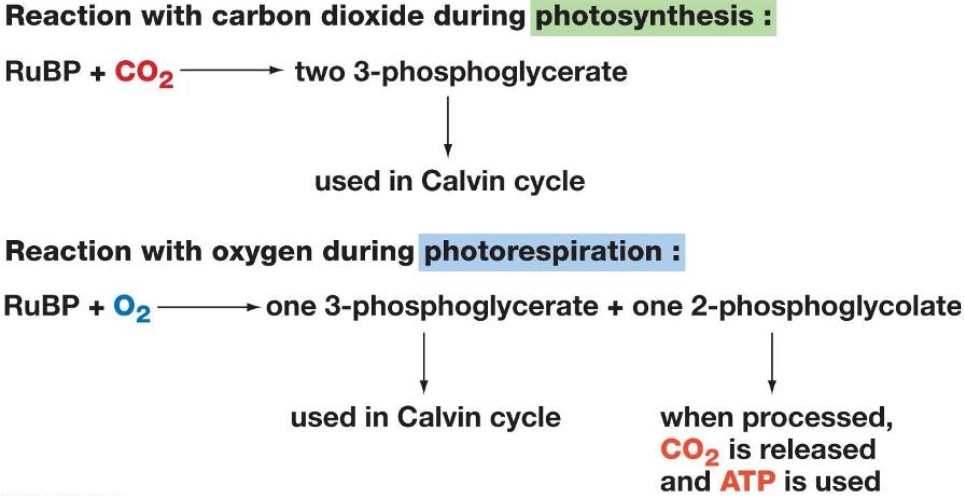
CO2 is added to Ribulose-1,5- bisphosphate to make two 3-phosphoglycerate molecules
(Catalyzed by Rubisco)
Reduction
3-phosphoglycerates are phosphorylated by ATP and reduced by NADPH to make glyceraldehyde 3-phosphate.
Regeneration
For every 1/6 G3P that leaves, the remaining is used to regenerate RuBP.
Carbon Fixation
1st rxn: CO2 is added to RuBP, which is catalyzed by Rubisco
for 1 CO2 added = 2 3-phosphoglycerate molecules.
Reduction
3-phosphoglyerate is converted to glyceraldehyde 3-phosphate with the help of ATP and NADPH.
Regeneration
For the 6 G3P’s made, 1 of them leaves to synthesize sugars.
The remaining is used to regenerate RuBP, which req. ATP
Fate of the Sugar (when the 1 G3P leaves)
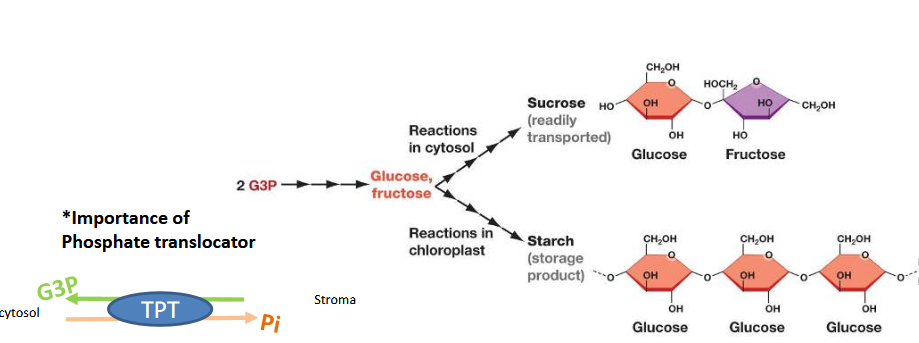
The glyceraldehyde 3-phosphate can be used to make glucose or fructose, which combine to make sucrose (a disaccharide)
This is used in plants to transport sugars to parts of plant that need it. (this process occurs in the cytosol)
Transport Protein: Triose Phosphate trans-locator
Helps move G3P out of chloroplast stroma into the cytosol, while inorganic phosphate moves into the stroma
In rapidly photosynthesizing cells where sucrose is abundant, glucose is made and then temporarily stored in chloroplast as starch
Starch is broken down at night to make more sucrose for transport throughout the plant.
Photorespiration
Rubisco - Ribulose Bisphosphate carboxylase/oxygenase
This can also bind to O2 at the active site.
if CO2 binds to Rubisco → it makes 3-phosphoglyerate
if O2 binds to Rubisco → 1 3-phosphoglyerate and 1 2-phosphoglycerate (which is toxic to plants)
When this occurs, the rate of photosynthesis decreases by a lot. Rubisco has a higher affinity to CO2 than O2.
Process of Photorespiration (Glycolytic Pathway)
Occurs in Chloroplast → Peroxisome → Mitochondrion
Phosphoglycolate gets de-phosphorylated into Glycolate →
This enters the Peroxisome and is processed into Glycine
Glycine goes into the mitochondrion to undergo decarboxylation and also reduces NAD+
Glycine is converted into Serine, this goes back to the peroxisome → chloroplasts where it becomes Glycerate →
This is phosphorylated by the hydrolysis of ATP to get 3-phosphoglycerate
Then it continues going to the Calvin Cycle
This process helps recover about 75% of reduced carbon to be used in the Calvin Cycle.
Avoiding Photorespiration
When CO2 levels are low and O2 levels are high, this causes Photorespiration. Rubisco binds to O2
This happens in hot & dry conditions, when the plants close their stomata to combat dehydration.
This cuts off CO2 airflow, leading to an abundance of O2 through water-splitting
C3 plants: These plants have no strategy for avoiding Photorespiration so they must undergo that process.
C4 plants: Confines Rubisco to cells that have high CO2 (Hatch-slack cycle)
Has 2 cycles that are separate into different cycles in the Mesophyll cells and the Bundle Sheath cells.
C4 plants separate initial carbon fixation from the Calvin Cycle.
In the Mesophyll, initial carbon fixation isn’t catalyzed by Rubisco, but by PEP carboxylase.
When CO2 is added to PEP at the active site, it forms 4C Oxaloacetate (doesn’t bind to O2 at active site)
Oxaloacetate → Malate
Malate is transported to the Bundle Sheath cells, where it undergoes Decarboxylation (this is where the Calvin Cycle takes place)→
This turns Malate into Pyruvate →
Transferred to the Mesophyll cells to be converted back into PEP
CAM Plants: minimizes Photorespiration and water loss; Only fixes CO2 at night so stomata can open and CO2 can come in.
PEP → Oxaloacetate → Malate (then stored in vacuoles at night)
In anytime, when stomata are closed → Malate is released from vacuoles and decarboxylated to raise CO2 levels, so it can be used by Rubisco in the Calvin Cycle.