Study Notes: Illness and Injury Prevention in Nursing Practice
Illness and Injury Prevention in Nursing Practice
Nurses experience both physical and psychologic demands throughout shifts. Pressures include workforce downsizing, longer hours, fast work pace, higher patient acuity, more older patients, environmental complexity, extended workloads, an aging nursing workforce, potential for violence, and chemical exposures.
These factors can contribute to acute or long-term health problems such as musculoskeletal injuries and disorders, infections, mental health changes, insufficient sleep patterns, and chronic exhaustion (AHRQ, 2020b).
Occupational hazards exist across all healthcare settings (acute care, extended-care, community-based facilities, and home environments) and pose risks such as exposure to infectious diseases and injuries or accidents.
In 2018, healthcare and social assistance workers accounted for cases of nonfatal occupational injuries and illnesses (BLS, 2019).
To create safer work environments and prevent illness and injury in nursing practice, the focus should be on awareness of potential safety hazards and solutions.
Infection prevention basics:
Simple measures such as hand hygiene and sanitation protocols help minimize illness exposure.
Nurses care for patients with diagnosed or undiagnosed infectious diseases such as influenza, norovirus, methicillin-resistant Staphylococcus aureus (MRSA), tuberculosis, HIV, and COVID-19 (RegisteredNursing.org, 2019).
Vaccines protect against some pathogens; employer-provided vaccination programs are encouraged.
The CDC provides comprehensive infection control recommendations that include standard, contact, and airborne precautions for all patient-care settings.
Healthcare facilities and organizations that provide home healthcare services have policies and procedures addressing safety infection control measures.
Guidelines for preventing transmission of infectious pathogens through PPE use are available.
Proper use of respirators by nurses and other healthcare workers is a key preventive practice.
Strategies for illness prevention:
Perform frequent and complete hand hygiene.
Don PPE following CDC guidelines whenever applicable.
When working with a patient on isolation precautions, call for assistance as needed.
Avoid touching the nose, eyes, and mouth.
Engage in self-care to keep the immune system healthy: appropriate diet, sleep, relaxation, and activity.
If you begin to feel sick at work, go home as soon as appropriate; if feeling sick at home, stay home.
Vigilance in preventing injuries and illness extends to the workplace environment, nursing practice, and personal safety.
Healthcare facilities have policies for preventing injuries and maintaining a safe work environment.
Safe practice and protocols can sustain a nurse’s well-being when dealing with infectious agents, needles, latex, chemical exposure, and patient handling.
Infectious Diseases and Infection Control (Overview)
Nurses care for patients with infectious diseases; infection control relies on standard, contact, and airborne precautions as applicable.
PPE use is a core preventive measure; vaccines are available and recommended through employer programs.
Home healthcare settings follow infection control policies tailored to home environments.
Needlestick and Sharps Injuries
Needlestick and sharps injuries are a large and growing problem in healthcare. Roughly exposures occur every day in U.S. hospitals.
Approximately pathogens (viruses, bacteria, fungi, or parasites) can be transmitted via needles.
The CDC notes that over half of all sharps injuries are not reported in required reporting systems, including injuries to healthcare personnel, laboratory staff, and housekeeping.
The STOP STICKS campaign (NIOSH) raises awareness of bloodborne pathogen risks, with resources for exposure prevention, equipment evaluation, and sharps-disposal container requirements (CDC, 2019k).
In 2018, nurses incurred of injuries from reported needlesticks (Grimmond, 2020).
Precautions when handling used/contaminated sharps:
Never recap needles after use unless absolutely necessary by protocol; dispose in appropriate sharps containers.
Sharps disposal containers must be puncture-resistant and leakproof on the bottom and sides.
If recapping is necessary, use the scoop method or a device (e.g., hemostat) to avoid injuries.
Do not recap by holding the cap in one hand while guiding the needle with the other.
Common causes of needlestick injuries include:
Not using proper disposal techniques, or failure to recap
Bumping into an uncapped/sharp needle
Contact with a used scalpel
(CDC, 2019k)
Chemical Exposure
Nurses may be exposed to high levels of chemicals used in sterilizing, pest control, and volatile organic compounds such as formaldehyde, as well as pharmaceuticals like antineoplastics.
These substances can be encountered as gases, aerosols, or skin contaminants and can be absorbed via lungs or skin.
Exposure may be a one-time event or occur over time.
Some chemicals are regulated for exposure limits; handling requires precautionary measures, though many common chemicals can cause injury or illness if spilled or ignited (OSHA, 2020a).
Safe Patient Handling
The Nurse and Healthcare Worker Protection Act of 2015 was proposed to reduce injuries to nurses and healthcare workers and patients.
The act promotes the use of mechanical devices to lift/move patients unless unsafe or contraindicated, helping to prevent musculoskeletal injuries for nurses and other workers.
Safe patient handling practices enhance patient safety as well as nurse safety.
Tools and equipment supporting safe handling include:
Height-adjustable electric beds
Mobile mechanical and ceiling-mounted patient lifts
Antifriction devices
Band transfer aids
Bed or chair repositioning devices
Training on safe patient handling is extensive and available via the Association of Safe Patient Handling Professionals (ASPHP) website (www.asphp.org).
See Figure 51.12 for illustrative equipment and concepts.
Workplace Violence Protection
Workplace violence is defined by NIOSH as any physical assault, threatening behavior, or verbal abuse occurring in the work setting (CDC, 2019f).
Nurses and healthcare workers are at particular risk from violence, which can originate from patients, families, or visitors due to inadequate security, unrestricted access within facilities, interpersonal conflicts, or coworker bullying.
Potential injuries include scratches, hits, kicks, beatings, bites, and threats with weapons (knives, guns).
Prevention strategies:
Keep hair tucked away; use breakaway lanyards
Be aware of surroundings; note changes in environment
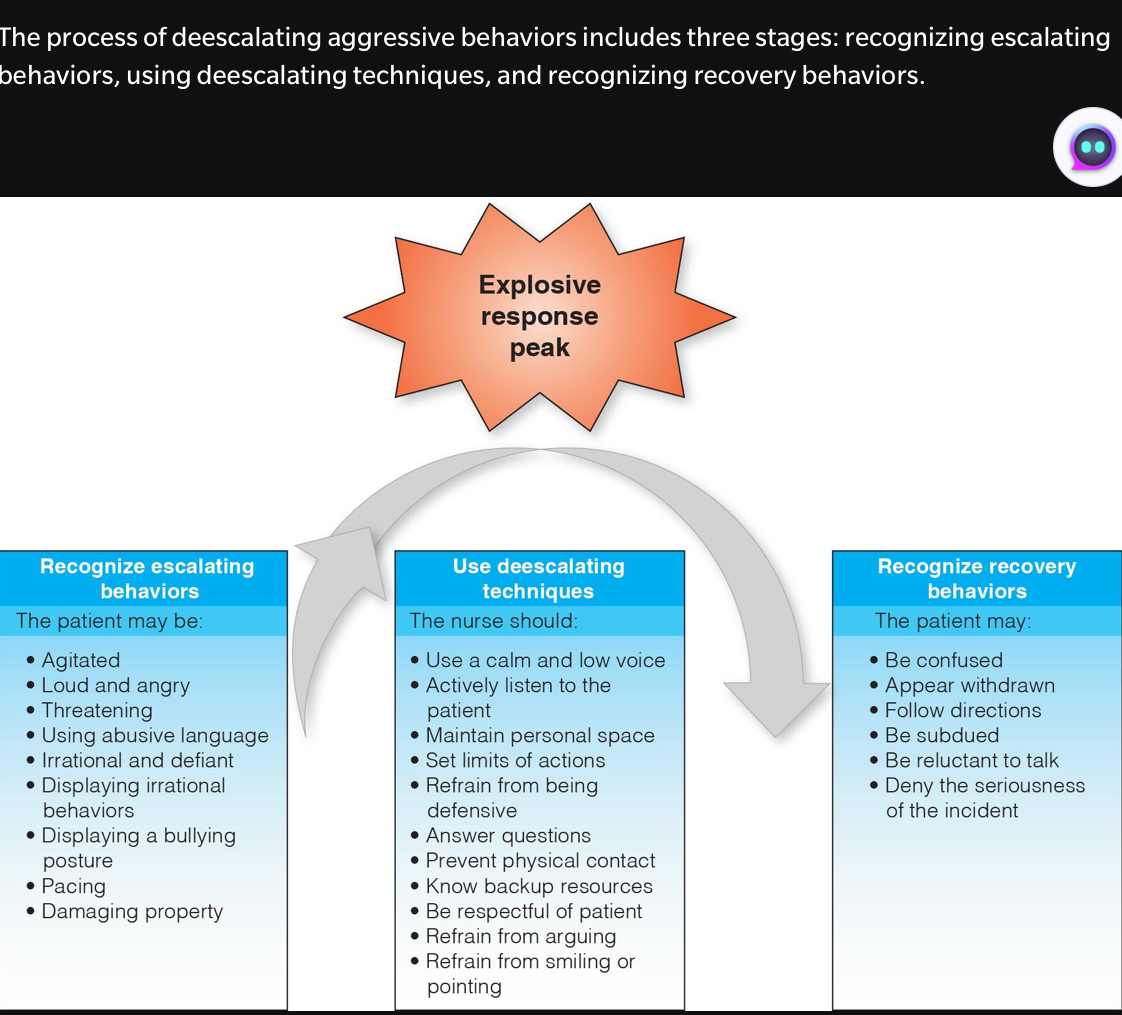
Monitor verbal and nonverbal cues signaling agitation or anger
Watch for inappropriate abusive language or behaviors from coworkers; observe signs of acute emotional upset
Some facilities offer training in managing aggressive behaviors (Figure 51.13)
Policy and legislation:
Many states have enacted laws addressing workplace violence, increasing penalties for attackers and requiring employer training
NIOSH collects data on violence against nurses to inform training programs and policy development (CDC, 2019f)
Mental Health Safety and Self-Care
Caring for others is central to nursing but contributes to stress; prolonged work stress can lead to fatigue, distress, burnout, or compassion fatigue.
Compassion fatigue reduces job satisfaction and engagement, and can impair performance and patient interactions.
Self-care for nurses includes:
Recognizing stressors and adopting coping strategies
Maintaining a healthy lifestyle, healthy coping mechanisms, and strong support networks
Learning to say no when appropriate to limit extra demands
Modules and resources referenced: Module 35, Caring Interventions (self-care information).
Healthcare facilities can support nurses by:
Reducing nurse-patient ratios to alleviate workload and improve patient outcomes
Boosting morale through recognition and incentives for safety improvements
Implementing debriefing teams after psychologically stressful events
Providing employee assistance programs to address compassion fatigue
When nurses are supported and refreshed, they can provide safe, effective, and high-quality care.
Workplace Policies, Training, and Support
Organizations should invest in policies that sustain nurse well-being and safety, including training on safe practices and violence prevention, access to counseling, and opportunities for rest and recovery.
Substance Abuse and Safety
Impaired nurses (under the influence of alcohol or drugs) are unable to perform procedures, make accurate clinical judgments, or ensure patient safety.
Nursing boards maintain substance abuse policies, treatment options, rehabilitation programs, peer support, license status guidelines, and return-to-work conditions.
There can be legal involvement by federal agencies if controlled narcotics are diverted, used, or sold.
Employee assistance programs support recovery and rehabilitation; addiction is treatable, but relapse can occur (refer to Module 22, Addiction).
Home Healthcare: Safety Hazards and Training
Home healthcare presents similar hazards as facilities (bloodborne pathogens, needlesticks, latex exposure, chemical exposure, patient handling) plus unique risks (hostile animals, unhygienic/dangerous surroundings, and travel).
OSHA provides safety resources for healthcare workers online.
Safety measures begin with a home safety assessment as part of discharge planning and patient/family education to create a safe environment.
Ongoing safety training for home health nurses should include:
Personal protection maneuvers
Prevention of infectious disease spread
Needlestick safety
Minimizing latex allergy reactions
Chemical exposure prevention
Prevention of musculoskeletal injuries
Practical Home Visit Safety Steps
Common steps to maintain safety for the home health nurse include:
Be aware of immediate surroundings
Use GPS or maps to confirm addresses
Schedule home visits during daylight hours if possible
Park in a well-lit area with minimal shrubs nearby
Avoid leaving supplies or personal belongings on carpeted floors; keep items secured
Use mechanical devices to assist lifting/moving when available
Use nonlatex gloves and hand sanitizer
Never leave supplies visible in the car; lock doors
Carry extra PPE supplies in the car
If an unrestrained animal poses a threat, wait outside the door until the animal is restrained
Take only necessary equipment into the home
Anticipate homes that may lack cooling or heating and dress accordingly
Key Resources and Campaigns
CDC infection control guidelines: standard, contact, airborne precautions
NIOSH STOP STICKS campaign: exposure prevention resources and sharps disposal guidance
OSHA safety materials for home healthcare
ASPHP resources on safe patient handling