NERVE CELLS & NERVE IMPULSES: (WK1):
CELLS OF THE NS:
comprised of two types: 1) neurons 2) glia
human brain contains approx 100 billion individual neurons
behaviour depends on the communication between neurons
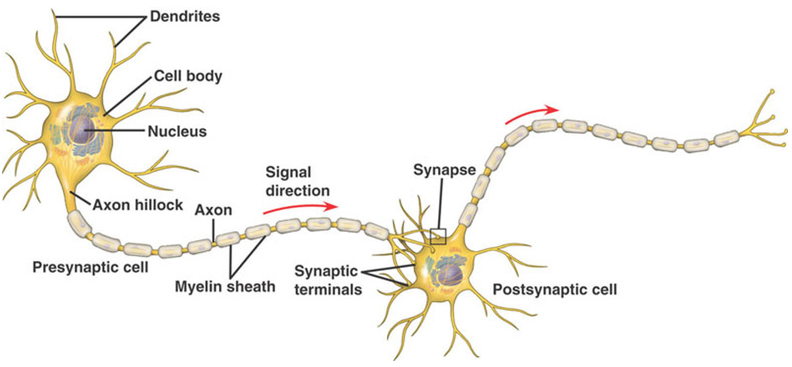
three subdivisions:
dendrites (gather info from other neurons)
cell body or soma (core region, contains nucleus & integrates the information)
axon (carries info to be passed onto other cells)
TYPES OF NEURONS:
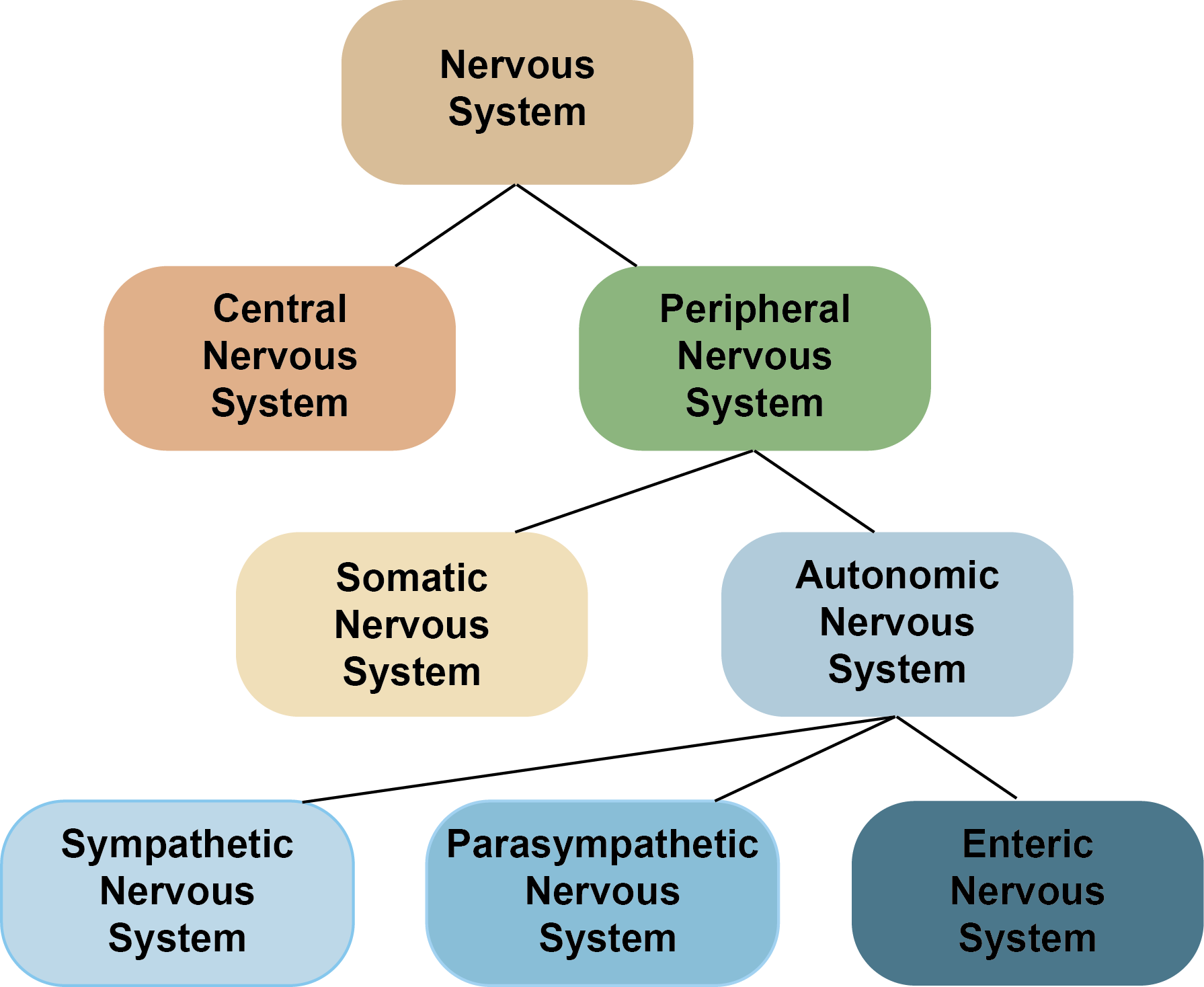
sensory neurons
brings info to the CNS
interneurons (association neurons)
associate sensory and motor neurons activity within the CNS
motor neurons
sends signals from the brain and spinal cord to muscles
EXCITATION AND INHIBITION:
each neuron receives thousands of excitatory and inhibitory signals every second
neurons ‘sum’ these signals and respond accordingly: 1 or 0
1 = sending message to downstream neurons
0 = not sending any messages downstream
EQUILIBRIUM:
efflux of chloride ions down the chloride concentration gradient is counteracted by the influx (inward flow) of chloride ions down the chloride voltage gradient
equilibrium is reached when the concentration gradient of chloride ions is balanced by the voltage gradient of chloride/sodium ions
equilibrium = no NET movement
RESTING MEMBRANE POTENTIAL:
electrical charge across the cell membrane in the absence of stimulation
a store of negative energy on the intracellular side relative to the extracellular side
the inside of the membrane at rest is -70 millivolts relative to the extracellular
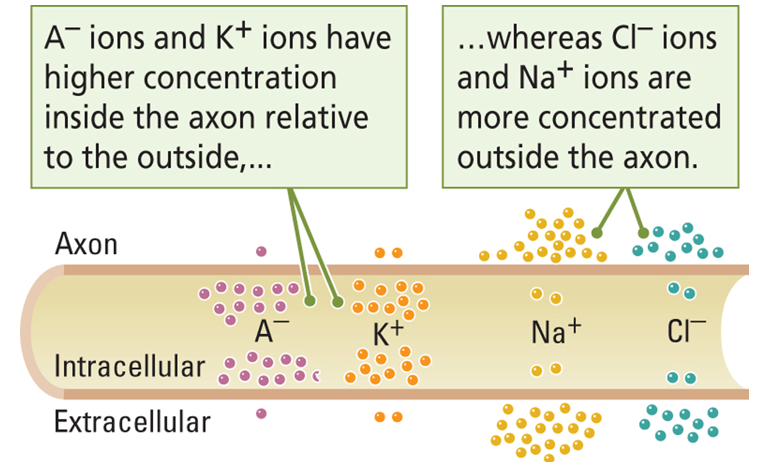
four charged particles take part in producing the resting potential
sodium (Na+) and chloride (Cl-)
higher concentration outside cell
potassium (K+) and large proteins (A-)
higher concentration inside cells
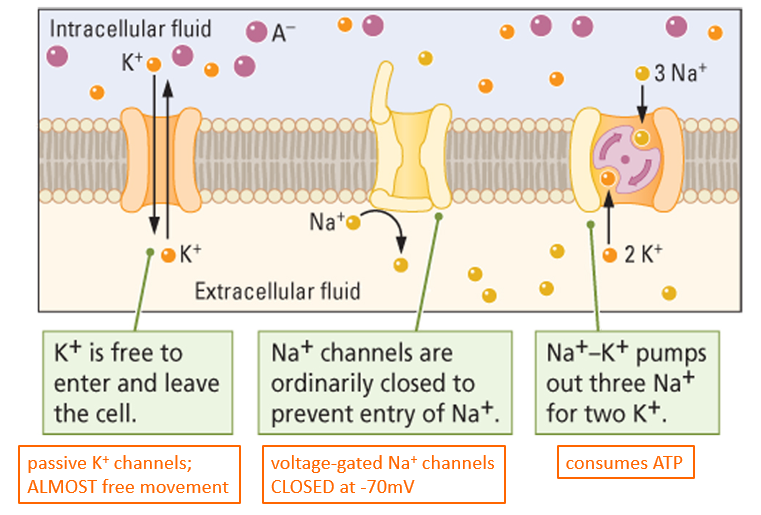
resting is NOT no-moving
large A- molecules cannot leave cell - making the inside negative
passive K+ channels allow K+ to move into and out of cell more freely but sodium channels keep out Na+ ions
Na+-K+ pumps extrude Na+ from intracellular fluid and inject K+
HOW NEURONS INTEGRATE INFORMATION:
graded potential:
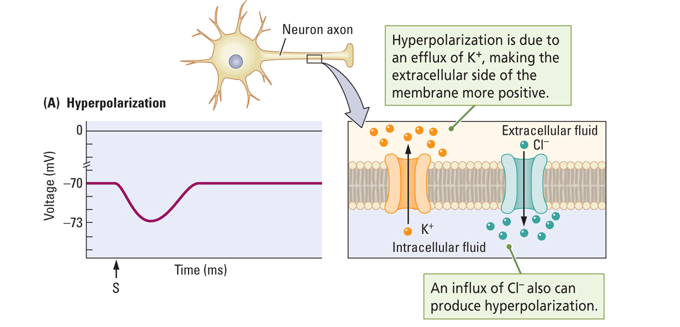
hyperpolarisation
increase in electrical charge across a membrane (more negative)
due to inward flow of chloride ions of outward slow of potassium ions
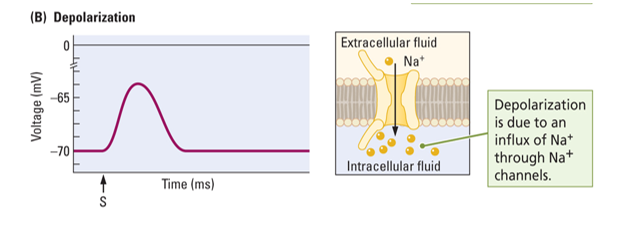
depolarisation
decrease in electrical charge across a membrane (more positive)
due to inward slow of sodium
GRADED POTENTIAL:
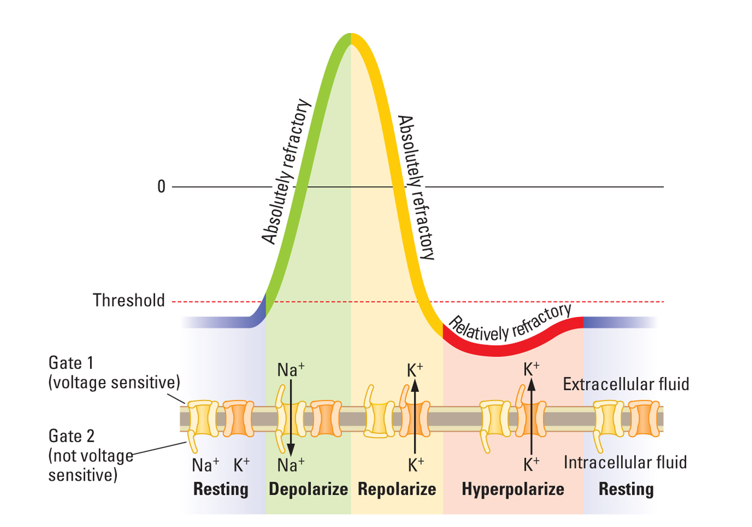
ACTION POTENTIAL:
action potential
large, brief reversal in polarity of an axon
lasts approx 1 millisecond
threshold potential
voltage on a neural membrane at which an action potential is triggered
opening of Na+ and K+ voltage-sensitive channels
approx -40 mV relative to extracellular surround