Gen Psych Mod 8 Memory Notes
POWERPOINT NOTES
MEMORY
Studying memory makes us ask these question:
How do we process & store information?
Are there different types of memory?
How do we retrieve memories?
Why do we forget things?
HOW MEMORY FUNCTIONS
Memory is an info processing system & is similar to a computer. It’s a set of processes used to encode, store, & retrieve info over different periods of time.
Encoding: inputting info into memory system
Storage: retaining the encoded info
Retrieval: getting info out of memory & back into awareness (so I guess consciously retrieving memory & thinking about it, like if you were having a convo about an event from last week)
ENCODING
When the brain gets info from the environment, it:
Labels/codes it
organizes it w/other similar info
connects new concepts to existing concepts
Encoding goes through 2 types of processes:
Automatic processing - encoding details like time, space, frequency, & the meaning of words. Usually done w/out conscious awareness, like remembering WHEN you last studied.
Effortful processing - encoding of details that takes time & effort, like WHAT you last studied, learning new skills.
TYPES OF ENCODING
Semantic encoding - encoding words & their meanings.
Most effective form of encoding. Attaching meaning to info makes it easier to recall later
Involes a deeper sense of processing
Visual encoding - encoding images
Words that evoke a mental image (like dog or car) are easier to remember than more abstract words (like truth or level).
Acoustic encoding- encoding sounds
Self-reference effect - the tendency of an individual to have better memory for information relating to themself than to material that is less personal/relevant to them.
STORAGE: BADDLEY & HITCH MODEL
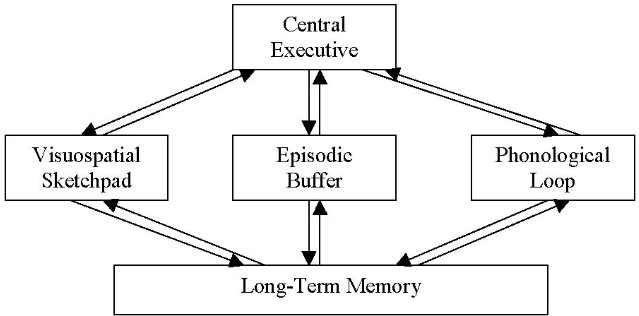
Baddley & Hitch proposed a model that said there are different types of short-form memory & storage depending on the type of info received.
storing info is like opening folders on a computer & adding info/data to them
3 Short-Term Systems:
Visuospatial sketchpad
Episodic buffer
Phonological loop
The model says a “Central Executive” supervises the flow of info between systems.
STORAGE: A-S Model
Storage makes permanent record of info.
Atkinson-Shiffrin Model of Memory
Info passes through 3 stages before making it to long-term memory
The model is based on the idea that memory is very similar to how computers process memory
SENSORY MEMORY
Sensory memory - storage of brief sensory events, like sights, sounds, & tastes
It’s stored for only a couple of seconds
It’s the 1st step of processing stimuli from the environment
If the info isn’t important, it’s discarded
If the info is valuable, it’s moved to short-term memory
SHORT-TERM MEMORY (STM)
Short-term/working memory - temporary storage system that processes incoming sensory memory
lasts about 20 sec
Capacity is usually about 7 items, give or take 2 (discovered by George Miller)
Short-term memories are either discarded or put into long-term memory.
Memory consolidation - transferring STM (short-term memory) to long-term memory
This can be done through rehearsal: consciously repeating info to remember it
LONG-TERM MEMORY
LTM is the continous storage of info
It is UNLIMITED & is like info you download on a hard drive
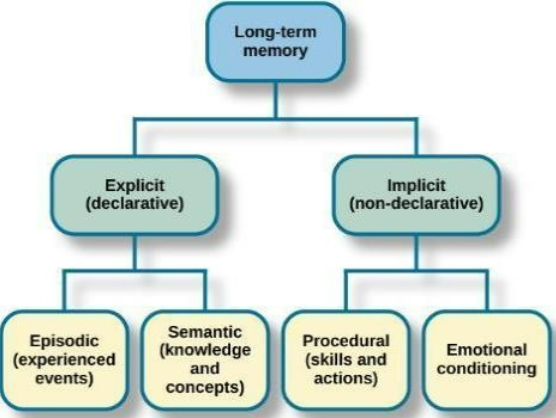
There are 2 main components: explicit & implicit.
LTM: EXPLICIT MEMORY
Explicit (declarative) memory: memories of facts & events we can consciously remember & recall/declare.
Include 2 types: Semantic & Episodic
Semantic: knowing words, concepts, & language.
Ex: knowing who the President is
Episodic: info about events we personally experienced.
Ex: remembering your bday, or the what, when, & where of an event.
Also called autobiographical memory
A small number of ppl (including actress Marilu Henner) have a highly superior autobiographical memory called hyperthymesia. (I think this is the one where you can remember every event of your life, including your birth.)
LTM: IMPLICIT MEMORIES
Implicit memory: memories that aren’t part of our consciousness
formed through behaviors
Procedural: stores info about how to do things
skills & actions
Ex: how to ride you bike, tie your shoes, or drive
Implicit memory also includes behaviors learned through emotional conditioning.
You might have a fear of spiders but not remember why you were conditioned to fear them or what happened to cause that conditioning.
RETRIEVAL
How do you get info back out of storage?
Retrieval - getting info out of storage & back into conscious awareness
Needed for everyday functioning, like knowing how to drive or how to do your job once you get there.
3 ways to retrieve info:
Recall - accessing info without cues (used for an essay test)
Recognition - being able to identify info that you’ve previously learned after encountering it again (used for a multiple choice test)
Relearning - learning info you’ve already learned
PARTS OF THE BRAIN INVOLVED IN MEMORY
Karl Lashley & Engrams
Lashley looked for evidence of engrams - groups of neurons that are the “physical representation of memory.”
He studied parts of the brain involved in memory-making by making lesions (changes/damage) in animal brains (rats, monkeys)
He trained rats to find their way through a maze, then made brain lesions to see if that would affect their memory.
The rats still remembered their way. It didn’t provide evidence of engrams, so he made a new hypothesis:
Equipotentiality hypothesis: if one part of the brain involved in memory-making is damaged, then another part of the brain can take on that job for it.
Eric Kandel - studied the synapse & its role in controlling info flow through neural circuits needed to store memories.
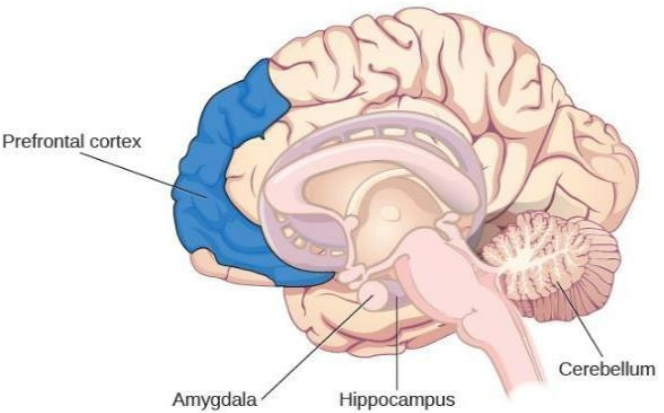
These parts of the brain are involved in memory:
DESCRIPTIONS OF PARTS OF THE BRAIN INVOLVED IN MEMORY
Amygdala
involved in fear & memories (memory storage is affected by stress hormones)
Hippocampus
Associated with explicit, spatial, & recognition memory
Process info to cortical regions that give memories meaning & connect them w/other memories
involved in memory consolidation
if it’s damaged, you can’t make new memories
*Patient H.M.
He had both temporal lobes (including hippocampus) removed to stop his seizures
He couldn’t make new memories & forgot lots of his old memories too.
Cerebellum
helps process procedural memories, like how to play the piano & classical conditioning
if it’s damaged, you can’t do classical conditioning, like the eye-blink response to air being blown in your eyes.
Prefrontal cortex
looks like it’s involved in remembering semantic tasks
Encoding = left frontal activity
Retrieval of info = right frontal region
NEUROTRANSMITTERS
Communication between neurons via neurotransmitters is KEY to forming new memories.
The more often this communication happens, the more these connections are made, & the stronger & more long-term the memory becomes.
Neurotransmitters involved in memory:
Epinephrine
Dopamine
Serotonine
Glutamete
Acetylcholine
Arousal Theory - strong emotions form strong memories; weak emotions form weak memories
FLASH-BULB MEMORY
Flash-bulb memory - a record of an unusual event that has very strong emotional associations
Some flash-bulb memories can act as generational reference point, like:
The assassinations of MLK Jr, JFK, Malcolm X, Robert Kennedy
The first humans landing on the Moon
9/11
They can depend on cultural reference & personal involvement
A national leader suddenly resigning could become a flashbulb memory for JUST those citizens
An athlete suddenly retiring could become a flashbulb memory for JUST fans of that sport/team/player
9/11 is the most recent flashbulb memory extensively researched.
AMNESIA
Amnesia: losing long-term memory due to disease or physiological/psyhological trauma.
There are 2 common types:
Anterograde amnesia: unable to learn new info after trauma
commonly caused by brain trauma
Hippocampus is usually affected - means info can’t be transferred from STM to LTM
Retrograde amnesia: losing memory (whether partial or complete) for events that happened before trauma

MEMORY CONSTRUCTION & RECONSTRUCTION
Construction: forming new memories
Reconstruction: bringing up old memories
When we retrieve memories, we often unintentionally alter/modify them, causing them to be inaccurate & distorted.
Suggestibility: the effects of misinformation from external sources that leads to making false memories
This can make people remember something that was only suggested & didn’t happen
Memories are fragile, so they’re susceptible to suggestion
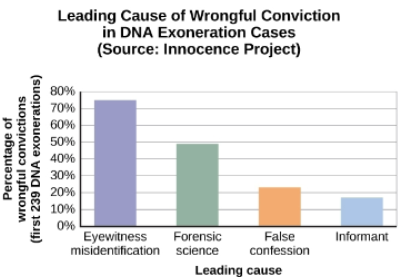
An important area of study has been the role of suggestibility in eyewitness testimonies.
EYEWITNESS MISIDENTIFICATION
Studies show that suggestive police identification can alter eyewitnesses’ memories & cause them to misidentify someone.
THE MISINFORMATION EFFECT
Elizabeth Loftus
studied false memories
Misinformation effect paradigm - a person might misremember something after being exposed to wrong info
Study (1974)
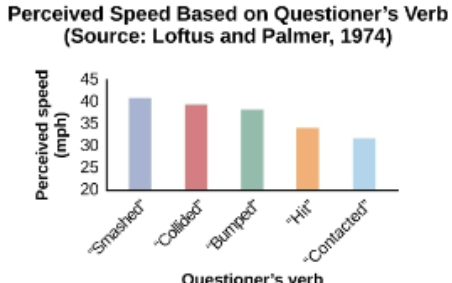
A study with college students was done. Students were asked to watch videos of cars moving & later say about how fast they were moving.
Students who heard the word “smashed” estimated the cars were going faster than people who heard the word “contacted” did.
Also, people who heard the word “glass” had the false memory of seeing glass.
REPRESSED & RECOVERED MEMORIES
There’s a controversial theory that says memories/events can be repressed or falsely recalled/remembered.
False memory syndrome: recalling false autobiographical memories
Repressed memories:
Some psychologists believe it is very possible to completely repress traumatic childhood events, like abuse.
This can lead to psychological distress in adulthood
Some psychologists think that through hypnosis or guided imagery, these memories can be recalled.
WHY DO WE FORGET?
Forgetting - loss of info from LTM
Encoding Failure
This happens when the memory (info? Typo?) doesn’t get stored into memory.
Successful encoding takes effort & attention.
MEMORY ERRORS
Schachter’s 7 Sins of Memory:
(Forgetting Type)
Transcience - accessibility of memories worsens over time (storage decay)
Absentmindedness - forgetting caused by lapses in attention
Blocking - temporarily blocking accesibility of info (the tip-of-the-tongue situation)
(Distortion Type)
Misattribution - source of memory is confused
Suggestibility- false memories
Bias - memories distorted by current belief system
(Intrusion Type)
Persistence - unable to forget undesirable memories
TRANSCIENCE/STORAGE DECAY
Over time, unused info fades away
Ebbinghaus (1885)
Studied memorization process
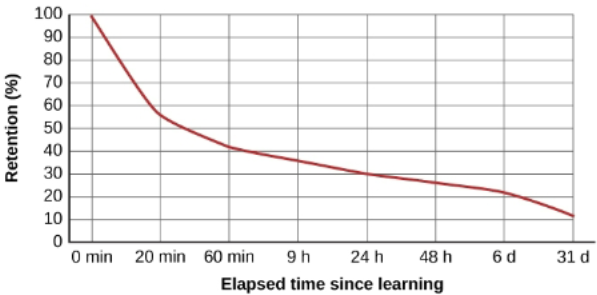
The Ebbinghaus forgetting curve shows how quickly memory for new info decays
50% after 20 minutes
70% after 24 hrs
BIAS
Schachter says your feelings & view of the world can distort your memory of past events.
Stereotypical bias - involves racial & gender biases
Ex: a group of people in a study might more frequently incorrectly remember African American names being associated with the job of being a basketball player, & they might associate white names more with a politician.
Egocentric bias - enhancing our memories of the past
people remember events in a way that makes them look better
Hindsight bias - tending to think an outcome was inevitable after it happened
Thinking you knew it all along
PERSISTENCE
Many soldiers involuntarily recall horrible, unwanted memories
INTERFERENCE
WAYS TO ENHANCE MEMORY
Rehearsal - consciously repeating info to remember it
Chunking - organizing bits of info to make it more manageable
Ex: how phone numbers are in 3 chunks
Elaborative rehearsal - technique where you think about new info’ s meaning & rleate it to info already stored in your memory
Mnemonic devices - memory aids that help us organize info for encoding
Ex: ROY-G-BIV, alphabet song (?), etc
HOW TO STUDY EFFECTIVELY
Memory techniques are helpful when studying for class
Use elaborative rehearsal - link new info to old info to make it more meaningful & rememberable
Apply the self-reference effect - make info personally meanigful to YOU
Don’ t forget the forgetting curve - keep studying to prevent storage decay
Rehearse
Be aware of interference (study w/out distractions)
Keep moving (blood flow helps the brain & memory)
Get enough sleep (the brain consolidaed memories during sleep)
Use mnemonic devices
VOCAB
absentmindedness
lapses in memory that are caused by breaks in attention or our focus being somewhere else
acoustic encoding
input of sounds, words, and music
amnesia
loss of long-term memory that occurs as the result of disease, physical trauma, or psychological trauma
anterograde amnesia
loss of memory for events that occur after the brain trauma
arousal theory
strong emotions trigger the formation of strong memories and weaker emotional experiences form weaker memories
Atkinson-Shiffrin model
memory model that states we process information through three systems: sensory memory, short-term memory, and long-term memory
automatic processing
encoding of informational details like time, space, frequency, and the meaning of words
bias
how feelings and view of the world distort memory of past events
blocking
memory error in which you cannot access stored information
chunking
organizing information into manageable bits or chunks
construction
formulation of new memories
declarative memory
type of long-term memory of facts and events we personally experience
effortful processing
encoding of information that takes effort and attention
elaborative rehearsal
thinking about the meaning of new information and its relation to knowledge already stored in your memory
encoding
input of information into the memory system
engram
physical trace of memory
episodic memory
type of declarative memory that contains information about events we have personally experienced, also known as autobiographical memory
equipotentiality hypothesis
some parts of the brain can take over for damaged parts in forming and storing memories
explicit memory
memories we consciously try to remember and recall
false memory syndrome
recall of false autobiographical memories
flashbulb memory
exceptionally clear recollection of an important event
forgetting
loss of information from long-term memory
implicit memory
memories that are not part of our consciousness
levels of processing
information that is thought of more deeply becomes more meaningful and thus better committed to memory
long-term memory (LTM)
continuous storage of information
memory
set of processes used to encode, store, and retrieve information over different periods of time
memory-enhancing strategy
technique to help make sure information goes from short-term memory to long-term memory
misattribution
memory error in which you confuse the source of your information
misinformation effect paradigm
after exposure to additional and possibly inaccurate information, a person may misremember the original event
mnemonic device
memory aids that help organize information for encoding
persistence
failure of the memory system that involves the involuntary recall of unwanted memories, particularly unpleasant ones
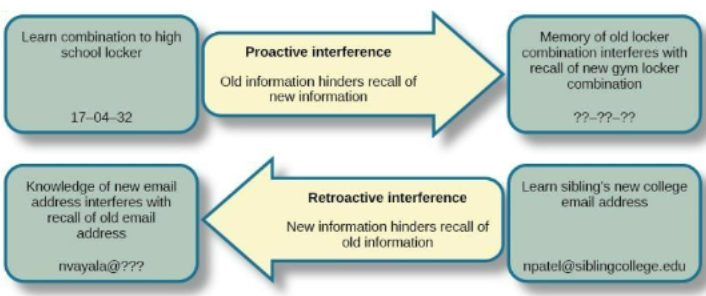
proactive interference
old information hinders the recall of newly learned information
procedural memory
type of long-term memory for making skilled actions, such as how to brush your teeth, how to drive a car, and how to swim
recall
accessing information without cues
recognition
identifying previously learned information after encountering it again, usually in response to a cue
reconstruction
process of bringing up old memories that might be distorted by new information
rehearsal
repetition of information to be remembered
relearning
learning information that was previously learned
retrieval
act of getting information out of long-term memory storage and back into conscious awareness
retroactive interference
information learned more recently hinders the recall of older information
retrograde amnesia
loss of memory for events that occurred prior to brain trauma
self-reference effect
tendency for an individual to have better memory for information that relates to oneself in comparison to material that has less personal relevance
semantic encoding
input of words and their meaning
semantic memory
type of declarative memory about words, concepts, and language-based knowledge and facts
sensory memory
storage of brief sensory events, such as sights, sounds, and tastes
short-term memory (STM)
holds about seven bits of information before it is forgotten or stored, as well as information that has been retrieved and is being used
storage
creation of a permanent record of information
suggestibility
effects of misinformation from external sources that leads to the creation of false memories
transience
memory error in which unused memories fade with the passage of time
visual encoding
input of images