11: Interviews
Quantitative research is reported very succinctly. Interviews are a qualitative method to explore. Explain first-person experiences. Instead of what party are you voting for, why are you voting for them?
Quantitative researchers look for generalizability. Qualitative researchers look for explanations, a rejection of positivism.
These designs are on a continuum. How structured do you want it? In an unstructured interview, the interviewees guide the questions that are asked. Depends on the research design.
Semi-structured interviews usually have headings of ground that must be covered. A leadoff for each of the sections.
Prompts encourage people to talk.
Differentiating qualitative & quantitative interviews
Unstructured interview: the researcher possesses a small set of prompts to investigate certain topics.
Semi-structured interview: the researcher has an interview guide of questions & specific topics, but the interviewee has leeway in how to provide. There can be deviation.
The process is to bring out how the interviewees themselves interpret and make sense of issues and events.
Quantitative (structured) | Qualitative |
Highly structured to maximize reliability & validity in measuring key concepts, a clearly specified set of research questions. | Much less structured and more open ended, allowing more freedom. |
The interview is driven mainly by the research agenda of the person conducting the study. | There is greater interest in the interviewee’s perspectives and concerns. |
Departures from the interview schedule is discouraged due to divergence from research plan. | Tangents are encouraged and the interviewer may vary both order and wording of questions to provide new insights. |
Typically inflexible because of the need to standardize the interactions with all interviewees. | Flexible, responding to the direction in which interviewees take the interview, which could also affect research emphasis. |
The interview is normally designed to generate specific answers that can be coded. | The researcher wants rich, detailed answers. |
Unless the research is longitudinal in nature, the interviewee is usually interviewed only once. | The interview may be interviewed more than once. |
Life history interview: often combined with personal documents inviting participants to look back in detail across their entire life course, and to report their experiences and worldviews.
Oral history interview: the participants may be asked to reflect on specific historical events or eras that they lived through. Emphasis is usually on how lives are affected by these things.
Memory lapses and distortion could occur.
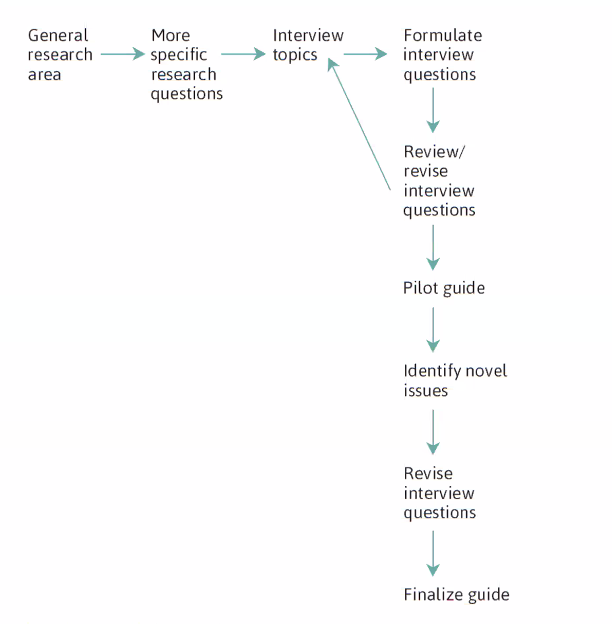
Interview guides
A brief list of memory prompts for areas to be covered in unstructured interviewing and a somewhat more elaborate list of issues to be addressed or questions to be asked in semi-structured interviewing.
The actual questioning must be flexible, allowing interviewers to pursue leads. Lofland and Lofland: just what about this thing is puzzling me?
Interview guides must:
establish order so that questions flow well, but allow flexibility
include questions/topics that address the research questions
use language familiar and comprehensible to those being studied
not asking leading questions
including prompts to remind the researcher to record basic participant demographics.
Before the interview: Interviewers must also be familiar with the research setting, have a recording device, make sure the interview occurs in a quiet place, and prepare for the interview by cultivating the traits of a quality interviewer.
Knowledgeable, structuring, clear, gentle, sensitive, open, steering, critical, remembering, interpreting, balanced, ethically sensitive, non-judgemental.
After the interview, there should be notes about how the interview went, how the interviewer felt, the setting of the interview and tentative insights.
Kinds of questions: Introducing/follow-up/probing/specifying/direct/indirect/structuring/silence/interpreting.
The first questions should be initial and open-ended, intended to ask about the past and factual members.
Then, intermediate questions ask about feelings.
Ending questions process and sum up the experience.
It is important for the interviewer to be a deep listener.
Vignette questions: grounds interviewees’ ideas and accounts of behaviour in particular situations. Present interviewees with a concrete and realistic scenario.
Transcription must be checked for accuracy.
Flexibility: able to vary the order of the questions and clear up inconsistencies in answers.
When transcribing and interpreting qualitative interviews, researchers should reflect on how their own interactions with participants have affected what was said, how it was said, and what was left unsaid.
Focus groups
Speaking with more than one interviewee at the same time. The moderator guides the session but does not intrude.
Focus groups enable researchers to develop understandings about why people feel the way they do, probing one another’s reasons.
Interviewees may argue and challenge the views of oneanother.
Opportunity to study how individuals collectively make sense of a phenomenon and construct meanings of it. Symbolic interactionism that meanings and understandings are not derived in isolation.
The dynamics of group interactions are part of the purpose.
Enough focus groups have occurred when the moderator is able to anticipate what the next group is going to say. Sociodemographic factors may also affect the number of groups.
Morgan suggests 6 - 10 members of a focus group, and smaller groups when the participants likely have a lot to say. Some people may also have differences in whether people are known to each other.
Most people lie between an open ended style and a more structured one. The moderator should be moderately involved to guide the session and direct focuses.
Recording and transcription is more important too. It is usually more time-consuming.
Focus group research frequently fails to take group interaction into account.
Focus groups are limited in how the researcher has less control over the proceedings.
Endless quantities of data are produced and may be difficult to analyze.
The focus group itself can be difficult to organize. Group effects (like shyness) may be an issue too. Sometimes, there are circumstances when individual interviews are more appropriate, like when a profound disagreement occurs.
In reporting, you should have two sections: one about individual interactions and one where you discuss group interactions.
Focus groups are usually used to test political commercials. How do people start talking about the commercials? Are people’s minds changed after the group interaction?
Interview guides can double as focus group guides. It should be more structured to prevent meandering. The number of questions must be reduced.
Focus groups are inherently naturalistic: it brings out how people collectively make decisions and interpretations.
Online interviews & focus groups
Virtual and in-person focus groups are both valid approaches. The experience could be replicated virtually. The participants felt like they were heard and capable of expressing themselves.
Labs 3
Lab 3 must be completed on-campus or looking out your home window. Create an observation table of 5 - 8 variables.
1 time, 15 minutes.
Some ideas for observations: people studying, quiet spaces. Are people studying by themselves? Together? The whole 15 minutes? Plugs & seating?
Restaurants & recycling behaviours. Pauses for recycling bins, do people use the garbage? Student vs. non-student.
Observable characteristics only.
Courtesy in gyms, do people respect time limits? Preferences for equipment, opinion on space in the facilities to accommodate people.
Worded answers are fine. Behaviours?
Take a snapshot of where you are, a map of where you are standing. Dichotomous variables or worded variables.
Young-ish vs. old-ish.
How did you do recordings?
Lab 4
Shows you a bad interview first and then shows you everything that went wrong in the first video.
Be able to identify more than 5 things in the bad interview.
Introduce to other academic institutions.
Discussion
Professor about improving the first year experience
Topics:
adapting to university from a high school setting
assessment types & adapting to university assessments
sociality & behaviour in high school vs. university.
Questions:
What is the difference between a first and second year class in terms of assessment?
Do you believe that first-year students enter university already prepared to complete assessments?
What do you believe is the most effective way of helping these first years make the adjustment to university?
How do you encourage first years to attend your office hours?
Ethical considerations:
Confidentiality: identifying information is not published in the final paper.
Informed consent in tape recording & transcription.
University policy in revealing student information and the information they may be able to provide about their courses.