molarity and dilutions
Chapter 8: Solutions
8.5 Molarity Dilutions
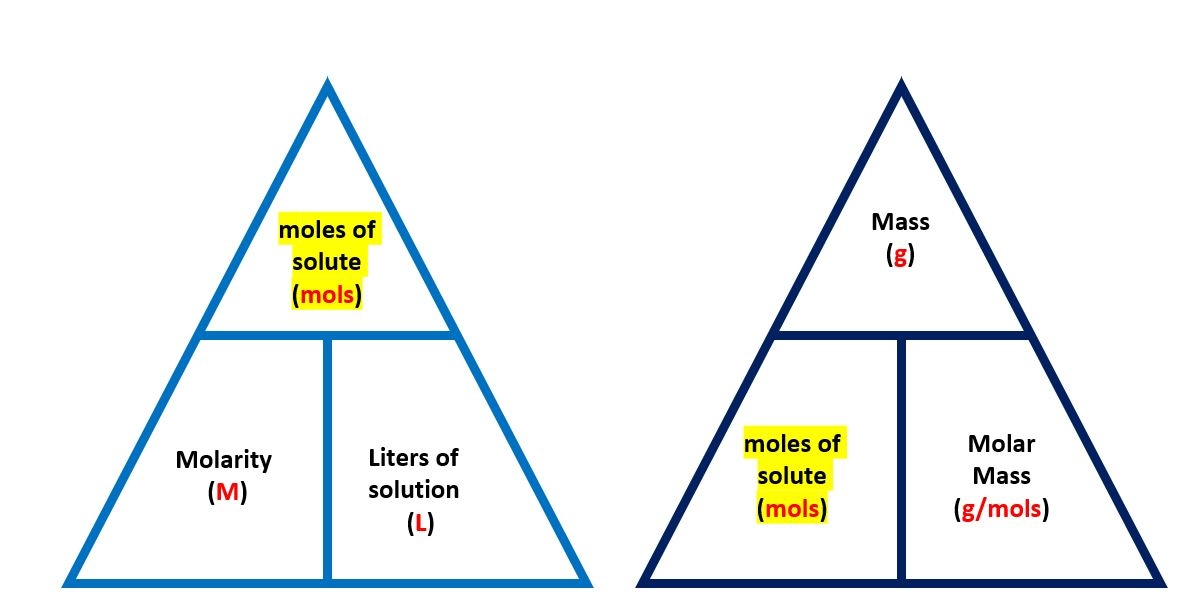
Molarity refers to the number of moles of solute per liter of solution.
Volumetric Flask Use: Add water to dissolve the solid completely, then add more water until reaching the 1 liter mark.
Example: To prepare a 1 M NaCl solution:
Start with 1 mole of NaCl, which weighs 58.5 g.
Concentration of Solutions
Concentration measures the amount of solute in a specific quantity of solvent.
Key terms:
Amount of solute vs. amount of water.
Pictorial Representation
Visual examples showing different amounts of NaCl in varying volumes of water indicating concentrated vs. dilute solutions.
30g NaCl in 100mL: Concentrated.
10g NaCl in 100mL: Dilute.
Concentration Explained
Increased solute in a fixed solvent creates a more concentrated solution.
Increased solvent dilutes the concentration when solute remains constant.
Key observations:
More solute with constant solvent: More concentrated.
Less solute with constant solvent: Less concentrated.
More solvent with constant solute: Less concentrated.
Less solvent with constant solute: More concentrated.
Types of Solutions
Concentrated Solution: Contains a large amount of solute relative to solvent.
Dilute Solution: Contains a small amount of solute relative to solvent.
Describing Concentration
Different ways to describe concentration:
% by mass: Common in medicated creams.
% by volume: Seen in solutions like rubbing alcohol.
ppm (parts per million) and ppb (parts per billion): Used for contaminants.
Molarity (M): Used heavily in chemistry.
Molality (m): Used for certain calculations.
Concentration Units
Concentration can be expressed in multiple units:
Percentage by Mass:
% by mass = (mass of solute / (mass of solute + mass of solvent)) × 100%
Mole Fraction (X):
X_A = moles of A / sum of moles of all components.
Molarity (M):
M = moles of solute / liters of solution.
Molality (m):
m = moles of solute / mass of solvent (kg).
Molarity Calculations
Molarity Definition: M = moles of solute / liters of solution.
A higher numeric value indicates a more concentrated solution.
Example: A 2 M HCl solution is referred to as "two molar" HCl.
The volume measurement includes the total volume of the solution (not just the solvent).
Preparing Molar Solutions
Steps for making a 1 molar NaCl solution:
Weigh 58.44 g of NaCl (1 mole).
Add this to water until it dissolves completely.
Add more water until the total volume reaches 1 liter.
Molarity Calculation Example 1
Problem: Find the molarity of a solution with 0.25 moles of NaCl in 0.75 L of solution.
Calculation:
M = 0.25 moles / 0.75 L = 0.33 M.
Molarity Calculation Example 2
Problem: Determine the molarity of a solution containing 0.80 moles of CaCl2 in 50 mL.
Calculation:
M = 0.80 moles / 0.050 L = 16 M.
Grams to Moles Conversion
Concept of converting grams to moles given:
1 mole = molar mass (g).
If mass (g) is present, use molar mass for conversions.
Example Molarity Calculations
Example 3: Grams of CaBr2 in a 0.39M solution.
Need to calculate the moles first, followed by converting to grams using molar mass.
Example 4: Volume of solution with a known mass of solute:
How many mL of a stock solution are needed for a specific molarity?
Dilutions
Dilution Procedures: Prepare a less concentrated solution from a more concentrated one.
Use formula: Moles of solute before dilution = Moles of solute after dilution (M1V1 = M2V2).
The total moles of solute remain unchanged during dilution.
Tips for Dilution Calculations
Always align units for volume in calculations.
Watch out for phrasing that can confuse volume calculations.
Example Dilution Calculations
Example 1: Volume of concentrated HNO3 needed to create a less concentrated solution.
M1 = 15.8M, M2 = 6.0M, V2 = 250 mL.
Calculate V1 using M1V1 = M2V2.
Additional Practice Problems
Solve problems involving calculations of molarity from given grams of solute and volumes of solutions, using the formulas discussed.