Aggression: Nature, Causes & Control
Definition (#f7aeae)
Important (#edcae9)
Extra (#fffe9d)
Intentional behaviour aimed at causing physical harm or psychological pain to another person. Behaviours are often extreme, but sometimes also subtle with the purpose of ignoring others’ existence.
Definitions:
Behavior intended to hurt another person.
Any behavior whose intent is to inflict harm or injury on another living being.
Hostile or forceful action intended to dominate or violate.
Behavior that is intended to injure another person (physically or verbally) or to destroy property.
A response that delivers that noxious stimuli to another organism.
Perspectives of aggression:
Aggression:
Actions with the goal of harming another who would want to avoid such treatment.
Whether aggressive behavior is intentional or unintentional, and whether we act with or without conscious thought, highlights the complex nature of aggression.
Role of biological factors: Biology & aggression
Thanatos, or "death drive" is a psychoanalytic concept by Sigmund Freud proposing an innate human drive toward destruction, aggression, and self-sabotage.
Fighting instinct, fight-or-flight-freeze response, is an automatic, brain-based survival mechanism triggered by perceived threats to protect oneself.
Originally rejected the idea of a biological explanation.
Currently, many agree that genetic factors may play a role in aggression.
Role of biological factors:
Role of Biological Factors:
According to Freud, aggression stems mainly from death wish through the desire to self- destruct as well as destroy others.
Other studies show that men shows aggression towards other men.
In soccer teams, men will show aggression towards their opponents but not their teammates.
Drive Theories: Motive to Harm Others
External conditions can create frustration, increasing motivation to harm others. Ex: provocation, presence of a weapon.
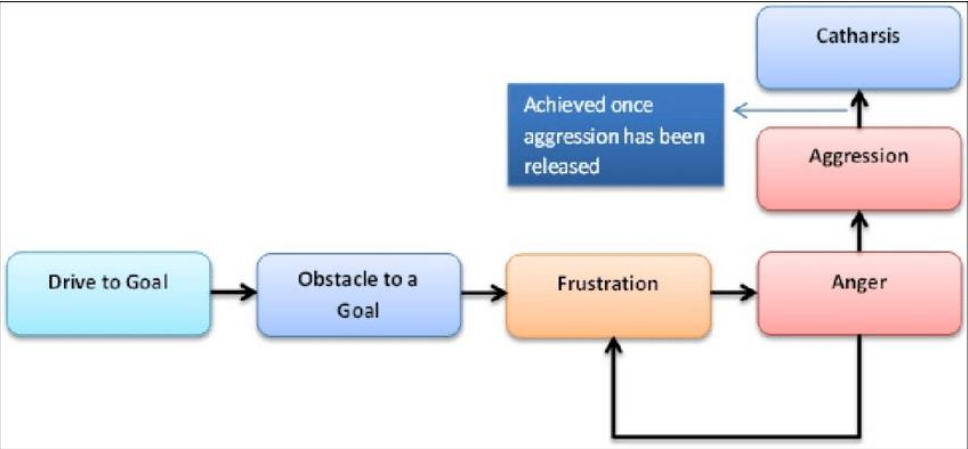
Frustration-aggression hypothesis: frustration is the strongest, or perhaps the only, cause of aggression.
Frustation is an emotional state, characterized by anger or annoyance, that arises when goal-directed behavior is blocked by internal or external obstacles.
Frustration theory: External condition → Drive to harm → Overt aggression.
Modern theories of aggression:
Social learning theory (Bandura): Individuals learn about:
Various ways to harm others.
Which people or groups are appropriate targets for aggression.
What actions by others justify retaliation or vengeance in their part.
What situations or contexts are ones in which aggression is permitted or even approved.
General aggression model (GAM):
Explains about individuals who are exposed to high levels of aggression can increase the aggression in them.

The GAM is an integrative, bio-socialcognitive framework explaining that aggression results from a fast-paced interaction between personal (traits, beliefs) and situational (provocation, frustration) factors.
Highlights how these inputs produce internal states, arousal, affect, and cognition, leading to automatic appraisals or decisions that determine aggressive behavior, acting as a feedback loop shaping future responses.
The GAM is widely used to understand media violence effects, bullying, domestic violence, and other forms of social conflict.
Causes of aggression:
2 basic Sources of Aggression: Frustration and Provocation.
Frustration:
According to the frustration-aggression hypothesis:
Frustration always leads to some form of aggression.
Aggression always stems from frustration.
Frustration does not always trigger aggression but rather sadness, despair, and depression.
Frustration can serve as a powerful determinant of aggression under certain circumstances - especially ones viewed as illegitimate or unjustified.
Provocation:
One of the strongest determinants of aggressive behavior.
Types: Condescension or arrogance from others / Teasing.
Its a behavior on the part of another person that triggers aggression.
Usually, originates from malicious objectives.
Criticism and condenscension are the powerful forms of provocation and often triggers aggression.
Teasing: Provocative comments regarding someone’s imperfections may sound playful, funny, yet sometimes hurtful.
Media Violence:
Exposure to violent media, significantly increases likelihood of aggression.
Television, video games, news programs and song lyrics.
The increase of aggressive cognition (thought to harm others), aggressive affect and aggressive behavior.
Exposure to violence in media creates desentization; Reduction of sensitivity towards violence and its consequences.
Gender and Aggression: Are men more aggressive than women?
Males are more likely to be aggressive than females in general (with no provocation).
However, when provoked, the gender difference tends to fade away.
Males are more likely to employ direct aggression, actions designed especially for the target (physical attacks).
Females are more likely to utilize indirect aggression, actions that permit aggressors to hide their identity from the victim (spreading rumors).
Victims of indirect aggression may not even know that they have been a target.
Social causes of aggression:
Social exclusion:
Exclusion occurs because the benefits of social relations with others is not enjoyable, and it reflects negatively on self image.
Hostile cognitive mindset might be affected by the feeling of social exclusion.
Being socially excluded/rejected → perceiving them as hostile → incresed aggression.
Why Some Are More Aggresive Than Others:
Hostile attributional bias:
Cognitive bias where individuals interpret behaviors from others through a negative without valid evidence.
Person perceives other people’s actions as intentionally aggressive, hostile or negative, even if the behvaior was not intended that way.
Ex: Road rage, social media anger.
The thoughts of “If they are hostile towards me, I’ll strike first”.
To them, outgroups are hostile (even though the stimulus is neutral in nature)
Narcissim:
When provoked by others, individuals high in vulnerable narcissism feel a strong need to “punish” these people who provoke them (threat towards ego).

Situational Determinants of Aggression:
High temperature:
High temperature can make people agitated and angry.
In hot weather, individuals become lethargic and focuses on reducing discomfort.
Alcohol:
Alcohol consumption increases aggression in both males and females, but the effect is stronger in males.
Individuals who consume alcohol shows a reduction in information processing capacity regarding people they think don’t like them, therefore are eager to attack those who they think are provoking them.
Alcohol lowers self-control from performing aggression.
Weapons:
Weapon effect: increases intention to harm others.
When an angry person has a weapon, their actions can become very aggressive.
Though the initial purpose of gun ownership is for self defense, it increases chances of suicide as well as aggression towards others.
Aggression in the Classroom and Workplace:
Bullying:
Intentional and repetitive aggression against another person.
Form of behaviour in which aggression is primarily “one way.”
Can occur in the workplace and prisons.
2 possible motives:
Motivation to have power over another person.
Motivation to be a member of a group that is seen as tough.
Bullying is done by individuals with more power or status than their target.
Victims of bullying tend to feel unhappy and unsafe, lowering their academic performance. They also tend to be lonely, withdrawn, and socially isolated.
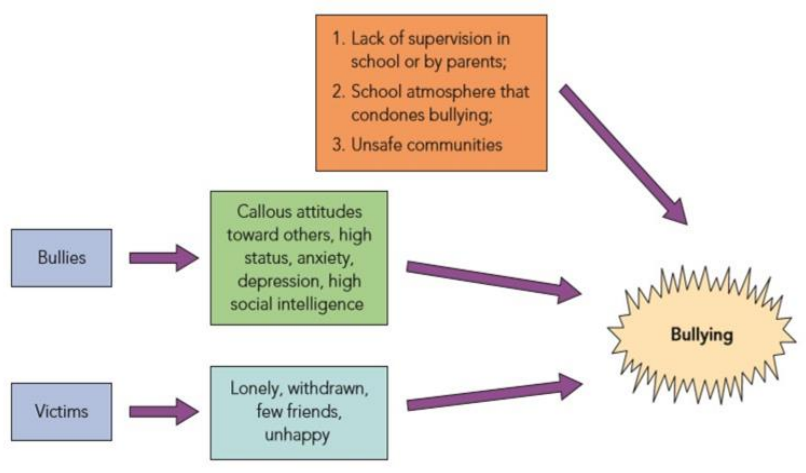
Characteristics of bullies & victims:
Research suggests that some people are always the bully, while some people are always the victim, but others can be the bully in some contexts and the victim in other contexts.
Bullies tend to believe that others act the way they do intentionally or because of lasting characteristics.
Victims tend to perceive others as acting as they do in response to external conditions.
Bullies are more likely to ascribe to the hostile attribution bias.
Bullies and bully-victims often have low self-esteem and believe the best reaction in a bullying situation is aggression.
Efforts to reduce bullying:
Strong efforts to supervise children’s behavior in school settings.
Training teachers to recognize and prevent or stop bullying.
Informing students who witness acts of bullying to report it to teachers immediately.
Involving parents and informing them about bullying.
Providing counseling for those affected by bullying.
Developing bullying prevention programmes.
Cyberbullying:
Cyberbullying is bullying occurring in chat rooms and other Internet locations.
Reducing the occurrence of bullying:
Bullying needs to be seen as the problem of all people surrounding the situation (parents, teachers, work supervisors).
Those in leadership positions must stand united against its occurrence.
Possible victims must be aware of the support system available to them.
Those in the situation should take advantage of outside help.
Workplace aggression:
Subtle behaviors in the workplace, ex: spreading negative rumors, moving equipment needed to complete work, destroying personal property etc.
Reason: thinking they’ve been treated unfairly, humiliated by coworkers.

Prevention and control of aggression:
Punishment:
Individuals who engage in inappropriate acts of aggression must be punished.
Preventing repetitive acts of aggression.
Remove dangerous people from society.
Characteristics of punishment that may reduce aggression: prompt, certain, strong, justified.
Self-regulation:
Self-regulation is needed to regulate self-control capacity, including aggression.
There needs to be an internal mechanism to regulate emotions.
Individuals with positive attitudes towards their emotion regulation can avoid aggressive behavior easily because it involves thinking prosocial thoughts.
Catharsis:
Catharsis hypothesis: If individuals vent their anger and hostility in non-harmful ways.
Catharsis can make people feel better, but only temporarily.
Reducing aggression by thinking non-aggressive thoughts:
One of the ways to reduce aggression is by inducing thoughts and feelings that are incompatible with anger or aggression.
Ex: Humor, empathy, changing the topic of conversation, diverting focus.