World War I
Key People
Kaiser Wilhelm - Kaiser Wilhelm was the last German Emperor and King of Prussia, ruling from 1888 until his abdication in 1918 at the end of World War I.
Archduke Franz Ferdinand - Archduke Franz Ferdinand was the 55-year-old heir to the Austro-Hungarian throne and Inspector-General of the Austro-Hungarian army
Gavrilo Princip - Gavrilo Princip was a Bosnian Serb who was part of the Black Hand, who assassinated Archduke Franz Ferdinand, and his wife Sophie, Duchess von Hohenberg
Sir John Monash - General Sir John Monash was an Australian civil engineer and military commander of the First World War
Key Terms
The Black Hand - A Serbian nationalist group that assassinated Archduke Franz Ferdinand
Triple Alliance - Alliance between Germany, Austria-Hungary, and Italy
Triple Entente - Alliance between France, Russia, and Britain
Militarism - The belief that a country should maintain a strong military and be ready to use it to defend or promote national interests
Nationalism - The belief that your nation (meaning a group of people with a shared culture, language, or history) is unique and important
Imperialism - When a powerful country takes control of lands or people outside its own borders, often by force
Western Front - The Western Front was a stretch of land over 600 kilometres long, situated between the North Sea coast in the north of France and the German-Swiss border. Many of the worst and bloodiest battles of the First World War were fought along this front
Trench Warfare - Trench Warfare was a new fighting technique that was used heavily during World War I. Soldiers on the frontline dug and occupied extensive trenches on the battlefield. Within the trenches, the soldiers were protected against enemy artillery
AIF - AIF stands for Australian Imperial Force. This was a volunteer ‘expeditionary force’, which meant Australian men could fight overseas.
Gallipoli - The Gallipoli peninsula is a coastal region in Turkey. Australian soldiers played a key role in the Battle of Gallipoli. In one of the bloodiest battles of World War I, 8,700 Australian men died in the fight to control the Dardanelles
Armistice - A formal agreement between warring parties to stop fighting
The Assassination of Archduke Franz Ferdinand
Archduke Franz Ferdinand was the 55-year-old heir to the Austro-Hungarian throne and Inspector General of the Austro-Hungarian army. In June 1914, he and his wife Sophie went to Bosnia to inspect the army’s training and manoeuvres. This small country had recently been claimed by the Austro-Hungarian Empire as part of its empire. Serbian ministers warned the Austrian government that it might be dangerous to visit, but the Austrians did not take the warnings seriously.
On the 28th of June 1914, in the Bosnian city of Sarajevo, Franz Ferdinand and his wife were shot and killed. The assassin, Gavrilo Princip, was a Bosnian-Serbian nationalist and a member of the Black Hand, an organisation that wanted to unite all Serbians into one nation. The assassination, called ‘the shot heard round the world’ in the newspapers of the day, led to a diplomatic crisis
The Schlieffen Plan
The Schlieffen Plan was Germany's 1905 military strategy to win a quick victory in a two-front war against France and Russia. The plan involved a massive, rapid German advance through neutral Belgium to outflank and defeat France within six weeks, after which forces would be sent to fight a slower-moving Russia.
The Main Causes of World War I
Militarism
What is Militarism?
Militarism is the belief that a country should maintain a strong military and be ready to use it to defend or promote national interests
Why Militarism was a problem
In the years leading up to World War I, militarism caused nations to build up their armies and weapons, even when there was no immediate threat. These military buildups made countries more confident and more aggressive.
The Arms Race
From the late 1800s to 1914, Europe saw a major arms race, a competition to build the biggest, strongest military forces. Countries spend massive amounts of money on rifles, cannons, warships, and ammunition.
Connecting Militarism to the Outbreak of War
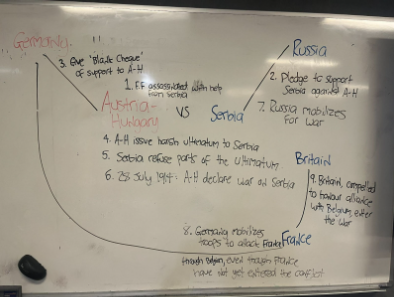
When Archduke Franz Ferdinand was assassinated in 1914, militarism helped turn a regional crisis into a full-scale world war. Because countries had massive armies, detailed war plans, and a belief in military power, they were quick to mobilise, to prepare for battle. Once a country began mobilising, others followed, and the chain reaction began. Instead of waiting or trying to calm tensions, military leaders pushed their governments toward war.
Alliances
What is an Alliance?
An alliance is an agreement between two or more countries to support each other, usually for military protection. If one country is attacked, its allies promise to help defend it.
Why Were Alliances Formed?
In the late 1800s and early 1900s, many European countries were nervous about each other’s power and military strength. To protect themselves, they made alliances with other nations. These alliances were meant to keep the peace by making countries too scared to attack, because they knew it would start a bigger war.
Two Main Alliance Systems
The Triple Alliance - Germany, Austria-Hungary, and Italy
The Triple Entente - France, Russia, and Britain
These alliances meant that if any one country in a group got into a fight, the others were expected to join in. That’s exactly what happened in 1914, when the alliances caused a chain reaction
The Domino Effect
When Archduke Franz Ferdinand was assassinated, Austria-Hungary declared war on Serbia. Because Serbia was supported by Russia, Russia began preparing for war. Germany, which was allied with Austria-Hungary, saw Russia’s actions as a threat and declared war on Russia. France, allied with Russia, then joined in when Germany invaded Belgium to attack France. Britain joined the war to defend Belgium. In just a few weeks, what could have been a small regional conflict turned into a full-scale world war, all because of the alliance system.
Alliances Increased Tension
The alliance system made European countries suspicious and aggressive. Countries like Germany and France felt they had to stick closely to their allies in case war broke out. Instead of solving disagreements peacefully, leaders relied on their alliance partners to back them up. This made diplomacy harder and war more likely. Everyone knew that one wrong move could drag multiple countries into conflict, and yet no one wanted to appear weak by backing down.
Imperialism
What is Imperialism?
Imperialism is when a powerful country takes control of lands or people outside its own borders, often by force. These lands became colonies, and the imperial country uses them for resources, labour, and power.
Why did Imperialism Lead to War?
By the early 20th century, almost the entire world had been divided up by European powers. This led to competition, jealousy, and tension among nations. Countries wanted to expand their empires and didn’t want others to grow stronger. As a result, imperialism created a climate where war became more likely.
The Race for Colonies
In the late 1800s and early 1900s, countries like Britain and France had huge empires in Africa, Asia, and the Middle East. These colonies provided raw materials like cotton, rubber, oil, and gold, which helped fuel their economies and increase their global power. Other countries, like Germany and Italy, were newer nations and felt left out of the empire-building game. They wanted colonies too, and were willing to fight for them.
Imperial Rivalries and Tension
As countries scrambled for colonies, they began to clash. One major example was in North Africa, where Germany challenged France’s control of Morocco in 1905 and again in 1911. These events, known as the Moroccan Crises, almost led to war. Even though war was avoided, the tension between Germany and France increased dramatically. These kinds of imperial conflicts made countries suspicious of each other and built up long-lasting resentment.
Global Competition = Global Conflict
Because imperialism was about controlling the world, the competition wasn’t just between neighbours; it became global. For example, the British Empire was worried that Germany’s navy was growing because Germany wanted to protect its colonies and trade routes. Britain responded by building more ships. This led to an arms race, a competition to have the most powerful military, which made war more likely. Countries also formed alliances to protect their empires and prepare for future conflicts.
Connecting Imperialism to the Outbreak of War
By 1914, the tensions caused by imperialism were just waiting for a spark. When the assassination of Archduke Franz Ferdinand occurred, it set off a chain reaction, but many of the deeper causes, like imperialism, had already created a dangerous environment. Countries didn’t trust one another because of past imperial struggles. They were also more willing to fight because they believed war would help them gain or protect colonies and prove their strength.
Nationalism
What is Nationalism?
Nationalism is the belief that your nation, meaning a group of people with a shared culture, language, or history, is unique and important. Sometimes, it’s even seen as better than other nations. Nationalism can unite people within a country and create a strong sense of pride. But before World War I, it also caused competition, hatred, and conflict between and within countries.
Why was Nationalism a problem before World War I?
In the early 1900s, Europe was filled with powerful nationalist feelings. In some places, it brought people together. But in many cases, nationalism tore countries apart and pushed Europe closer and closer to war. Across Europe, countries like Germany, France, Britain, and Russia all had growing pride in their military strength, culture, and history. Governments, schools, and newspapers taught people to be proud of their nation and suspicious of others. This strong national pride made many people believe that going to war was not only necessary, but honourable. It became common for countries to see war as a way to defend their reputation and prove their greatness.
Ethnic Groups Wanting Independence
Nationalism wasn’t just a problem between countries; it also caused conflict inside large empires. Countries like Austria-Hungary and the Ottoman Empire were made up of many different ethnic groups: Bosnians, Czechs, Serbs, Croats, and others. These groups often didn’t feel loyalty to the empire they lived in. Instead, they wanted to rule themselves and have their own independent countries. This created constant tension and led to uprisings, especially in areas like the Balkans (southeastern Europe), which became known as the ‘power keg of Europe’ because it was so ready to explode.
Pan-Slavism and Serbian Nationalism
One of the strongest nationalist movements was Pan-Slavism, the idea that all Slavic people should unite into one big Slavic nation. Serbia was especially passionate about this idea. It wanted to unite all Slavs under its leadership. Russia supported Serbia because it was a Slavic country too, and wanted more influence in the Balkans. But Austria-Hungary opposed this idea, because it didn’t want to lose control of its own Slavic regions, especially Bosnia. This clash of national interests created dangerous hostility between Serbia and Austria-Hungary
The Assassination That Triggered the War
Nationalism led directly to the event that started World War I. In 1914, a Serbian nationalist group called the Black Hand assassinated Archduke Franz Ferdinand. This act of nationalist violence shocked Europe and gave Austria-Hungary a reason to declare war on Serbia. Because of alliances, other countries were pulled in, and the First World War began.
Nationalism Glorified War
Nationalism also made war seem like a good thing. Many people in Europe thought that going to war would prove their country’s strength and honour. They believed their armies would win quickly and bring glory to their nation. This mindset made it easier for governments to go to war, and harder for people to question it. In reality, World War I turned into a long and devastating conflict that killed millions.
The War Begins
Australia’s Involvement
What was Australia’s response to the war?
During the early 20th century, Australia’s ties to Britain were very strong. When Britain entered the war, Australia also joined by extension. Spurred by propaganda, large numbers of men and women enlisted to fight or support the troops. However, as the war continued, attitudes towards the conflict became much less positive.
Reasons for Enlisting
Many Australians still held strong familial and cultural ties to England, so fighting to protect the ‘Mother Country’ felt important
Australians were proud of their new nation; they wanted to represent their country overseas and show Europeans what Australians could do.
Australia, a mostly rural nation, was very isolated. Travelling to Europe or the Middle East was an exciting idea for many young men
There was a lot of social pressure. Army propaganda posters were everywhere, and enlistment became a topic of conversation. Eligible men who didn’t enlist might find a white feather in their letterbox, suggesting they were cowards
Football teams, cricket teams and groups from small towns would often sign up together, keen to share the adventure
Use of Propaganda
Propaganda is information that is used to influence an audience, often by producing an emotional response. World War I saw a massive increase in the production and variety of propaganda on all sides of the conflict. British and Australian propaganda sent a message that fighting the war against the ‘evil’ enemy was a moral imperative. Posters, pamphlets, newsreels and official speeches were all used by the Allies as propaganda. By modern standards, many of the propaganda images and messages of the time are racist and offensive.

Sir John Monash
Leadership
On the Western Front, Monash commanded 200,000 troops, including soldiers from Australia, Britain and the United States
When the First World War broke out, he was appointed commander of the 4th Infantry Brigade, controlling 17 ships that reached Egypt in January 1915. After Gallipoli, he was promoted to brigadier general and his troops fought at Sari Bair, Hill 971, Hill 60 and near the Suez Canal. In July 1916, as Major General commanding the 3rd Division, his troops served in Armentieres, Messines, Broodseinde, Passchendaele and Ploegsteert.
In 1918, he was knighted in the field by King George V in recognition of his outstanding service
He was promoted to lieutenant-general, commanding the Australian Imperial Force and American troops. The Battle of Hamel (4 July 1918) was regarded by many as his greatest hour, earning him a reputation as a commander of genius. Monash planned the battle to last 90 minutes; it finished in 93, foreshadowing the ‘blitzkrieg’ (lighting war) of the Second World War.
A series of victories followed – Chuignes, Mont St Quentin and Peronne and Hargicourt – with relatively low casualties (5000). With the Australians’ final battle at Montbrehain, the Hindenburg Line was finally broken.
After the Armistice on 11 November 1918, Monash oversaw the repatriation of Australian troops over an eight-month period, providing further evidence of his administrative skills.
His Legacy
Monash was Australia’s most accomplished senior commander of the First World War and, arguably, in Australia’s military history. His command of the 3rd Division and later of the Australian Corps in 1918 is remembered for its remarkable achievements and high levels of skill, thoroughness and competence.
Monash valued men over machines, coordinating all resources to preserve lives, and he encouraged individualism, famously telling his men: “I don’t care a damn for your loyal service when you think I am right; when I really want it most is when you think I am wrong.”
Soon after the war, Monash’s wife died from breast cancer, and he wrote books about his experiences on the Western Front. He took up several prominent jobs, including head of the State Electricity Commission of Victoria, and he was involved in organising military commemorations, including Anzac Day and the Shrine of Remembrance.
In the 1920s, according to his biographer Geoffrey Serle, Sir John Monash was regarded as Australia’s greatest living Australian. He died in 1931 from a heart attack, at the age of 66, and was given a state funeral. He asked that his gravestone simply bear the words “John Monash”.
In 1958, Monash University in Melbourne took its name and inspiration from Sir John’s personal philosophy: “Adopt as your fundamental creed that you will equip yourself for life, not solely for your own benefit but for the benefit of the whole community.”
Further reading: Geoffrey Serle. John Monash: A Biography. Melbourne: Melbourne University Press, 1982.
Armistice
The Final Offences
Australian troops played a key role in the Allied “Hundred Days Offensive”, which pushed the German forces back on the Western Front
Battles such as Amiens (8 August 1918), described by General Ludendorff as “the Black Day of the German Army,” showcased Australian effectiveness
Heavy casualties and exhaustion took a toll; by October, most Australian divisions were withdrawn from front-line fighting.
The Armistice - Background
By late 1918, Germany and its allies (Austria-Hungary, the
Ottoman Empire, and Bulgaria) were collapsing:The Allied offensives had pushed German forces
back toward their borders.Germany’s allies had already surrendered.
Food shortages, strikes, and mutinies spread across
Germany.The German government realised the war could not
be won.As a result, Germany requested a ceasefire through the
U.S. President Woodrow Wilson’s “Fourteen Points” plan
for peace.
The Armistice - The Signing
The armistice was signed in a railway carriage in the Forest of Compiègne, France,
about 60 km north of Paris.
German delegation leader: Matthias Erzberger (a civilian politician)
Allied delegation leader: Marshal Ferdinand Foch (French Supreme Commander)
The negotiations were tough; the Germans had no real power to bargain. They were
presented with Allied terms and had to accept them:
Immediate ceasefire on all fronts.
Withdrawal of German troops from France, Belgium, Luxembourg, and Alsace-
Lorraine.Surrender of weapons, including artillery, aircraft, and naval ships.
Release of Allied prisoners of war.
Occupation of the Rhineland by Allied troops.
Continuation of the Allied naval blockade, meaning Germany still faced food shortages
The Armistice - German Reaction
When the guns finally fell silent at 11 am on 11/11/1918, soldiers and civilians across
Europe celebrated, believing the “war to end all wars” was finally over.
The German people were shocked — many had believed they were still winning,
As fighting never reached German soil.This sense of betrayal later fueled resentment and the “stab-in-the-back”
myth, which extremist groups (including the Nazis) exploited in the 1920s and
1930s.
betrayed by civilians at home, especially politicians, socialists,
communists, and Jews, who supposedly undermined the war effort
and forced Germany to surrender.Nonetheless, the armistice ended more than four years of devastating warfare.
Paved the way for the Treaty of Versailles (June 1919).
Established on November 11 as Armistice Day or Remembrance Day,
commemorating those who died in WWI and later conflicts.
The Armistice - Australia
News of the Armistice reached Australian forces in France and the Middle East with relief and disbelief.
In Australia, spontaneous celebrations broke out, bells rang, flags waved, and cities erupted in
parades and street parties.Prime Minister Billy Hughes declared 11 November“ a day of thanksgiving,” while mourning the
immense loss of life.
Mourning and Reflection (Late 1918 – 1919)
Over 60,000 Australians had died; nearly 160,000
were wounded or gassed.
Communities grappled with grief and the challenge of rebuilding.
The ANZAC legend solidified as a national story of courage and endurance, shaping how Australians remembered the war.
Whilst the scars of war were hidden from those
back home, that was not the case in France. This looks like a memorial you may see in Australia, but it is actually in Pozieres, France