Blood Vessels & Circulation
Blood vessels and Circulation
Pulmonary and systemic circulation
Arteries- Carry blood away from the heart
Capillaries- Site of exchange with tissues
Veins- Carry blood toward the heart
Tunics
- Tunica Intima- 4 Layers, most interior
- Tunica media- middle
- Tunica externa (adventitia)- most external
Arteries
Elastic or conducting arteries
- Largest diameters
- Pressure is high and fluctuates between systolic and diastolic
- more elastic tissue and less muscle tissue than other arteries
- thick tunica media and intima, thin tunica adventitia
- include most of the named arteries
Muscular Arteries
- Smooth muscle
- 25-40 layers of smooth muscle
- also called distributing arteries
- most of the smaller unnamed arteries
Arterioles
- transport blood from small arteries to capillaries
- Smallest arteries where the three tunics can be differentiated
- like small arteries, capable of vasodilation and vasoconstriction
Capillaries
Substances move through Capillaries through diffusion
Only site of exchange between the blood and interstitial spaces
- Lipid-soluble and small water soluble molecules pass through the plasma membrane
- Larger water-soluble molecules pass through fenestrae or gaps between endothelial cells
Endothelium
simple squamous epithelium resting on basement membrane
delicate layer of loose connective tissue
Pericapillary cells
scattered cells, closely associated with endothelial cells (fibroblasts, macrophages, and smooth muscle cells)
Types of Capillaries
Continuous
- no gaps
- no fenestrae
- less permeable to large molecules
- location: muscle and nervous tissue
Fenestrated
- Numerous fenestrae
- highly permeable
- location: intestinal villi, ciliary process of eyes, choroid plexus of CNS
Sinusoidal
- Large diameter with large fenestrae
- less prominent or absent basement membrane
- found in places where large molecules move into the blood
- location: endocrine glands, liver
Sinusoids
- Large diameter sinusoidal capillaries that allow the passage of large molecules and calls
- sparse basement membrane
- location: liver and basement membrane
Venus Sinuses
- similar in structure but even larger than sinusoids
- location: spleen
Capillary network
Arterioles> Metarterioles> Capillary network
Metarterioles- Vessels with isolated smooth muscle cells along their walls
thoroughfare channel: vessels within the capillary network that extend in a direct fashion from metarteriole to venule
Tissues with high metabolism have more capillary networks
capillary networks in the skin function in thermoregulation
Venules
Drain capillary network
Venules>small veins
Veins
Medium veins- collect blood from small veins and deliver it to large veins
Large veins- Tunica intima is thin; Tunica media has circularly arranged smooth muscle cells
Valves
found in all veins greater than 2 mm in diameter
Folds in intima form two flaps that overlap
**Function-**prevent backflow
more valves in veins of lower extremities than in veins of upper extremities
Other vessel systems
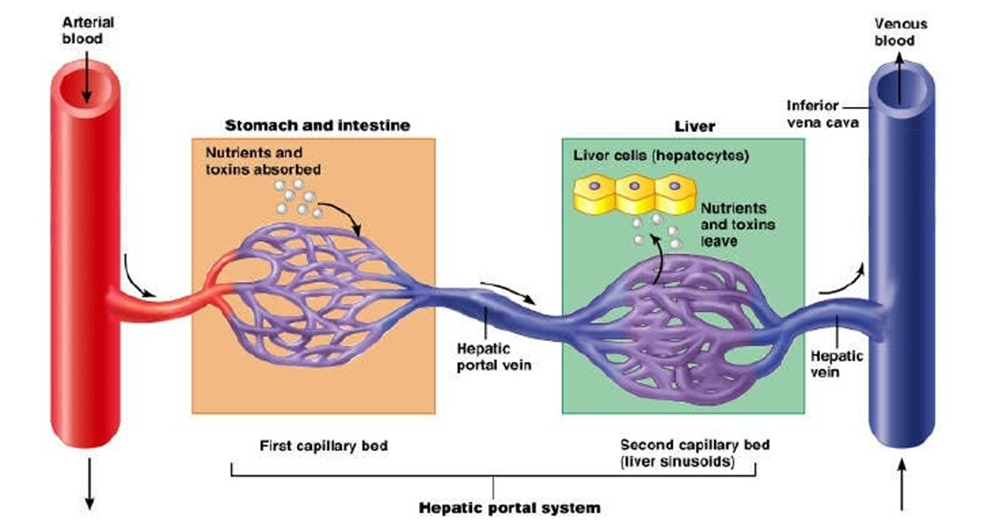
Portal veins
directly connect capillary networks
no pump between networks
3 portal vein systems in the human body
- Discussed in endocrine, digestive, and urinary systems
Vasa Vasorum
blood vessels that supply the walls of arteries and veins
Neural innervation of blood vessels
Sympathetic nerve fibers
parasympathetic nerve fibers
sensory nerve fibers
Aging of the Arteries
Arteriosclerosis
general term for degeneration changes un arteries making
Atherosclerosis
\
slides 28-49; 78- skipped
Pulmonary Circulation
Dynamics of blood circulation
Factors that influence blood movement through vessels
Pressure
Measure of force exerted by blood against the wall
Blood moves through vessels because of blood pressure
Flow
The volume that passes a specific point per unit of time
Flow=(P1-P2/R)
Increase pressure gradient>increase flow
Flow of blood is opposed by resistance (increase resistance> decrease flow)
Laminar flow
Streamlined
no sound
Turbulent flow
interrupted
Resistance
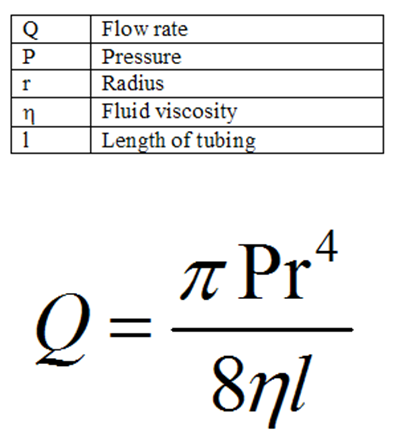
Poiseuille’s Law
Resistance is effected by:
- Blood viscosity increased viscosity> increased resistance
- vessel length increased length> increased resistance (doesn’t really change in the human body)
- vessel diameter increased diameter> decreased resistance
## Viscosity
Measure of resistance liquid to flow
as viscosity increases, pressure required to force it to flow increases
viscosity influenced largely by Hematocrit (the ratio of the volume of red blood cells to the total volume of blood)
- Laplace’s Law
Force acting on blood vessel wall is proportional to diameter of the vessel times times blood pressure
(F=DxP)
- Aneurysm
Bulge that forms in a weakened part of a vessel wall
\
\
\
\ \ \ \ \
Compliance
Vascular Compliance
Tendency for blood vessel volume to increase as blood pressure increases
easier to move and stretch to hold more blood
Physiology of the Systemic Circulation
Circulatory system maintains adequate blood flow to all tissues
determined by: Anatomy of circulatory system
Blood Volume, Mostly in Veins, and then capillaries and arteries
Cross-sectional area
area of one vessel multiplied by the number of vessels of that type
Aorta= Low cross sectional area, High velocity
Capillaries= high cross sectional area, low velocity
Capillary Exchange and regulation of interstitial fluid
Capillary exchange
The movement of substances in and out of capillaries
most important means of exchange: Diffusion
Movement of fluid from capillaries affected by
- Blood Pressure
- Capillary permeability
Osmosis (Water follows Solutes)
Net filtration pressure = Net hydrostatic pressure - net osmotic pressure
Arterial end
Venous end
hydrostatic pressure - pressure against the walls of the capillary
osmotic pressure - Blood colloid pressure; interstitial pressure
\
\