Predation and Evolutionary Responses
Moderating the Effects of Predation
Refugia: Areas with a lack of predators, and self sustaining prey populations - may serve as a ‘source’ for immigrating prey
Stabilise predator-prey dynamics of single populations of predators and prey, leading to increased persistence of predators and prey and increased abundance of prey populations
Prey populations may be topped up by immigration - immigration from refugia may result in ‘rescue effects’ that maintain pre populations in ‘sink’ environments with many predators
sink environments where local reproduction rates are insufficient to sustain the population
Example: Banff, Rocky Mountains
Elk find safety in the town of Banff due to wolves' avoidance of humans. This human shield provides a significant refuge.
Elk disperse from Banff into the surrounding forest to get mopre food when their numbers increase within the town, making them available as prey for wolves. This emigration balances the local ecosystem.
Illustrates the importance of heterogeneous environments, where the landscape offers varied levels of safety and exposure to predators.
Experimental Evidence provided by Gause:
Microcosm 1:
No refugia (no safe place to stay), no immigration.
Both predator (Didinium) and prey (Paramecium) populations collapse over time
Didinium species prey on the paramecium, the paramecium numbers decline. And once the paramecium numbers decline, the Didinium numbers also decline.
Microcosm 2:
Prey refugia, no immigration.
Paramecium numbers increase initially, but Didinium eventually dies out because they cannot access the prey because they are in the refugia hence predator dies out over time
Microcosm 3:
No refugia, immigration of prey.
Oscillations occur as Didinium consumes Paramecium, prey numbers decline followed by predator decline.
Followed by the immigration and reintroduction of new Paramecium causing oscillations.
Huffaker's Experiment (1958):
Examined predator (predatory mites) and prey mites (herbivorous mites) on oranges
Experimental setup (universes): Arrangements of oranges separated by partial barriers (Vaseline) to manipulate mite dispersal. The spatial arrangement was critical in controlling interactions.
Predatory mites disperse primarily by crawling, while prey mites disperse by crawling or ballooning (aerial dispersal),
Petroleum jelly was used to restrict the movement of predatory mites, effectively creating a refugia for prey mites where predators could not easily access them.
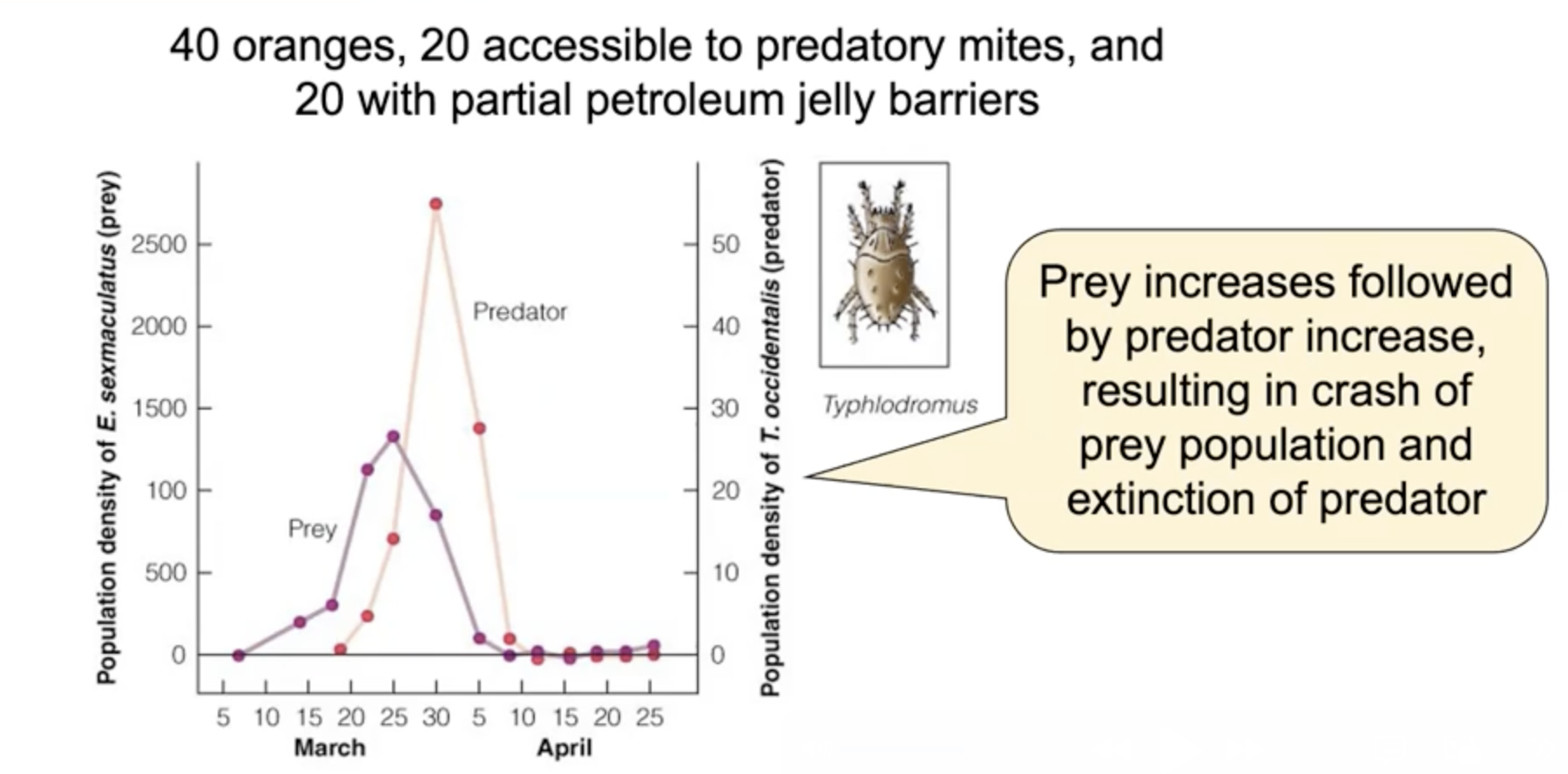
Simple setup: 40 oranges, with 20 accessible to predatory mites and 20 with partial vaseline barriers. Prey numbers initially increase, followed by predator increase, leading to a crash in prey populations followed by crash of predator population
Predator mites eventually overcome barriers, leading to the extinction of both species
Complex model: 252 oranges with connections and parafilm to create a heterogeneous environment with multiple refugia. Oscillation cycle between predator and prey mites persisted longer before the eventual crash
Only a small portion of each orange was exposed which creates refugia for the prey mite, places for it to hide, and making it harder for the predator mite to get all the spots to get to all the spots on the oranges.
and the complex environment facilitated longer cycles between the two mite populations before they eventually both crashed and went extinct.
Heterogeneous environments are more useful in sustaining populations in the long run by providing varied niches and refuges that prevent predators from completely eliminating prey.
Evolutionary Responses to Avoid Predation
Aposematism: The use of colouration to confuse or warn predators of toxicity
deter predators. Aposematic signals are generally visual but can also include auditory or olfactory cues.
Visual signals and markings to warn predators of toxicity or unpalatability.
This is an honest signal because the cost of producing toxins is real and predators learn to avoid these signals.
Examples:
Lionfish: Bright stripes and spines to warn of venomous defenses.
Cuttlefish: Rapid coloration and shape changing to confuse predators,
Blue-ringed octopus: Undergo a colour change when they are threatened and iridescent blue rings glow to warn of its deadly tetrodotoxin venom; highly effective aposematic display.
Red-backed spider and poisonous frogs: Red coloration to signal the presence of toxins
Camouflage and Cryptic Coloration:
Blending in with the environment to avoid predator detection. This is achieved through matching the background color, texture, or pattern, making the organism difficult to distinguish.
Examples: cryptic coloration helps animals blend in with their environment by resembling leaves, bark, or other natural elements.
Mimicry:
Batesian: Palatable species mimic unpalatable ones to avoid predation. The mimic benefits because predators that have learned to avoid the model species will also avoid the mimic.
Examples: Mantis and moth mimicking wasps to deter predators by resembling dangerous stinging insects.
Mullerian: Convergence in appearance of unpalatable species, reinforcing to predators that the colouration/pattern is dangerous. This mutual mimicry enhances predator avoidance learning as multiple species share the same warning signal.
One predators may not realise the model species is poisonous and eat it —> predators learn quickly that all species that look like it may be unpalatable
Benefits both species, as predators learn to avoid the colouration or patterning more quickly, reducing predation rates for all involved species.
Active Defense:
Methods by which prey directly defend themselves against predators, often involving physical or chemical defences.
Bombardier beetle: Sprays hot acid on predators, combined with aposematic colouring as a further deterrent.
Stinging caterpillars (e.g., spitfire caterpillar): Possess hairs that deliver a painful sting upon contact, effectively deterring predators.