PS210 T1 W2 - Lecture 2 - Pidgin, Creole and Regularisation - Notes and Required Reading
Pidgin, Creole and Regularisation
Input
The quantity and quality of language children hear has a profound and long-lasting impact on their language skills
Quantity - recall the case of Genie (previous lecture) who was deprived of any linguistic input until the age of 14 which was extremely detrimental and damaging for her linguistic and language capabilities.
There are also studies that show that the more speech that a mother exposes her child to, the larger the child’s vocabulary will be and the better their linguistic comprehension capabilities will be when the child grows up.
(E.G., Bornstein et al., 2021)
Interestingly, there does not seem to be a correlation between a fathers linguistic input and the child’s linguistic comprehension capabilities.
The quality of the linguistic input that a child receives also matters
It has been found that language found in books directed at children tends to be more complex and richer, as it contains more diverse vocabulary compared to spoken language.
(Nation et al., 2022)
Children who were read ti more often tend to have better reading and language comprehensions skills when growing up. (Niklas et al., 2016)
Communication without a Shared Language?
We can now think of a hypothetical example where we are stuck on an island in the pacific ocean with no form of exit. There are a group of indigenous people who we will need to be able to communicate with in order to survive on the island, yet they do not speak not one of the worlds major languages. What are the options that we have to communicate with these people to survive?
We could learn the peoples’ language, however this will take a lot of time, and requires a lot of formal instruction which will be difficult. We may attempt to teach the people our own language, but the same problems arise.
In colonial times, colonisers would always force their own languages onto the people of their colonies, which is how major language such as English and Spanish spread across the world.
But in other cases, people from different linguistic background may develop a new linguistic background called “pidgin” and “creole”.
Pidgin and Creole:
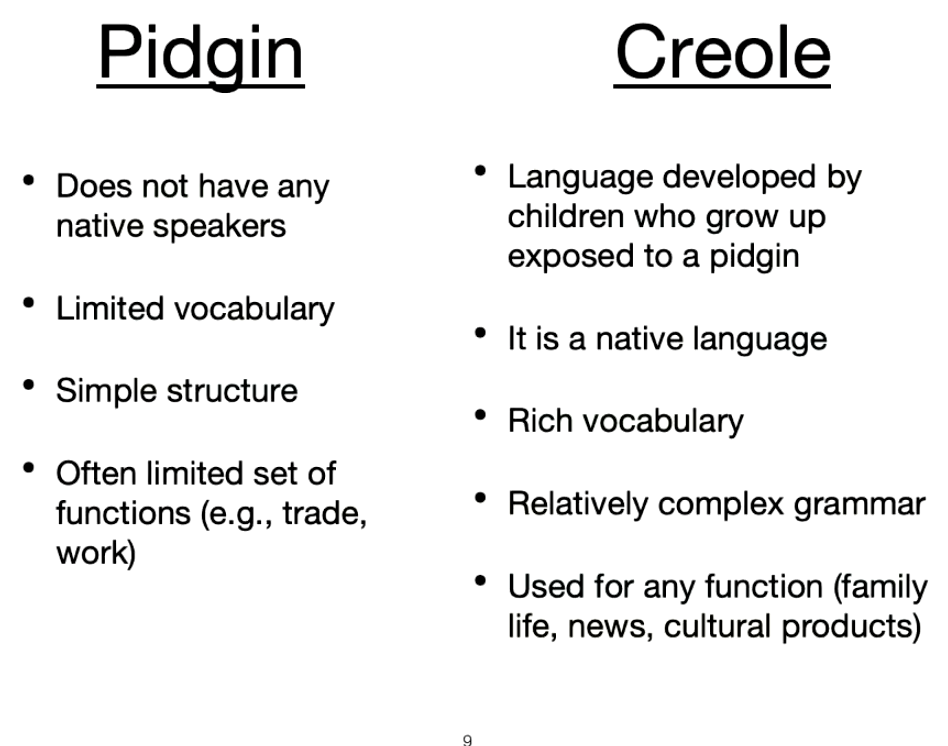
Pidgin is a simplified language that draws on elements of both languages (in our example, it would draw on the language spoken by us, English, and whatever language the indigenous people spoke) which would allow for easier and basic communication. Overtime, if a “pidgin” becomes stable and is developed and learned by children, it may then develop into a “creole”.
Another way to define these two is that pidgins are “non-native lingua francas” whereas creoles have native speakers.
Pidgins usually begin as restricted to a specific purpose of “on the job”, basic communication. E.g., an English speaking colonial power has a sugar plantation and brings workers from different countries to work on the plantation and the workers need to communicate in a shared language. The workers will develop a pidgin language derived from the English the colonial power speaks and whatever language they speak.
However, some pidgins can become “expanded”, meaning that they begin to be used for all facets of life, and they become languages in their own right, being passed down through generations
Pidgin and Creole are not distinct “languages” in the same way that we would refer to Spanish, German etc. They are instead referring to a “category” of languages, which therefore means that there are different creoles and different pidgins spoken all over the world.
Now, if the pidgin language develops and becomes the native language of the next generation, then it is now a “creole” language. E.g., the slaves working on the plantation develop the pidgin language to communicate when working, and this quickly becomes their pidgin language that is now used in everyday life. The children of these people then grow in this environment and the expanded pidgin language then becomes the next generations native tongue. That is now a Creole language.
Now considering HOW a pidgin becomes a creole
Nicaragua (🇳🇮) is important to consider when looking at how pidgins become creoles.
This country holds some significance in psycholinguistics due to the emergence of Nicaraguan Sign Language (NSL) in the 70s.
Before the 80’s deaf people in Nicaragua were largely isolated from each other as there were no formal educational programmes for deaf people. This meant that they were not able to connect with the wider society. When deaf people needed to communicate, they would often use a version of ‘sign language’ that was only restricted to the members of their families. This meant that it would be impossible for them to communicate with anyone who was not a part of their family (and likely, their immediate family) as they would not understand one another
Then in the early 80s, the government of this country establish a Special Ed school, that was aimed at providing education for death pupils. However, the syllabus being taught was centred around spoken Spanish, a language that the deaf pupils had not heard or fully grasped. The curriculum was not tailored to the death pupils. Despite this, the school became the gathering place for death children, despite its flaws. As a result of this, the children who were here developed a signing system in absence of a formal Sign Language that allowed them to communicate, and so a “pidgin” was developed.
The original system was simple and basic, and was only capable of expressing basic needs and ideas e.g. “I want food/ water”. However, this laid the groundworks for more a more sophisticated system to be developed over time. The language that the children developed was then passed down to the next set of pupils who would be enrolled into the school the following year.
How the early gestural system evolved into Nicaragua Sign Language? - Senghjas, Kita, & Ozyurek 2004
Researchers studied a group of 30 deaf Nicaraguan children who learned NSL, in which they were grouped into three cohorts, based on when they entered the special education school. The three groups of children were:
first cohort (before 1984) - these children developed the earliest and most basic gestural system. They learned gestures that were simple enough to the point that they were understandable even to outsiders.
Second cohort (1984-1993) - the system had now evolved a little bit. The children here now learned a more structured system of NSL.
third cohort (1993+) - Now, the NSL is now an established, recognised, and developed language that was now comparable to other sign languages with clear grammar and syntax.
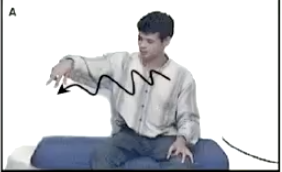
To compare these groups, the researchers studied these students, and compared their gestures to the gestures produced by 10 hearing Nicaraguan students who spoke Spanish. They asked the children in the cohorts to describe a video, and then they asked the 10 hearing students to do the same thing. The video that the children were presented with (according to the lecture) was of a cat who had swallowed a bowling ball, and then had rolled down a hill. Those who are not deaf and thus do not have experience in sign language may use gestures to describe this video by making a rolling motion with their hand, and then motion/signal their hand in a downward slanted motion to represent the fact that the cat was rolling downwards on the hill. This is known as “Sequential Gesturing”.
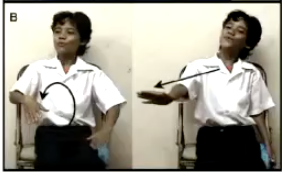
There are 2 things that need to be considered when describing the event: the rolling (manner of movement), and the path of movement going downwards.
However, it is also possible to represent what was seen in the video through just one gesture instead of two (1- rolling motion with your arms, 2- moving arms downwards), which is what hearing people who have no experience in sign language would do which is simultaneously making a rolling gesture with your hand and moving it in a downwards diagonal direction. This can be known as “Simultaneous Gesturing”.
The results of this study:
The results showed that the students that could hear and had no experiences with NSL, 100% of the time, they used simultaneous gesturing to describe the video. Of the first cohort of deaf students that attended to special education school (the cohort of children before 1984), about 70% of them used simultaneous gesturing also.
This suggests that this cohort of children may have been mimicking close speech gestures of the Spanish speakers. This may be because this group of children may still have needed to interact with people who are hearing well, and so would have mimicked what hearing people would have done in order to make the gestures understandable to both hearing and non-hearing people.
In the second cohort of deaf students who attended the special education school (1984-1993), the vast majority of these pupils used Sequential Gesturing to describe the video.
This could suggest that as the NSL developed, they were communicating more with other deaf people than hearing people, and thus needed more complex gestures to communicate more fluently.
In the third cohort (1993+), the results were similar, being that the vast majority used Sequential Gesturing when describing the video.
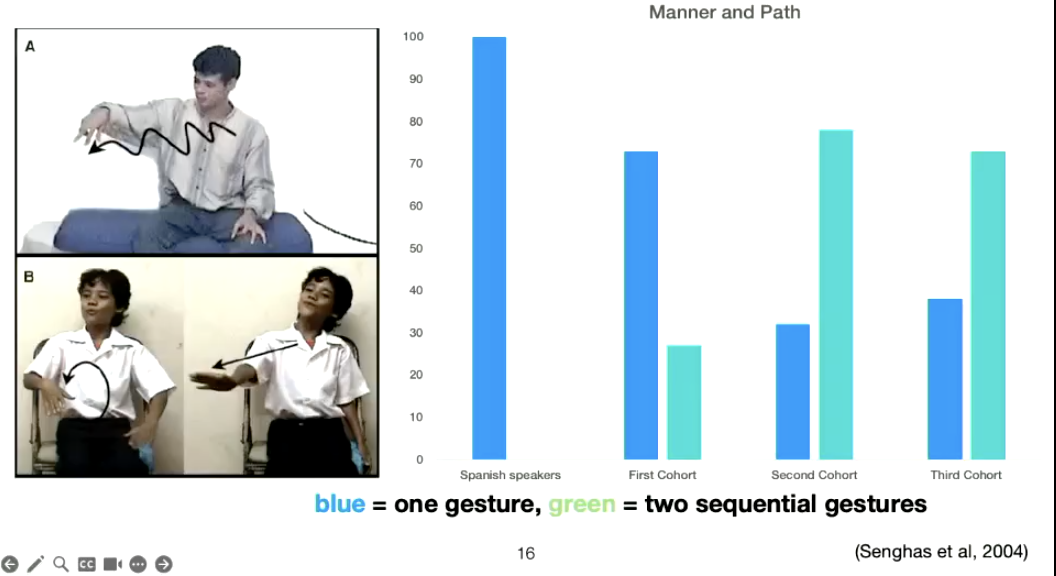
This shift shows that those who learned NSL at a later time, were not simply copying earlier forms of NSL, or trying to mimic hearing peoples’ gestures, and were instead building a separate and complex linguistic system with more complex gestures.
If later 2 cohorts of students were mimicking the earlier form of NSL, it would predict that their performance would be identical to those in the first cohort, but that is not the case.
Conclusions from Senghas et al., (2004):
NSL signers do not always reproduce the same gestures that well-hearing people happen to produce when they talk. This means that NSL signers are not just mimicking the gestures that well-hearing people. would make, and are making their own linguistic system.
The deaf children who developed NSL, took the gestures of well-speaking people, and analysed them into two distinct units. This is significant because it reflects the emergence of a morphological systems, which refers to the rules that govern the structure of words. The fact that NSL signers were able to develop the two discrete units suggests that they created a unique linguistic system.
(Morphology: rules that govern the structure of words e.g. The word unhappy comprises two morphemes: [un] & [happy])
It also demonstrates that children can build a new linguistic system, even though their linguistic input is relatively impoverished. The fact that when all of the deaf children were brought together, and were then able to develop and build what is now known as NSL highlights the remarkable capacity that children have to innovate language.
(Important to note that this is different to the case of Genie (done in previous lecture) who received no linguistic input during their childhood. In contrast, the Nicaraguan children did receive SOME input during childhood. Although not from a fully developed language, as they were raised in households were they may have observed gestures as speaking language, and so did receive linguistic input.)
What happens during creolisation?
What “creolisation” refers to is the development of a pidgin language to a creole.
Example language used: Hawaiian pidgin, developed in Hawaii in the 19th century
This emerged as a means of communication between workers on sugarcane plantations who from diverse linguistic backgrounds. As a result of their being a large amount of different linguistic backgrounds being brought together under this pidgin, there are a lot of unpredictable things that can be observed. E.g.:
The terms “he” and “she” might be used interchangeably regardless of gender. Meaning that a man may be called “she” and a woman may be called “he”. This depended on the speakers preference and context of the conversation.
Additionally, “him” or “her” could be used for both the subject and object position. In english the words “him” and “her” are always used as the object position in a sentence. Eg. “I saw him.” But in Hawaiian Pidgin, that is not the case. Meaning in this pidgin, it would be viable to say, “Him go store”, even though in English, one would say “He went to the store”.
Because pidgins emerge from blending multiple languages that have their own grammar, pidgins (like Hawaiian) have “Unpredictable (random) Variation”. This is in contrast to fully developed languages such as English that have a very fixed set of rules.
What should be noted, however, is that whilst pidgins can contain a lot of random variation, creoles (or other full-fledged languages) rarely do. An implication of this is that unpredictable variation disappears over natural evolution of the language and development.
How does unpredictable variation disappear when pidgins transition into creoles?
The process of random variation is referred to as “regularisation” in psycholinguistics. This happens when people eliminate random variation by using only one of the variants.
The following two experiments look at how random variation became regularised by children:
Deaf child learning American Sign Language (ASL) - (Singleton & Newport, 2004)
A deaf child named Simon who was 7 years old who was a native ASL signer who learned from non-native signers (his parents who learned ASL decades later in life and so were not that good at it). This means that Simon received very basic grammar in ASL from his parents.
What is significant about this case is that Simon’s only language input is from his parents (who do not natively communicate in ASL and are poor in it) and has not communicated with any people who are native communicators in ASL.
In the experiment, a morphology task was presented to children. Here are the results:
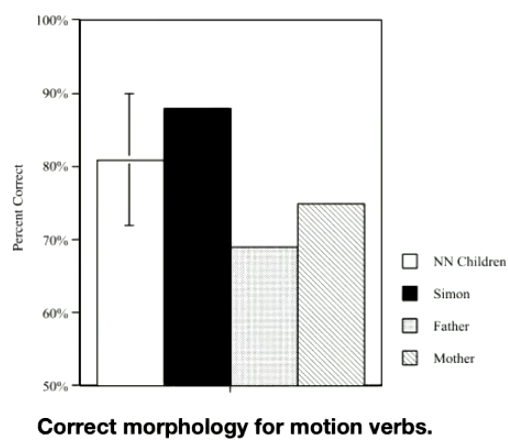
(NN children [6-10 years old] = Native of Native, meaning that these children learned from parents who were Native signers of ASL).
For the NN children, they performed fairly well, over 80%. Whilst this is not perfect, they are fairly young and their language is still developing, so for their age, this is a good score.
For Simons parents, since they learned ASL decades later in life compared to the NN children, their scores are predictably lower than the NN children, with the father scoring around 70%, and the mother at around 76%.
Now, when predicting what Simon would score, since he learned from parents who were not native signers, it would be reasonable to predict that he would score similarly to his parents. However, this was not the case. Simon outscored his parents, and was on par with the NN children.
To explain this, we use “unpredictable (random) variation” and “regularisation”. Because Simons parents learned ASL decades later in life, they were not perfect at the language and often made mistakes in the sentences that they produced, and would sometimes produce ungrammatical sentences. This can be likened to unpredictable variation. Now, instead of Simon simply picking up the random variation in the grammar his parents were inputting, he “regularised”, essentially choosing the correct grammatical versions of his parents’ sentences, which allowed him to perform as well as the NN children.
Whilst this is informative, he sample size is small, and so we cannot conclude a lot from this case study. The next study has a larger sample group with the aim of producing more convincing evidence.
Studying regularisation in the lab - Hudson Kam & Newport, 2009)
Here, researchers created perfectly controlled environments to study how children regularise linguistic input when the input is unpredictable. This is referred to as an artificial “language experiment”.
In the following experiment, the participants would watch a video, and would then be given a “sentence” in a gibberish language that would be describing the video seen.
In the experiment (according to lecture) the participants were presented with a video of a bee attempting to hug an elephant, and were then presented with the gibberish sentence (Glim flugat ka daffin po) (flugat = bee, daffin = elephant). What is important here is the red words, which are determiners (e.g., words in English like “the”, “a”, “an”, “my”, “this” etc). In this study, the paring of the determiners and nouns is arbitrary, which means that any of the nouns can be followed by any determiner with limited consistency. In this gibberish language, it should be noted that the determiners are coming after the noun, where as in English, the determiners come before the noun.
In the experiment, there were both adults and children, where there were 4 conditions. The 4 conditions were:
1. The consistent condition - there is no variation in the mappings of the determiners and the nouns. This means that flugat is always followed by ka and daffin is always followed by po.
2. 60% presence/40% absence of determiner (not important)
3. 60% occurence of the main determiner form, alternating with 2 “noise determiners” that each occurred 20% of the time. This means that most of the time, “flugat” is followed by “ka”, and then there are other times where “ka” will be followed by a noise determiner. (more important)
4. 60% occurrence of the main form and 4 noise determiners, each occurring 10% of the time. (more important)
Results of this experiment:
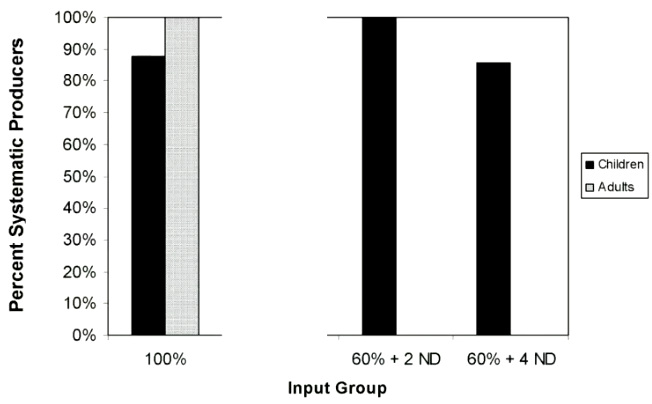
The graph on the left represents the first condition of the experiment. The Y axis represents the percentage of participants who consistently use the same determiners. The higher the number, the higher the amount of participants that stuck with one determiner(s). What 100% means here is that all participants in either group always used the same determiners consistently, meaning that since the bar representing the adult group is at 100%, all participants in this group used the determiners consistently.
The graph on the right shows conditions 3 and 4 where there is some inconsistency. For the children, it can be seen that when there is noise in the learning input, they end up using consistent determiners in the test phase. The reason for there being no bar for the adults is because none of the adults tried to be consistent. What this means is that the adults were trying to recall what they had learned during the previous exposure. They weren’t trying to regularise, and were just recalling what they had received
What this study shows is that children are more systematic users than adults: they eliminate the unpredictable variation by regularising their input.
English may be a creole.
Before the year 1066, people in England spoke old english, which had a system of grammatical genders, similar to that of German, with three genders, masculine, feminine, and neuter.
In 1066, the Normans who spoke French invaded and conquered England. The ruling class spoke Norman french, where the common people continued to speak old English. This resulted in intense language contact between the two languages, and so the Old English borrowed words from Norman French. This then caused confusion between common speakers, thus leading to regularisation and leading to the english spoken today.
Required Reading
Paper 1 - Getting it right by getting it wrong: When learners change languages - Carla L. Hudson Kam
1. Main aims of the study
Summary:
The authors aimed to understand why and when learners “regularize” inconsistent linguistic input—that is, when they turn variable, probabilistic grammatical patterns into more consistent ones. They examined types of inconsistency and differences between adults and children using artificial-language experiments.
Quote (required):
“We present results from three experiments investigating how humans learn from languages containing inconsistent or probabilistic grammatical tendencies… asking about the circumstances under which they succeed at learning the variation veridically, and when and why they make the language more regular.”
PS210 T1W2 - Required Reading -…
2. Author’s initial hypothesis
Summary:
The authors hypothesised that:
Adults would generally match probabilities in the input but might regularize when exposed to complex inconsistency.
Children would regularize far more readily than adults.
The nature of inconsistency itself determines whether learners replicate or regularize.
This is implied across the introduction; e.g., adults probability-match in previous studies, while children regularize inconsistencies.
(No quote required for Q2.)
3. Key research questions
The authors explicitly structured the study around these questions:
Does the complexity of inconsistency influence whether adult learners regularize? (Experiment 1)
Is regularization in adults caused by inconsistency itself, or just low-frequency forms? (Experiment 2)
Do children regularize more than adults when exposed to the same inconsistent patterns? (Experiment 3)
These questions are stated throughout the Introduction (especially pp. 31–36).
PS210 T1W2 - Required Reading -…
(No quote required for Q3.)
4. Key arguments made
Summary of main arguments:
Natural languages rarely have true probabilistic inconsistencies, but second-language learners and emerging creole speakers DO, and children often regularize them.
Artificial-language learning can reveal mechanisms of regularization by isolating input variables.
Adults tend to reproduce variability unless inconsistency is sufficiently complex; children regularize even simpler inconsistencies.
Regularization may stem from general cognitive constraints, not just language-specific mechanisms.
Quote (required):
“Learners, it seems, are able to ‘fix’ or repair this kind of abnormal input. Here we examine how this change is accomplished, by examining the kinds of information that human learners extract from inconsistent linguistic input.”
PS210 T1W2 - Required Reading -…
5. What experiments did they conduct?
They ran three artificial-language learning experiments:
Experiment 1
Adults learned languages with inconsistent determiners, varying in complexity (2, 4, 8, or 16 “noise” determiners). Purpose: test whether complexity induces regularization.
Experiment 2
Adults learned a complex but fully consistent language with the same number of determiners as Experiment 1. Purpose: test whether low frequency alone explains difficulty.
Experiment 3
Compared children vs adults learning scattered inconsistency. Purpose: test whether children regularize more broadly.
(No quote required for Q5.)
6. HOW were these experiments conducted?
General method across experiments:
Participants were exposed to a miniature artificial language via videotaped scenes paired with spoken sentences.
Exposure lasted 8 sessions, ~25–29 min each.
Languages differed only in the structure of the determiner system.
Testing included:
Vocabulary test
Sentence production (sentence completion)
Grammaticality judgments
General grammar tests
Quote (required):
“Participants were seated in front of a video monitor… They then heard a sentence in the miniature language that described the scene… There was no explicit instruction… Participants learned the language solely from the auditory exposure.”
PS210 T1W2 - Required Reading -…
7. Findings of the experiments
Experiment 1 – Adults & inconsistency complexity
Control (simple inconsistency): Adults reproduced inconsistencies (probability-matching).
High complexity (many noise determiners): Adults increasingly regularized, using the main determiner far more than 60% input frequency.
At highest complexity (16 noise determiners), adults used the main determiner ~90% of the time.
Quote (required):
“Participants exposed to 16 noise determiners produced the main determiner forms almost 90% of the time, a full 30% more often than they heard them.”
PS210 T1W2 - Required Reading -…
Experiment 2 – Frequency vs inconsistency
When input was complex but perfectly consistent, adults learned low-frequency forms accurately.
Thus regularization is NOT caused by low frequency, but specifically by inconsistency.
Experiment 3 – Children vs adults
Children almost always regularized, even with much simpler inconsistency.
Adults only regularized under extreme scattered inconsistency.
8. Summary of the discussion section
The authors argue that:
Regularization occurs when learners cannot track or store inconsistent, probabilistic variation.
Adults can learn inconsistent forms when variation is simple, but struggle when variation is scattered across many low-frequency alternatives, leading to regularization.
Children, by contrast, regularize almost all inconsistent patterns, suggesting stronger biases toward rule-formation.
These patterns help explain:
Why children create more regular languages (e.g., creoles, Simon learning ASL).
Why adult second-language learners fossilize irregular, inconsistent systems rather than eliminate them.
The results support the idea that general cognitive mechanisms, including memory limitations, underlie regularization.
Quote (required):
“Our results suggest that regularization processes… depend crucially on the nature of language learning by young children.”
PS210 T1W2 - Required Reading -…
9. Conclusions the authors arrived at
Main conclusions:
Adults and children do not learn inconsistent linguistic input the same way.
Adults regularize only when inconsistency is high and scattered; otherwise they probability-match.
Children regularize broadly, suggesting an intrinsic developmental bias.
Regularization likely arises from general learning constraints, not special linguistic mechanisms.
These results provide insight into the emergence of more regular grammar in creoles, child learners, and situations of inconsistent input.
Quote (required):
“Humans can learn from inconsistent linguistic input, but they also make it more consistent under certain circumstances… importantly, the degree to which they regularize depends on both the age of the learner and the nature of the inconsistency.”
PS210 T1W2 - Required Reading -…
Paper 2 - Children Creating Core Properties of Language - Ann Senghas
1. Main aims of the study
The study aimed to investigate how fundamental linguistic properties — specifically discreteness and combinatorial patterning — emerge when children create a language in the absence of an existing fully-formed linguistic model. The authors examined Nicaraguan Sign Language (NSL), a brand-new sign language created spontaneously by deaf children in Nicaragua over about 25 years.
Quote:
“This study asks whether these properties can arise naturally as a product of language-learning mechanisms, even when they are not available in the surrounding language environment.”
PS210 T1W2 - Required Reading -…
2. Author’s initial hypothesis
The authors hypothesised that children possess innate learning mechanisms that naturally segment complex events into discrete elements and recombine them into structured, hierarchical linguistic forms, even when the input environment does not provide these forms.
In other words, children—not adults—would introduce linguistic structure into the emerging language.
(No quote required for Q2.)
3. Key questions the author was investigating
The paper investigated these core questions:
a. Can universal language properties (discreteness, combinatorial patterning) emerge spontaneously in a newly formed language?
b. Do children, rather than adults, drive these structural innovations?
c. Will successive cohorts of children further refine and systematise the structure introduced by earlier child learners?
d. Do learners prefer sequential, segmented expression even when a simultaneous gestural model is available?
These questions all tie back to whether child learning mechanisms imprint core linguistic structure onto a language.
(No quote required for Q3.)
4. Key arguments made
The authors argued:
a. Children naturally introduce linguistic structure
Children in the early NSL cohort were the first to segment continuous events (like rolling-down) into discrete elements (manner + path), even though the surrounding gestures expressed these things simultaneously.
b. Successive child cohorts expand and regularise this structure
Later (younger) cohorts increased the use of sequential signs and developed more complex hierarchical structures, such as A-B-A constructions.
c. Gesture ≠ language
Even though NSL originated from gesture, signers quickly diverged from gesture-like holistic expression to linguistic sequencing.
d. This reveals innate learning mechanisms
Children impose discrete and combinatorial structure on communication systems, showing that human learning predispositions shape language formation.
Quote:
“NSL thus quickly acquired the discrete, combinatorial nature that is a hallmark of language.”
PS210 T1W2 - Required Reading -…
5. What experiments did they conduct?
The authors conducted a comparative production study involving:
30 deaf NSL signers divided into three cohorts (1st cohort pre-1984; 2nd cohort 1984–1993; 3rd cohort post-1993).
10 hearing Nicaraguan Spanish speakers as a comparison group.
Participants:
Watched an animated cartoon.
Retold the story to a peer.
Researchers analysed how they expressed motion events (manner + path).
They coded whether participants expressed these components:
Simultaneously
Sequentially (manner-only + path-only signs)
Using A-B-A hierarchical structures
(No quote required for Q5.)
6. HOW were these experiments conducted?
The procedure:
Participants viewed an animated cartoon depicting complex motion events (e.g., rolling down a hill, climbing up a wall).
They were videotaped retelling the cartoon to a peer.
Deaf participants used NSL; hearing participants spoke Spanish, but researchers only analysed their co-speech gestures.
Narratives were coded for how manner and path were integrated:
Simultaneously in one holistic sign/gesture
Sequentially as separate signs
Hierarchically using A-B-A patterns
Quote:
“We presented participants with an animated cartoon and videotaped them telling its story to a peer… Those expressions that included both manner and path information were coded with respect to how the information was integrated.”
PS210 T1W2 - Required Reading -…
7. Findings of the experiments
a. First cohort:
Still used simultaneous gesture-like expressions most of the time, but introduced some sequential segmentation (27%).
b. Second and third cohorts:
Massively increased use of sequential, discrete manner-then-path constructions (≈75%).
Introduced and regularised hierarchical A-B-A structures to indicate simultaneity.
c. Hearing speakers:
Used purely simultaneous gestures (never sequential).
Overall finding:
Children—not adults—introduced and expanded the discrete, combinatorial linguistic structure of NSL.
Quote:
“As second and third cohorts learned the language… they rapidly made this segmented, sequenced construction the preferred means of expressing motion events.”
PS210 T1W2 - Required Reading -…
8. Detailed yet succinct summary of the discussion
The discussion argues:
1. Children imposed linguistic structure on an initially gestural communication system.
Although the first cohort’s signs looked like co-speech gestures, they introduced segmentation of events into elemental units (manner + path).
2. Later cohorts built on this foundation, systematising linguistic structure.
Second and third cohorts expanded sequential constructions and developed hierarchical forms like A-B-A, enabling expression of embedded relationships—something gestures cannot do.
3. This demonstrates innate learning biases.
Children favour:
Segmentation (breaking wholes into meaningful units)
Linear sequencing, even when simultaneous expression is possible
Hierarchical organisation
These mechanisms likely shape every human language.
4. Adults cannot restructure the language in the same way.
Child learners shaped NSL; adults retain its earlier forms and do not acquire later innovations, highlighting a preadolescent sensitive period.
5. The findings challenge theories claiming language structure is purely culturally inherited.
Because children recreated linguistic core properties with no model, this indicates these properties may come from the child learning mechanism itself, not merely from existing languages.
Quote:
“The rapid restructuring of Nicaraguan Sign Language… shows that even where discreteness and hierarchical combination are absent from the language environment, human learning abilities are capable of creating them anew.”
PS210 T1W2 - Required Reading -…
9. Conclusions of the author
The authors conclude:
a. Children naturally create the core structural properties of language.
They dissect holistic events into discrete units and recombine them into sequential and hierarchical forms.
b. These mechanisms drive language emergence and evolution.
As long as children participate in learning a language, its structure will be shaped by segmentation and combinatorial organisation.
c. Linguistic universals may reflect child learning mechanisms.
Rather than language shaping children, children may shape language.
d. NSL provides real-time evidence for how new languages can gain structure even without adult linguistic models.
Quote:
“Human learning abilities are capable of creating them [discreteness and hierarchy] anew.”
PS210 T1W2 - Required Reading -…