Music Theory
Notes and the Clefs
Notes
The piano started at C1 before A and B were added, so in order of the piano, the octaves start at C.
ex. A3 B3 C4 D4 E4 F4 G4 A4 B4 C5

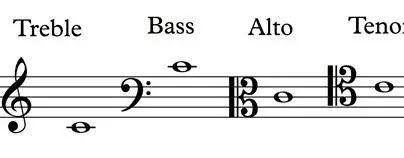
Treble Clef
The spiral circles around G
Bass Clef
The two dots are on either side of F
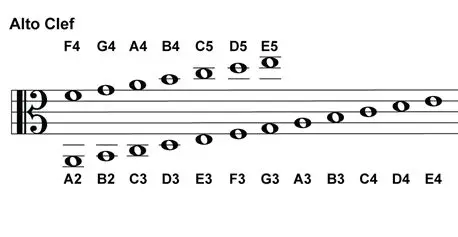
Alto Clef
The wherever the middle of the clef symbol is, is middle C (C4)
Time Signatures
Simple meter: the numerator beat is divisible by 2 eighth notes (1, 2, 3, 4, 8)
Compound meter: the numerator beat is divisible by 3 eighth notes (6, 9, or 12)
Duple - 2 pulses
Triple - 3 pulses
Quadruple - 4 pulses

Scales and Key Signatures
tonic - supertonic - mediant - subdominant - dominant - submediant - leading tone(subtonic m) - tonic
1^ 2^ 3^ 4^ 5^ 6^ 7^ 8^
Transposition- preserves scale intervals while shifting to a new pitch level
Major
W-W-S-W-W-W-S
Minors
Natural minor
W-S-W-W-S-W-W
Harmonic minor
Raise the 7th scale degree a semitone
The 6th and 7th scale degrees create an augmented 2nd
Melodic minor
Ascending- Raise the 6th and the 7th scale degrees
Descending- Revert back to natural minor scale
Circle of Fifths
Flats get added → BEADGCF ← sharps get added
With every counterclockwise turn around the circle, the tonic pitch descends five steps and one flat is added (one sharp is taken away)
With every clockwise turn around the circle, the tonic pitch ascends five steps and one sharp is added (one flat is taken away)

Relative key: major and minor keys with the same key signature
Parallel key: major and minor keys with the same tonic
Scale degrees 3, 6, and 7 are a semitone lower in the parallel minor
Identifying Keys
Look at the key signature to narrow down options to one major and the relative minor
Look for accidentals (is it a type of minor or are the accidentals random?)
Look at the highest note in the treble line and the lowest note in the bass line, what is the arrival note?
Do the accidentals agree with either the major or minor scale, or does it align with a different key?
Collect the notes you see and line them up to create a scale, identify a potential matching scale
Writing Chords from Keys

Look at the key and determine the root from the roman numeral (ex. D: IV is key of D major and the fourth chord, so we know the root of the chord is the fourth note, G)
Spell out the rest of the chord in it’s root position (ex. IV is major so spell a perfect fifth and a major third from G)
Adjust notes up or down the octave to fit the figured bass notation (ex. a 6 marking means the third of the chord is now the root)
Intervals
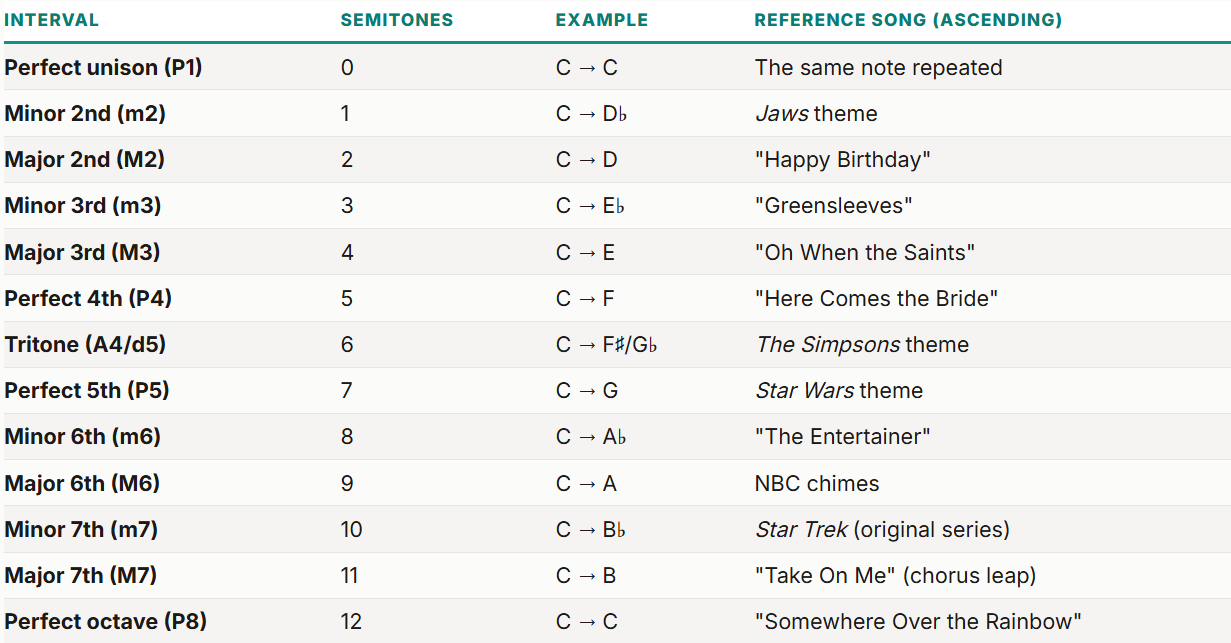
Interval: A distance between two notes
Named after how many lines and spaces the interval spans
ex. an interval spanning two lines and spaces is a second
Size: Total number of lines and spaces spanned between the two notes including where the notes rest
Quality: Precise number of semitones between the two notes
Harmonic interval: Two notes played at the same time (harmony)
Enharmonic interval: Same number of semitones, different number of scale steps (at least one is dissonant)
Natural interval: Written without intervals, only white notes are played
Inverted interval: Two notes are reversed in position (one moves up an octave or one moves down), done by dividing the octave into two smaller parts
When an interval is inverted, the sizes add up to nine
A second inverted turns into a seventh, a fourth inverted turns into a fifth, a sixth inverted turns into a third…

Melodic interval: Two notes are played one after the other (melody)
Simple interval: The interval notes fit within an octave
Compound interval: The interval is farther than an octave
Numerical interval
1. Major/minor
2nd, 3rd, 6th, 7th
Major intervals contain one more semitone than the minor interval
In a major scale, all intervals after the tonic are either major or perfect
In a minor scale, all intervals after the tonic are either minor or perfect except for the major second between scale degrees 1 and 2
Augmented interval contains one more semitone than the major
Diminished interval contains one less semitone than the minor
2. Perfect
unison, 4th, 5th, 8th(octave)
Augmented intervals contain one more semitone than the perfect interval
Diminished interval contains one less semitone than the minor
Consonant Intervals:
Major and minor 3rds and 6ths, perfect 5ths and 8ths (perfect 4ths are context-dependent)
Considered ‘resting points’; all other intervals are considered dissonant
Perfect consonances: perfect unisons, perfect fifths, perfect octaves
Imperfect consonances: major and minor thirds and sixths
Determining Interval
Odd or even
Odd: Both notes are on lines or both notes are on spaces
Even: One note is on a line, one note is on a space
Size
How many semitones are within the interval
ex. five lines and spaces = fifth
Quality
What can the interval be based on size
ex. a 6th can only be major, minor, augmented, or diminished, but not perfect
Scale
Think of the low note of the interval as the tonic of a major scale and check if the higher note is included in that scale’s key signature
ex. E and C# —> E major has four sharps and C# is one of them. Intervals in major scales are either major or perfect and since E and C# is a 6th, it can’t be perfect, making E and C# a major 6th (M6)
Triads
Triad: A chord made up of three notes 5/3
Can be major, minor, augmented, or diminished
Major and minor triads have a perfect fit between the root and the fifth, the quality comes from the quality between the root and the third
Perfect fifth = major or minor, minor third= minor triad, major third= major triad
Augmented and diminished chords have major and minor thirds between the root and the third, so name comes from the quality of their fifth
Augmented or diminished fifth= augmented or diminished triad, minor third=diminished triad, major third=augmented triad
Chords in a Major Key: I ii iii IV V vi vii^o VIII
Chords in a Minor Key: i ii^o III iv v VI VII viii
Determine triad
determine quality of the fifth
determine quality of the third
Writing triads
write the root
write a stack of generic thirds above the root
adjust the fifth with an accidental as needed
adjust the third with an accidental as needed
degree symbol = diminished
+ = augmented
Inversions
When the root note is in the lowest/bass position, the triad is in root position
The triad is considered to be inverted when the lowest note is not the root note
Bass vs. Root
Bass=lowest sounding note in a chord
Root=foundation of the chord, bottom note in root position (stacked thirds)
Identifying/writing inversions
Bass note is the one that matters
Upper voices can be any order or spacing
Figured bass- intervals above the bass
Root position (5/3) - “ending” “most stable”
First inversion 6/(3) - “middle” “going somewhere”
Second inversion 6/4 - “least stable”
Determined only by the lowest note of the triad
Third of the triad as the bass = first inversion, creating a third and sixth above the bass 6/3
Fifth of the triad as the bass = second inversion, creating a fourth and a sixth above the bass 6/4
Figured bass symbols: intervals above the bass
Recognizing inverted triads
move the notes around (octaves) to create a root position triad
identify the position of the bass
Writing inverted triads
spell out the chord
determine which note of the triad needs to be the lowest
Seventh Chords
Four notes stacked in thirds
Quality is determined by the triad quality and the seventh quality
Triad quality is written first, and then seventh quality


Inversions
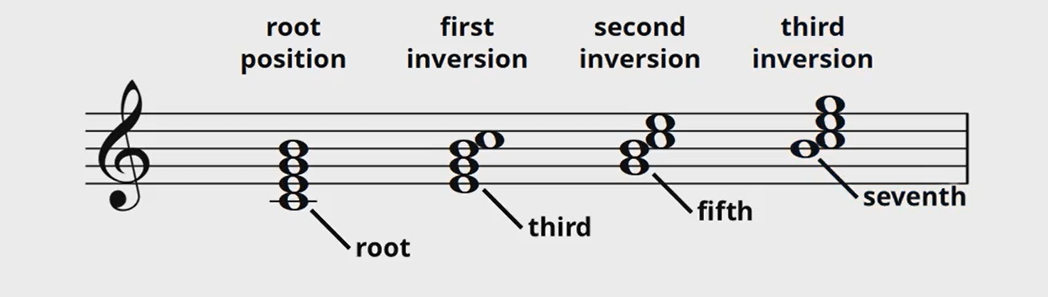
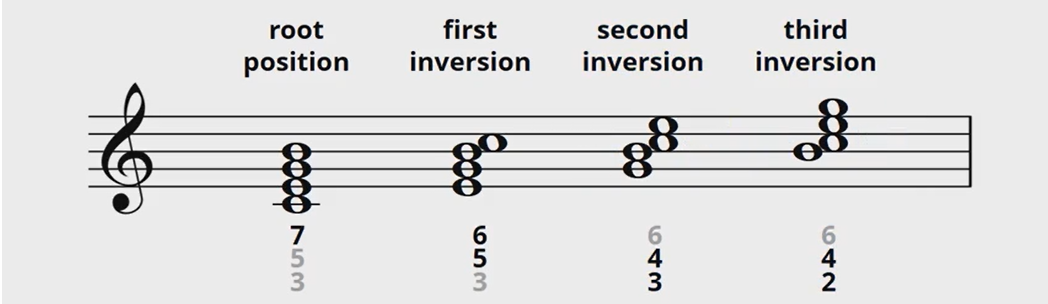
When the root note is at the bottom, the seventh chord is in root position, shorthand 7 (7/5/3)
When the third of the seventh chord is at the bottom, the chord is in first inversion, shorthand 6/5 (6/5/3)
When the fifth note is on the bottom, the chord is in second inversion, shorthand 4/3 (6/4/3)
When the seventh note is on the bottom, the chord is in third inversion, shorthand 4/2 (6/4/2)
Chords on the Grand Staff
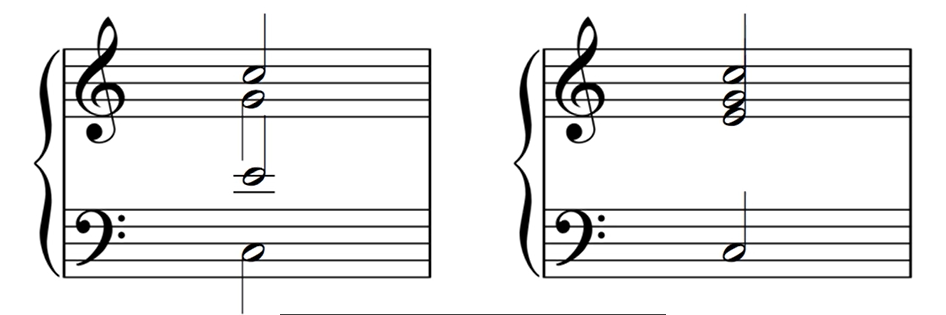
SATB/Chorale style
Written for singers: sopranos, altos, tenors, and basses
Each singer has their usual range, so keep that in mind when writing for each part
Stems for each voice alternate: bass and alto stems point downwards, tenor and soprano stems point up


Spacing
Upper voices should be no more than an octave away from the next closest voice
Soprano and alto voices should be within an octave of each other, alto and tenor voices should be within an octave of each other
The distance between tenor and bass is unrestrained as long as they fall within their usual ranges
Soprano should always be written above or in unison to the alto voice even though the ranges overlap, alto always above or in unison to tenor, and tenor always above or in unison to the bass
Keyboard style
Right hand takes upper voices while left hand plays bass
Spacing
Soprano and tenor distance should not be more than an octave
Distance between bass and tenor is unrestrained
Comparison
Realizing Chords from Roman Numerals
Spell out chord using letter names'
Determine the inversion and the bass note
Write the bass note on the staff
Doubling guidelines for triads (three notes but writing for four voices)
Root position: double the bass
First inversion: double any note*
Second inversion: double the bass
*Never double the leading tone of the key or any chordal dissonance
Write the remaining notes in any voice as long as it fits within the proper range
Writing Chords from Figures
The figures represent the intervals above the bass
There can be accidentals that tell you to raise or lower a given note above the bass, an accidental with no figure means it applies to the third above the bass
Notes above the bass do not have to follow the order given in the figure
Voice Leading
Motion
Contrary: Voices moving the opposite direction
Oblique: One voice stays the same, the other moves
Parallel: Same direction in the same intervals
Similar: Same direction, but not identical intervals
Guidelines
Contrary motion is preferred, mainly between the outer voices (bass and soprano)
Oblique and stationary motion are okay, especially between the middle voices (tenor and alto)
Parallel thirds and sixths are good, parallel perfect fifths and octaves are evil
Avoid similar motion when approaching a perfect interval unless the upper voice moves by a step
No hidden or direct octaves
Upper voices should move smoothly, avoid leaping more than a sixth (leaping in upper voices is okay in sustained chords though)
Avoid augmented intervals between chords
Avoid making the bass leap more than a seventh
Avoid approaching the leading tone with an ascending melodic leap of more than a third
If the leading tone appears in an outer voice, the next chord has to have that voice going up to the tonic, inside voices having the leading tone don’t need to go a step up to the tonic
Chordal sevenths should resolve a step down in any voice (can be shifted to another voice/register and then resolved down, can be repeated and then resolved down)

Musical Narratives
Phrase: basic unit of tonal music communication, a complete thought, a musical sentence
Cadence: musical punctuation, the closing harmonic/melodic/rhythmic material
V → I = authentic cadence, ends at home (tonic) (like a period)
Perfect (final/complete): ends with root position V/V7 and root position tonic; soprano ends on DO (tonic)
Imperfect: incomplete in some way, usually either the soprano doesn’t end on the tonic or the dominant isn’t root position V/V7
→ V = half cadence, ends away from home (dominant) (like a question mark)
Not all V → I are cadences, look for where it makes sense (usually pauses, endings, etc)