Wakefulness & Sleep (Week 8)
Definition (#f7aeae)
Important (#edcae9)
Extra (#fffe9d)
Circadian Rhythm:
Endogenous circannual rhythm:
These are internal body rhythms that follow a yearly pattern.
Found in some animals. Happen even without outside cues like weather or daylight.
Endogenous circadian rhythm:
Internal rhythms that follow a 24-hour cycle.
Found in all animals, including humans.
Help regulate daily activities and body functions.
Ex: Sleep & wake cycles, when we feel hungry/thirsty or hormone release.
What is the Circadian Rhythm?
The body’s internal clock that helps keep daily activities in sync with the world.
Without outside cues, the body naturally runs on a rhythm that’s a bit longer than 24 hours.
We need to reset this rhythm, especially after travel or work.
Zeitgeber: German word meaning “time giver.” Refers to anything that helps reset the biological clock.
If the body relied on weak cues, it can lead to: depression, easy irritation & trouble focusing.
Jet Lag:
Jet lag happens when your body’s internal clock (circadian rhythm) doesn’t match the local time after traveling across time zones.
Causes:
Feeling sleepy during the day.
Trouble sleeping at night.
Difficulty concentrating or thinking clearly
Travelling west: Body clock is delayed → day feels longer. Easier to adjust as you can stay up later and sleep in.
Travelling east: Body clock is advanced → day feels shorter. Harder to adjust as you need to sleep earlier.
Shift Work & Your Body Clock:
The amount of sleep you get depends on what time you go to bed.
Working at night doesn’t automatically reset your body’s internal clock (circadian rhythm).
Your body thinks it should be awake during the day and asleep at night. Hard for the body to adapt to night work.
Morning vs Evening people:
Age influences sleep patterns.
Young children tend to be morning people, they wake up early & feel energetic.
Teenagers often become night owls, they stay up late and struggle to wake up early.
Adults vary, either morning or evening types.
Your sleep pattern as an adult is partly influenced by your genes.
Gender Differences in Circadian Rhythms:
Sleep timing & body clock:
Women’s circadian rhythms often run slightly earlier than men’s.
Men’s rhythms are usually later, prone to being night owls.
Sleep quality:
Women rate their sleep quality lower than men.
Report more fluctuations in sleep, especially during different phases of the menstrual cycle.
Hormonal influence:
Hormones like estrogen and progesterone affect sleep patterns and sensitivity to light.
Mental health connection:
Poor sleep quality in women is linked to higher risks of anxiety and depression, which are more common in women than men.
Mechanisms of the Circadian Rhythms:
The suprachiasmatic nucleus (SCN)
Genes that produce certain proteins (PER & TIM)
Melatonin levels
SCN:
Brains internal clock.
The SCN is the main control center for your body’s circadian rhythms.
Located in the hypothalamus, above where the optic nerves cross (optic chiasm).
If damaged:
Your body rhythms become inconsistent.
You may no longer follow a regular sleep-wake cycle or respond properly to light and dark.
SCN Research:
Scientists injected rats with a chemical that shows which brain cells are active.
Rats injected during the day showed more SCN activity than those injected at night.
Proving that SCN is more active when it’s light, regulating the body clock.
Light, the SCN, and the Retinohypothalamic Path:
How light resets the body clock:
Your SCN keeps your body on a 24-hour rhythm.
Light helps reset this clock every day so it stays in sync with the outside world.
The retinohypothalamic path: Light shortcut to the brain
Special pathway from your eyes to the SCN called the retinohypothalamic path.
Direct route from the retina to the SCN.
Special light sensing cells:
This path uses unique ganglion cells in the retina.
These cells have their own light-sensitive chemical called melanopsin.
They can detect light on their own, don’t need help from rods or cones.
Biochemistry of the Circadian Rhythm:
Key genes:
2 important genes help control your body’s daily rhythm:
Period gene → makes PER protein
Timeless gene → makes TIM protein
PER and TIM proteins:
These proteins build up during the day and break down at night.
They activate neurons in the SCN to help regulate:
When you feel sleepy.
When you feel alert.
If the gene is mutated:
A mutation in the PER gene can mess up your sleep rhythm.
You might:
Feel sleepy at odd times.
Struggle to stay alert if you didn’t sleep well.
mRNA’s role:
mRNA carries instructions from the Period and Timeless genes to make PER and TIM proteins.
These proteins then interact to keep your circadian rhythm running smoothly.
Melatonin:
HOW YOUR BRAIN CONTROLS SLEEP?
The SCN sends signals to the pineal gland.
The pineal gland releases melatonin, a hormone that makes you feel sleepy.
Pineal gland: Small gland near the center of the brain.
When melatonin is released:
Melatonin levels start rising about 2–3 hours before bedtime.
Helps the body prepare for sleep by lowering alertness and body temperature.
Helps reset the clock:
Melatonin sends signals back to the SCN to help adjust your internal clock.
This feedback keeps your sleep-wake cycle in sync with the day-night cycle.
Melatonin as a sleeping aid:
Taking melatonin in the afternoon or early evening can help shift your sleep schedule earlier.
This is called a phase advance; useful for jet lag or night owls trying to sleep earlier.
Often used to treat sleep problems or adjust to new time zones.
Stages of Sleep:
Sleep:
A special state that your brain actively creates.
Serves important functions like:
Restoring energy
Strengthening memory
Supporting immune and brain health
How it works:
During sleep, your brain:
Slows down activity → Responds less to sounds, light, and touch.
Brain uses specific mechanisms to control when and how you fall asleep.
Not forms of sleep:
Coma: Caused by brain injury, no awareness or control.
Vegetative state: Awake but not aware.
Minimally conscious state: Limited awareness, may respond to stimuli.
Brain death: no brain activity at all.
EEg to study the brain:
EEG (Electroencephalograph) is a tool that records electrical activity in the brain.
Helps see how brain waves change during sleep.
Discovered:
Sleep isn’t just one state: it has different stages (light sleep, deep sleep & REM).
EEG shows how brain activity changes in each stage.
Polysomnograph:
A sleep study tool that combines:
EEG (brain waves) and eye movement tracking.
Helps researchers understand:
When someone enters REM sleep (when eyes move quickly).
How deep or light their sleep is.
Stage 1 of sleep:
Light sleep, when you’re just starting to fall asleep.
Your brain shows alpha waves, appears when you're relaxed but still awake.
EEG shows irregular, jagged, low-voltage waves and brain activity starts to slow down.
Stage 2 of sleep:
Deep sleep starts, fully asleep but not deep sleep.
EEG shows two special features:
Sleep spindles: Quick bursts of brain activity lasting about half a second.
K-complexes: sharp waves that help block out distractions and keep you asleep.
Stage 3 & 4 of sleep:
Deepest stages of sleep.
EEG shows slow, large waves, brain activity is very low.
Heart rate, breathing and brain activity slow down.
Neurons fire in a highly synchronized way.
REM sleep:
Rapid Eye Movement, eyes move quickly under your eyelids during this stage.
Called paradoxical sleep as it’s:
Deep sleep (your body is very relaxed).
Also light sleep (your brain is active, like when you're awake).
What happens in the brain:
EEG shows fast, irregular, low-voltage waves.
Meaning the brain is busy and active, even though you're asleep.
In the body:
Postural muscles (back and legs) are very relaxed, almost paralyzed.
This prevents you from acting out your dreams.
REM & nREM sleep:
Types of sleep:
NREM: Includes Stages 1, 2, 3, and 4.
REM: Stage where most vivid dreaming happens.
Cycle:
When you fall asleep, your brain goes through: Stage 1 → Stage 2 → Stage 3 → Stage 4.
After about 1 hour, it reverses: Stage 4 → Stage 3 → Stage 2 → REM
Repeats every 90 minutes.
In the night:
Early in the night: Spend more time in deep sleep (Stages 3 & 4). The body repairs and restores itself.
Later in the night: Spend more time in REM sleep Dreaming becomes more frequent and intense.
Brain Mechanisms of Wakefulness & Arousal:
Reticular formation:
Located in the midbrain, stretching from the medulla to the forebrain.
Acts like a wake-up switch, keep you alert and awake.
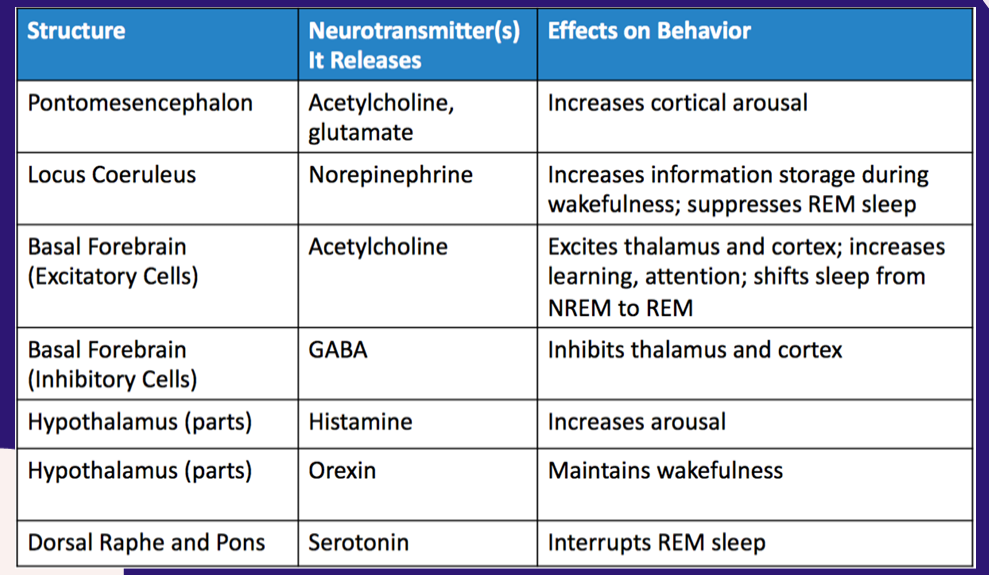
Pontomesencephalon:
Part of the midbrain.
Sends signals to the hypothalamus, thalamus, and basal forebrain.
Releases acetylcholine and glutamate, chemicals that excite the brain.
Can wake someone or boost alertness when already awake.
Locus coeruleus:
A tiny structure in the pons.
Releases norepinephrine, activating the cortex and helps you stay awake.
Inactive during sleep, but fires up when you wake.
Hypothalamus:
Releases histamine, which stimulates the brain and keeps you alert.
Antihistamines block this and make you feel sleepy.
Orexin (Hypocretin):
Activates cells in the basal forebrain to release acetylcholine.
Keeps you awake and alert, important for staying awake over time.
Gaba & acetylcholine in basal forebrain:
Gaba: A calming chemical that slows down brain activity, essential for sleep.
Acetylcholine: An excitatory chemical that boosts arousal and alertness.
These two work like opposites, one helps you sleep, the other helps you wake.
Summary:
Morning:
Reticular formation activates → sends alert signals.
Pontomesencephalon and locus coeruleus fire → boost brain activity.
Hypothalamus releases histamine → keeps you awake. Orexin helps you stay alert through the day.
Night:
GABA from the basal forebrain increases → brain slows down.
You fall asleep.
Sleep Phenomena:
Sleep walking:
Some brain areas are asleep, but motor areas are still awake.
The person can walk or do simple actions — but they’re not fully conscious.
Lucid dreaming:
You’re dreaming, but a part of your brain is aware that you’re dreaming.
You might even be able to control the dream.
REM paralysis (Pons Still in REM):
The pons (part of the brainstem) stays in REM sleep, keeping your body muscles relaxed.
But other brain areas wake up, so you become aware but can’t move.
Brain Activity During REM Sleep:
Increased activity in:
Pons (controls REM and sends signals to the body)
Limbic system (handles emotions and memory)
Decreased activity in:
Primary visual cortex (less real visual processing)
Motor cortex (less movement planning)
Dorsolateral prefrontal cortex (less logical thinking and decision making).
PGO waves (dream signals):
REM sleep shows special brain waves called PGO waves:
Starts in the pons.
Moves to the lateral geniculate nucleus (part of the thalamus).
Ends in the occipital cortex (vision center).
These waves are linked to dreaming and visual imagery.
If deprived of REM sleep, they’ll have more PGO waves when they sleep.
Brain activity in REM sleep:
Why you can’t move in REM:
The pons sends signals to the spinal cord to turn off motor neurons.
This paralyzes large muscles so you don’t act out your dreams.
Chemical control of REM:
Acetylcholine: Boosts REM sleep.
Drugs that activate acetylcholine receptors can trigger REM quickly.
Serotonin: Interrupts REM sleep. Too much serotonin can reduce REM.
Sleep Disorders:
It’s when someone can’t get enough good-quality sleep.
This can lead to tiredness, poor focus, and mood problems during the day.
Causes:
Common:
Environmental factors: Noise, light, or uncomfortable temperature.
Stress and emotional issues: Worry, anxiety or sadness can keep your brain too active to sleep.
Physical discomfort: Pain or illness can make it hard to relax.
Diet and medication: Caffeine, alcohol or drugs can interfere with sleep.
Medical conditions:
Disorders like: Epilepsy, parkinson’s disease, depression or anxiety.
These can disrupt sleep patterns or make it harder to fall asleep.
Sleep aids and circadian rhythm disruptions:
Relying too much on sleeping pills or alcohol can make sleep worse over time.
Circadian rhythm shifts can cause insomnia.
Sleep Apnea:
A sleep disorder where a person stops breathing for short periods while asleep.
These pauses can last several seconds and happen many times a night.
Causes cognitive problems like memory issues or slower thinking.
Consequences:
Daytime sleepiness even after a full night’s sleep.
Trouble focusing or paying attention.
Mood issues like depression or irritability.
Heart problems in serious cases.
Causes:
Genetics: Runs in families.
Hormonal changes: Can affect breathing control.
Aging: Muscles that keep airways open may weaken.
Obesity: Extra tissue can block the airway.
Brain issues: Parts that control breathing may not work properly.
Treatment:
CPAP machine (Continuous Positive Airway Pressure): A mask worn during sleep that keeps airways open using gentle air pressure.
Weight loss: Losing weight can reduce pressure on the airway.
Surgery: In some cases, surgery can remove blockages in the nose or throat.
Dental devices: Special mouthpieces that keep the airway open by adjusting jaw or tongue position.
Avoiding alcohol/sedatives: These relax throat muscles and make apnea worse.
Narcolepsy:
A sleep disorder where a person feels very sleepy during the day, even after a full night’s sleep.
Can cause sudden or gradual “sleep attacks”, the person may fall asleep unexpectedly.
Key symptoms:
Sudden Sleepiness: Can happen anytime, in the middle of a conversation or activity.
Cataplexy: Sudden muscle weakness, often triggered by strong emotions like laughter or surprise.
Sleep Paralysis: Temporary inability to move when falling asleep or waking up.
Hypnagogic Hallucinations: Dream-like images or sounds that happen just before falling asleep.
Causes:
May run in families, but no specific gene has been found.
Caused by a lack of orexin, made in the hypothalamus.
Treatment:
Treated with stimulant medications like Ritalin.
These drugs boost dopamine and norepinephrine, which help increase alertness.
Periodic Limb Movement:
A sleep disorder where the legs or arms move without control during sleep.
Movements are repetitive and involuntary.
Legs may kick or twitch every 20 to 30 seconds.
These movements can last for minutes or even hours.
Usually happens during NREM sleep.
Night Terror:
A person suddenly wakes up in fear, often screaming or panicking.
Happens during NREM sleep (not dreaming stage).
Person usually doesn’t remember the episode.
Sleepwalking:
A person gets up, walks or does simple actions while still asleep.
Happens during deep sleep (stage 3 or 4 of NREM).
Not linked to dreaming, the brain is partly asleep.
Runs in families and is common in children.
Sexsomnia:
A rare condition where a person engages in sexual behavior while asleep.
Can happen during deep sleep, like sleepwalking.
Importance of Sleep:
Brains have natural systems that make us sleep.
These systems slow down brain activity and reduce alertness.
Inhibitory brain processes help us sleep:
Special chemicals (GABA) calm the brain, making you feel less awake and less responsive.
Why REM and dreams:
REM sleep is a special stage where your brain is active, but your body is relaxed.
It’s when most dreaming happens.
Scientists believe REM and dreams may help with:
Memory processing.
Emotional regulation.
Brain development
Function of sleep:
Resting the Body: Sleep gives your muscles a break from daily activity.
Slow Down Metabolism: The body uses less energy during sleep, helps with energy conservation and body repair.
Cellular Maintenance in the Brain: Sleep allows neurons to clean-up and repair work.
Reorganizing Synapses: Synapses are adjusted and fine-tuned during sleep, helps the brain stay flexible and efficient.
Strengthening memories: Sleep helps store and organize new information. Especially during REM sleep, your brain replays and strengthens memories.
Sleep & Energy Conservation:
Sleep helps to save energy.
During sleep, the body lowers its temperature by about 1–2°C.
Reduces muscle activity, less movement means less energy used.
Hibernation:
In hibernating animals: Body temperature drops close to the surrounding environment.
Heart rate and brain activity slow down dramatically.
Brain cells shrink, and dendrites lose about 25% of their branches. These grow back when the animal warms up again.
Animals sleep differently based on their daily needs and survival strategies.
Key factors that affect sleep patterns:
Predator vs. prey status.
Time spent hunting or foraging.
Safety while sleeping.
Sleep & learning:
Sleep boosts learning: Getting enough sleep after learning helps to remember it better the next day.
Your brain replays what’s learnt: While sleeping, the brain replays the same activity patterns used during learning. This happens especially in the hippocampus.
Strengthening and cleaning up connections: Sleep helps the brain strengthen important connections and weaken unneeded ones, making memory more effective.
Sleep spindles = brain at work: After learning something new, your brain produces more sleep spindles. More spindles are linked to better learning and higher nonverbal IQ.
How much we sleep:
Sleep takes up a large part of life:
Humans spend about one-third of their life sleeping.
Around 20% of that sleep is REM sleep.
Different animals, different sleep patterns:
The amount of REM sleep varies between species.
Birds and mammals are the ones that experience REM sleep the most.
More sleep = more REM:
In most animals, the more total sleep they get, the higher the percentage of REM.
People who sleep longer tend to have more REM sleep.
Function of REM sleep:
Still researching:
Scientists aren’t 100% sure what REM sleep is for.
Brain clean up:
During REM, the brain might get rid of unneeded connections.
Learning motor skills:
REM may help strengthen physical skills you’ve recently learned.
Eye movement theory (MAURICE, 1998):
REM sleep keeps your eyes healthy.
The rapid eye movements may bring oxygen to the corneas.
Dreaming:
2 main biological theories of dreaming:
Activation-synthesis hypothesis:
Dreams start with random brain activity in the pons.
This activity spreads to the cortex, which tries to make sense of it by creating a story of your dream.
Clinico-anatomical hypothesis:
Dreams are like thinking, but in a weird, dream-like way.
Doesn’t focus much on REM sleep or pons, instead, it looks at how the brain processes internal signals.
Dreams start from internal brain stimulation, mixed with: Recent memories and bits of sensory info.
Brain Areas Active During Dreaming:
Parietal cortex: Helps with body awareness and space.
Damage: No dreams or trouble combining body and visual info.
Visual areas (outside V1): Create mental images in dreams.
Hypothalamus & amygdala: Add emotion and motivation to dreams.