Infancy (4)
Defintion (#f7aeae)
Important (#edcae9)
Extra (#fffe9d)
Physical Growth & Development Physical Growth:
The Cephalocaudal pattern:
Sequence in which the earliest growth always occurs at the top with physical growth and differentiation of features gradually working their way down from top to bottom.
Motor development generally proceeds according to the cephalocaudal principle.
Infants see objects before they can control their torso, and they can use their hands long before they can crawl or walk; but they are not rigid.
Some infants reached their toys with their feet before their hands.
The proximodistal pattern:
Growth starts at the center of the body and moves toward the extremities.
Eg: infants use their whole hands before they can control several fingers.
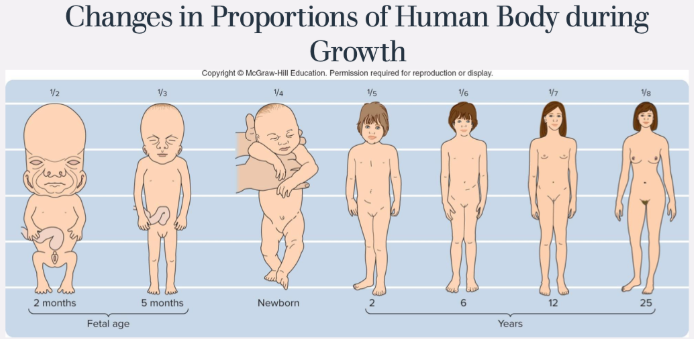
Height & Weight:
Most of the newborns are 18-22 inches long and weigh between 2.5-5kg.
Grow about 1 inch per month during the first year.
By 2 years of age:
Infants weigh approximately 10 kg to 14 kg.
Average 32 to 35 inches in height.
The Brain:
Contains approximately 100 billion neurons at birth
The infant's head should be protected from falls or other injuries.
Shaken baby syndrome: Brain swelling and haemorrhaging.
While most of the brain’s neurons are present at birth, they are not fully mature.
During the next several years dendrites, or branching extensions that collect information from other neurons, will undergo a period of exuberance.
Brain’s development:
Neurons: Nerve cell that handles information processing.
Myelin sheath: A layer fat cells that helps electrical signals travel faster down the axon.
Neurotransmitters: Tiny gaps between neuron’s fibers.
Mapping the brain:
Cortex: Most of the neural activity is occurring here as its involveds in voluntary activity and thinking.
Frontal lobe: Involved in voluntary movement, thinking, personality, and intentionality or purpose.
Occipital lobes: Function in vision.
Temporal lobes: Have an active role in hearing, language processing, and memory.
Parietal lobes: Play important roles in registering spatial location, attention, and motor control.
Lateralization: Process in which different functions become localized primarily on one side of the brain.
At birth, the hemispheres of the cerebral cortex already have started to specialize:
Newborns show greater electrical brain activity in the left hemisphere than the right hemisphere when they are listening to speech sound.
Changes in neurons
Myelination: Involved in providing energy to neurons and in communication.
Connectivity among neurons increases allowing information to pass from neuron to neuron.
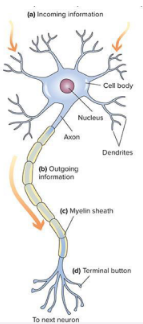
Changes in regions of the brain:
Blooming and pruning vary by brain region.
Peak of synaptic overproduction in the visual cortex followed by a gradual retraction.
Heredity and environment influence the timing and course.
The pace of myelination varies in different areas of the brain.
Myelination for visual pathways occurs rapidly after birth and is completed in the first six months.
Auditory myelination is not completed until 4 or 5 years of age.
Early experience and the brain.
Children in deprived environment may have depressed brain activity.
Brain demonstrates both flexibility and resilience.
Brain has plasticity and is context-dependent.
Development of the brain and the child’s cognitive development are closely linked.
Sleep & SID:
Sleep:
Evolutionary perspective - Survival.
Replinishes and rebuilds the brain and body.
Restorative Function.
Clearing out waste in neural tissue.
Critical for brain plasticity.
Increases synaptic connections between neurons.
SIDs - Findings:
Sudden death infant syndrome: Condition that occurs when infants stop breathing usually during the night and die suddenly without an apparent cause.
Risk Factors:
Low birth weight infants.
Infants whose siblings have died of SIDS.
More common in lower socioeconomic groups.
More common in infants who are passively exposed to cigarette smoke.
More often in infants with abnormal brain stem functioning.
Involving the neurotransmitter serotonin.
Nutrition:
Nutritional needs & eating behaviour:
Infants should consume approximately 50 calories per day for each kg they weigh.
As motor skills improve, infants change:
From using suck-and-swallow movements
To chew-and-swallow movements with semisolid and then complex foods
Need to have a diet that includes:
Fruits and vegetables
Breast vs bottle feeding: (which one is better)
For the first four to six months of life, human milk or an alternative formula is the baby’s source of nutrients and energy.
The growing consensus is that breast feeding is better for the baby’s health
Benefits of breast feeding: outcomes for the child
Lower gastrointestinal infections
Lower respiratory tract infections
No evidence reduction in the risk of allergies
Motor Development:
Dynamic systems view:
Dynamic systems theory: Infants assemble motor skills for perceiving and acting.
Motor skills are developed by:
Development of the nervous system
Body’s physical properties and its possibilities for movement
Child’s motivation to reach a goal
Environmental support for the skill
Reflexes:
Built in reactions:
To stimuli that govern the newborn’s movements.
Automatic and beyond the newborn's control.
Rooting reflex:
Occurs when the infant's cheek is stroked or the side of the mouth is touched.
Turns his or her head in an effort to find something to suck.
Sucking Reflex:
Occurs when newborns automatically suck an object placed in their mouth.
Enables newborns to get nourishment before they have associated a nipple with food.
Serves as a self-soothing mechanism.
Motor Reflex:
A neonatal startle response that occurs in reaction to a sudden intense noise or movement.
Believed to be a way of grabbing for support while falling.
Grasping Reflex:
Occurs when something touches the infant’s palms.
Respond by grasping tightly.
Gross Motor Skills:
Involve large muscle activities:
Walking, Slow running.
Development of posture:
Posture: Dynamic process linked with sensory information in the skin, joints and muscles which tells us where we are in space.
The first year: Motor development milestones and variations.
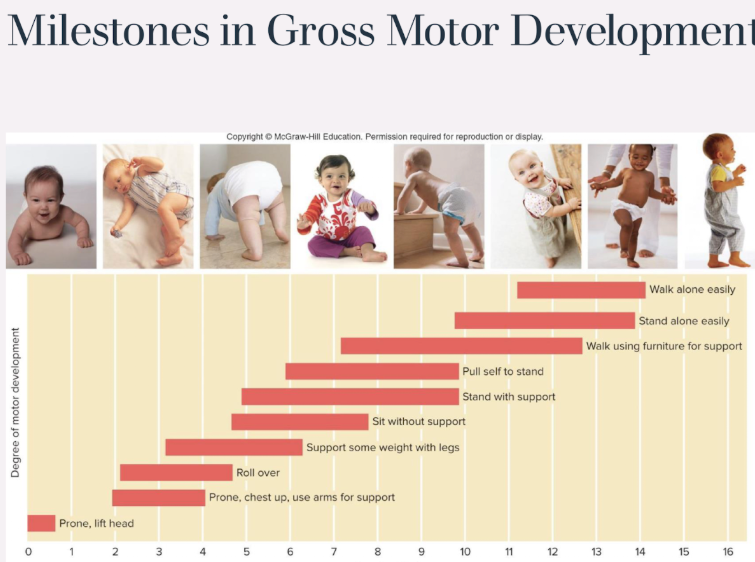
Fine Motor Skills:
Involve more finely tuned movements such as finger dexterity.
Types of grasps: Palmer gasp and Pincer grasp.

Sensory and Perceptual Development:
The Ecological view:
We directly perceive information that exists in the world around us.
The view is called ecological “because it connects perceptual capabilities to information available in the world of the perceiver”.
Affordances:
Opportunities for interaction offered by objects that fit within our capabilities to perform activities.
We directly and accurately perceive these affordances by sensing information from the environment.
When babies who could walk were faced with a squishy waterbed, they stopped and explored it, then chose to crawl rather than walk across it.
Visual perception:
Infants show an interest in human faces soon after birth.
As infants develop, they change the way they gather information from the visual world, including human faces.
Cognitive Development in Infancy:
Cognitive development in infancy:
Piaget’s theory of infant development.
Learning, remembering and conceptualising.
Language development.
Piaget’s Theory of Development:
Cognitive Processes:
Schemes: Actions or mental representations that organize knowledge.
Behavioral scheme.
Mental scheme.
Assimilation: Using existing schemes to deal with new information or experiences.
Accomodation: Adjusting schemes to fit new information and experiences.
Organization:
Grouping of isolated behaviors and thoughts into a higher-order system.
More smoothly functioning cognitive system.
Equilibrium and satges of development:
Equilibration: Mechanism by which children shift from one stage of thought to the next.
In trying to understand the world, the child inevitably experiences cognitive
conflict, or disequilibrium. The child is constantly faced with
counterexamples to their existing schemes and with inconsistencies.
The child assimilates and accommodates, adjusting old schemes, developing
new schemes, and organizing and reorganizing the old and new schemes.
Stages of development:
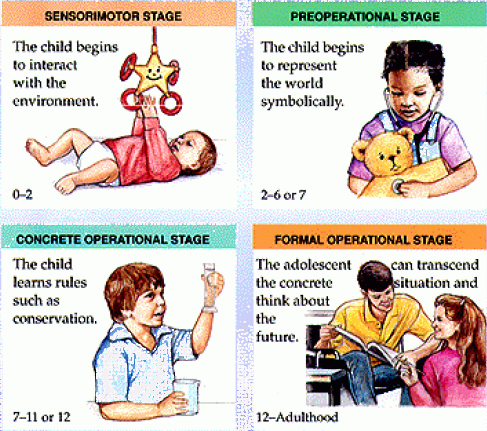
Period of Development | Age range |
Sensorimotor Period | Infancy (0-2 years) |
Preoperational Period | Preschool and early elemntary school years (2-7 years) |
Concrete Operational Period | Middle and late elementary school years (7-11 years) |
Formal Operational Period | Adolescence and adulthood (11+ years) |
Sensorimotor stage:
Lasts from birth to about 2 years of age.
Construct an understanding of the world by coordinating sensory experiences.
8 months: Infants reach a watershed: the onset of deliberate, intentional behaviour.
12 months: Infants become active experimenters.
infant may deliberately shake a number of different objects, trying to discover which produce sounds. Or may decide to drop different objects to see what happens.
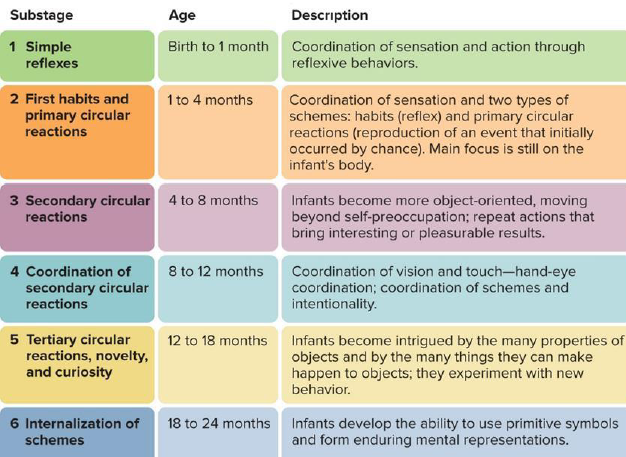
Concepts in sonsorimotor stage:
Object permanence:
The understanding that objects continue to exist even when they cannot be seen, heard, or touched.
Infants who already developed object permanence would reach for the hidden toy, indicating that they knew it still existed, whereas infants who had not developed object permanence would appear confused.
Object permanence can only be developed around 8 months.
Object permanence experiments help researchers and child development experts assess the developmental progress of infants and young children.
A-Not-B error:
Occurs when infants make the mistake of selecting the familiar hiding place (A) rather than the new hiding place (B).
As they progress into substage 4 in Piaget’s sensorimotor stage, between 8 to 12-month-old infants.
Older infants are less likely to make the A-not-B error because their concept of object permanence is more complete.
Nature-Nurture issue:
Certain researchers endorses a core knowledge approach, which states that infants are born with domain-specific innate knowledge systems.
Some researchers suggested that infants likely come into the world with “soft biases to perceive and attend to different aspects of the environment, and to learn about the world in particular ways.”
Conditioning and attention:
Conditioning:
Operant conditioning has been especially helpful to researchers in their efforts to determine what infants perceive.
Ex: Infants will suck faster on a nipple when the sucking behaviour is followed by a visual display, music, or a human voice.
Attention: Focusing of mental resources on select information, improves cognitive processing on many tasks.
Sustained attention/focused attention: Allows infants to learn about and remember characteristics of a stimulus as it becomes familiar. Starts from 3 months to 9 months of age.
Habituation and dishabituation:
Habituation: Decreased responsiveness to a stimulus after repeated presentations of the stimulus.
Dishabituation: Increase in responsiveness after a change in stimulation.
Joint attention requires:
Ability to track another’s behaviour.
One person’s directing another’s attention.
Reciprocal interaction.
Memory:
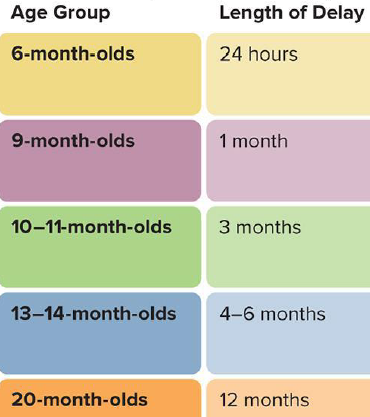
Memory involves the retention of information over time:
Encoding: The process by which information gets into memory.
Implicit Memory:
Memory without conscious recollection - memories of skills and routine procedures that performed automatically.
Ex: Brushing teeth, singing your favourite song and driving back home.
Explicit Memory:
Refers to the conscious memory of facts and experiences.
Imitation:
Infants’ imitative abilities are biologically based, because infants can imitate a facial expression within the first few days after birth.
The infant’s imitative abilities do not resemble an inborn response but rather involve flexibility and adaptability.
Deferred imitation: Occurs after a delay of hours or days.
Language:
Recognizing language sounds:
Infants recognize when sounds change most of the time, no matter what language the syllables come from.
Over the next 6 months, infants get even better at perceiving the changes in sounds from their “own” language and gradually lose the ability to recognize differences that are not important in their own language.
Babbling and other vocalizations:
Crying, cooing, babbling.
Gestures:
Infants start using gestures, such as showing and pointing, at about 8-12 months of age.
First words:
Receptive vocabulary considerably exceeds spoken vocabulary.
18 months (50 words), 24 months (200 words) -Vocabulary spurt
Two-word utterances:
By the time children are 18-24 months of age, they usually utter two-word utterances.
Ex: Dog there; big car.
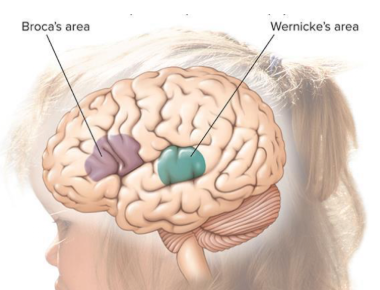
Language Sites in the brain:
Socioeconomic Development in Infancy:
Emotional and personality development
Social orientation and attachment
Social contexts
Emotional Development:
Emotion: Feeling or affect that occurs when a person is in a state or interaction that is important to them.
Plays important roles in: Communication with others and behavioral organisation.
Early Emotions: Primary emotions are emotions that are present in humans and other animals; these emotions appear in the first 6 months of the infant’s development.
Basic emotions: Self conscious. Emotions require self awareness that involves consciousness and a sense of “me”.
Jealousy, empathy, embarrassment, pride, shame and guilt.
Emotional Expression and Social Relationships
Crying:
The most important mechanism newborns have for communicating with their world.
Basic cry:
A rhythmic pattern that usually consists of a cry, followed by a briefer silence, then a shorter whistle that is somewhat higher in pitch than the main cry, then another brief rest before the next cry.
Anger cry:
A variation of the basic cry in which more excess air is forced through the vocal cords.
Pain cry:
A sudden long, initial loud cry followed by breath holding; no preliminary moaning is present. The pain cry is stimulated by a high-intensity stimulus
Smiling:
Reflexive smile: Smile that does not occur in response to external stimuli.
Social smile: In response to an external stimulus.
Fear:
Stranger anxiety: Fear and wariness of strangers, appears during the 2nd half of the first year of life.
Separation protest: Distressed crying when the caregiver leaves.
Emotional Regulation and Coping:
Caregivers’ actions and contexts can influence emotional regulation.
Soothing a crying infant helps infants develop a sense of trust and secure attachment to the caregiver.
Temperament:
Individual differences in behavioural styles, emotions, and characteristic ways of responding.
Describing and classifying temperament: Chess and Thomas’ classification.
Easy child: Generally in a positive mood
Quickly establishes regular routines in infancy.
Adapts easily to new experiences.
Difficult child: Reacts negatively and cries frequently
Engages in irregular daily routines.
Slow to accept change.
Slow-to-warm-up child: Low activity level
Somewhat negative.
Displays a low intensity of mood.
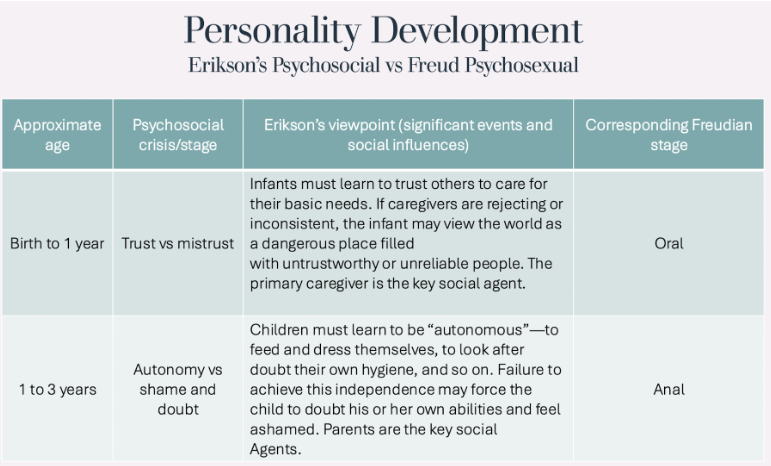
Erik Erikson’s theory:
Trust:
The 1st year to year and a half of life involves the establishment of a sense of trust and highlights the importance of attachment.
Erikson proposed that infants learn trust when they are cared for in a consistent, warm manner.
If the infant is not well fed and kept warm on a consistent basis, a sense of mistrust is likely to develop.
Social Orientation:
Social orientation:
The focused social interaction of face-to-face play may include vocalizations, touch, and gestures.
Locomotion skills:
Body is moved in one direction, or a combination of directions, from one point to another.
The infant’s and toddler’s push for independence also is likely paced by the development of locomotion skills
Intention and goal-directed behaviour:
Joint attention and gaze-following help the infant to understand that other people have intentions.
Social referencing:
Reading emotional cues in others to help determine how to act in a particular situation.
The development of social referencing helps infants to interpret ambiguous situations more accurately.
Attachment:
Freud:
Infants become attached to the person that provides oral satisfaction.
Harlow:
Contact comfort preferred over food.
Rhesus Monkey Experiment: Harlow removed infant monkeys from their mothers at birth; for six months they were reared by surrogate “mothers.” One surrogate mother was made of wire, the other of cloth.
Erikson:
Trust arises from physical comfort and sensitive care.
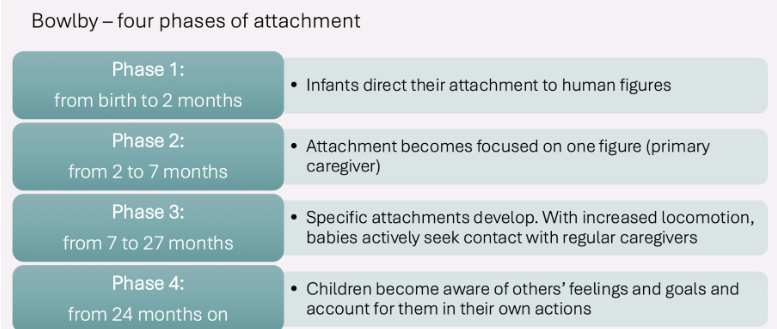
Bowlby:
Stresses the importance of attachment in the first year of life and the responsiveness of the caregiver.
Bowlby maintains both infants and their primary caregivers are biologically predisposed to form attachments.
Argues that the newborn is biologically equipped to elicit attachment behaviour.
Steps Towards Attachment
According to Bowlby, children who form an attachment to an adult— an enduring socioemotional relationship—are more likely to survive.
The key is a strong emotional relationship with a responsive, caring person.
Attachments other than mothers can form with fathers, grandparents, or someone else.
Preattachment (birth to 6 – 8 weeks):
During prenatal development and soon after birth, infants rapidly learn to recognize their mothers by smell and sound.
Attachment in the making (6 – 8 weeks to 6 – 8 months):
Babies begin to behave differently in the presence of familiar caregivers and unfamiliar adults.
Babies are gradually identifying the primary caregiver as the person they can depend on.
True attachment (6 – 8 months to 18 months):
Most infants have singled out the attachment figure as a special individual and the attachment figure is infant’s stable socioemotional base.
Styles | Descriptions |
Secure |
|
Avoidant |
|
Resistant |
|
Disorganised (disorientated) |
Child Attachment Theories:
Secure Attachment:
Child is content, ready to learn and engaged with tasks.
Can be independent and seek out caregiver for comfort.
Avoidant Attachment:
A child often feels rejected. They do not show distress.
Can appear withdrawn and quiet.
Ambivalent Attachment:
Child express anxiety in their environment.
Often asks questions and can appear distracted or lacking focus.
Disorganised Attachment:
Child does not have a predictable pattern of attachment.
Can appear angry, sad and scared. Can be passive with limited ability to maintain friendships.
Caregiving styles and attachment
Maternal sensitivity is linked to secure attachment.
Although maternal sensitivity is positively linked to the development of secure attachment in infancy, important to note that the link is not especially strong.
Securely attached babies have caregivers who are sensitive to their signals and are consistently available to respond to their infants’ needs
Caregivers of insecurely attached infants tend to be:
Rejecting
Inconsistent
Abusive
Not affectionate
Parent’s methods of managing and correcting infant’s undesirable behaviors:

The family and childcare:
Studies emphasize that marital relations, parenting, and infant behaviour and
development can have both direct and indirect effects on each other.

Transition to parenthood:
When people become parents through pregnancy, adoption or step-parenting they face disequilibrium and must adapt.
Ex: A baby places new restriction on partners: parents no longer will be able to rush out to a movie on a short notice and money may not readily be available for vacation.
Reciprocal socialisation:
Socialization that is bidirectional. Children socialize parents just as parents socialize children.
Scaffolding:
Parents time interactions in such a way that the infant experiences turn-taking with the parents.
Involves parental behaviour that supports children’s efforts, allowing them to be more skillful than they would be if they were to rely only on their own abilities.
In using scaffolding, caregivers provide a positive, reciprocal framework in which they and their children interact.