Week 5 - Lecture (The Archaic Period and the Development of Classical Greece)
Archaic Period
800 C to 500 BCE
Disappear for a variety of ambiguous reasons
Resurgement/different patterns of settlement
Artwork reproduced
A little bit of literature
Map shows the different Greek dialects
Came after a time where population declined, settlements disappeared, and artwork decreased
Beginning of the Archaic Period is shown how there were certain areas controlled by city states, while other areas have looser structure not controlled by city states
Key marker of the archaic period is the redevelopment of Urban Centres
Development of the Polis
Polis: The renewed idea of citizenship, and the development of identity, rights, regarding the safety of a city state
Question of who belongs to the polis, who’s allowed to make the decisions regarding this?
Different constitutions in the sense of legal descriptions of the rights of residents of a particular place
Polis is represented by an urban area and the territory surrounding that urban area who supports it economically
Not just the city state, but the suburbs and the other infrastructure
There arre individual groups and peoples’ that get incorporated into Sparta as a polis
All the theoretical groups of people/areas become apart of the city of Sparta
All of the land/territory/familliarity/legal rights in society and government is folded into the idea of the Polis of Sparta
During the ——- period, the polis affiliation matters way more than the geographic affiliation
Hellene: The territory that we refer to as Ancient Greece - you don’t think of yourself as this unless in very specific contexts (Athenian, Greek, is what overrides that)
Ancient Greece = loose affiliation of Polis that is occupying the same land mass
Most of what we have to study comes from Athens and this gets projected onto other parts of Greece
Citizenship and who belongs to a Polis, and who can act on it becomes very important once we lay the foundations of the government
Aristotle wrote in 300 BC about how the polis has developed in the classicla period, stating that a polis is a state that is a collection of citizens, depending primarily on who lives there and hwo acts on the polis’ behalf so if you want to talk about the polis, you have to know who the citizen is
Not everyone agrees on what citizens are apart of the polis, specifically in the legal constitution
Look at how women are regarding when it comes to the Polis later on (keep in mind)
Residential foreigners are sometimes considered citizens, sometimes not it depends on the Polis
Greeece is not necessarily an actual thing, just a lot of different corporations that is taken up lots of mass
The fundamental issue of idscussing a polis is that the existance of the polis depending on the citizenry, but we can’t agree on what the citizenry actually is, is what Aristotle talks about
Root word for “political”
Aristotle discusses the government, based on polis
During the archaic period we see what is going to generally run the classical period
Greek Colonization
Long and drawn out process of colonization in the Archaic period
The complete opposite of modern colonization within the western world
Population redistribution
The devleopment of Polis is leading to bigger groups of people living in the same place, and creating lots of population density issues in some of these places
Greece as a land mass doens’t have a lot of space
As a solution to population space, expeditions are sent out
Apoikia: “A household away” which are the expeditions sent out under the guidance of an appoinyted leader and go somewhere else in the Mediterranean and establish a colony
Colonists are not there to impose Greekness on anybody, just to live and be a household outside of the city state that sent the expedition
Metropolis: Word for “mother city” ie the polis that sent out this expedition
All of the mediterrenean were having the creation of individual, sattelite communities
Eg. Massalia, and Emporion which are trading centres that are placed down to be a polis in that area
The whole process of colonization is to be greek somewhere else, not to make someone else greek
Eastern Mediterranean, Black sea, egypt, western medditerranean, east italy, lots of people are Greece elsewhere
Being Greek in the presence of other people
Colonization is used because there’s no better term for ths process (diaspora is being argued)
Factoring in to the development of things socially and politically
Women in Archaic Art
The Dipylon Vase
Not lots of literary element within the archaic period
Lots of physical evidence that can be interpreted
Funerary displays
Talk about the trend of large vessels
The Dipylon Vase: Dipylon is the area in which it’s found, showing a monument for a woman,
Earliest representation of humans within the vase
Early scene of cerramic painting
Dead person layed on bed/table and person is wearing a long skirt and two of the people under the table are in the traditional sad posture, are also wearing long skirts
Long skirts distinguish between male and female figures
Lots of the other figures in the middle and underneath the handles are men because they have legs instead of skirts
Men = legs
Women = skirts
VERY decorated funerary monument for a woman
A metre tall
Show how women are represented in the Archaic period
Geometric designs

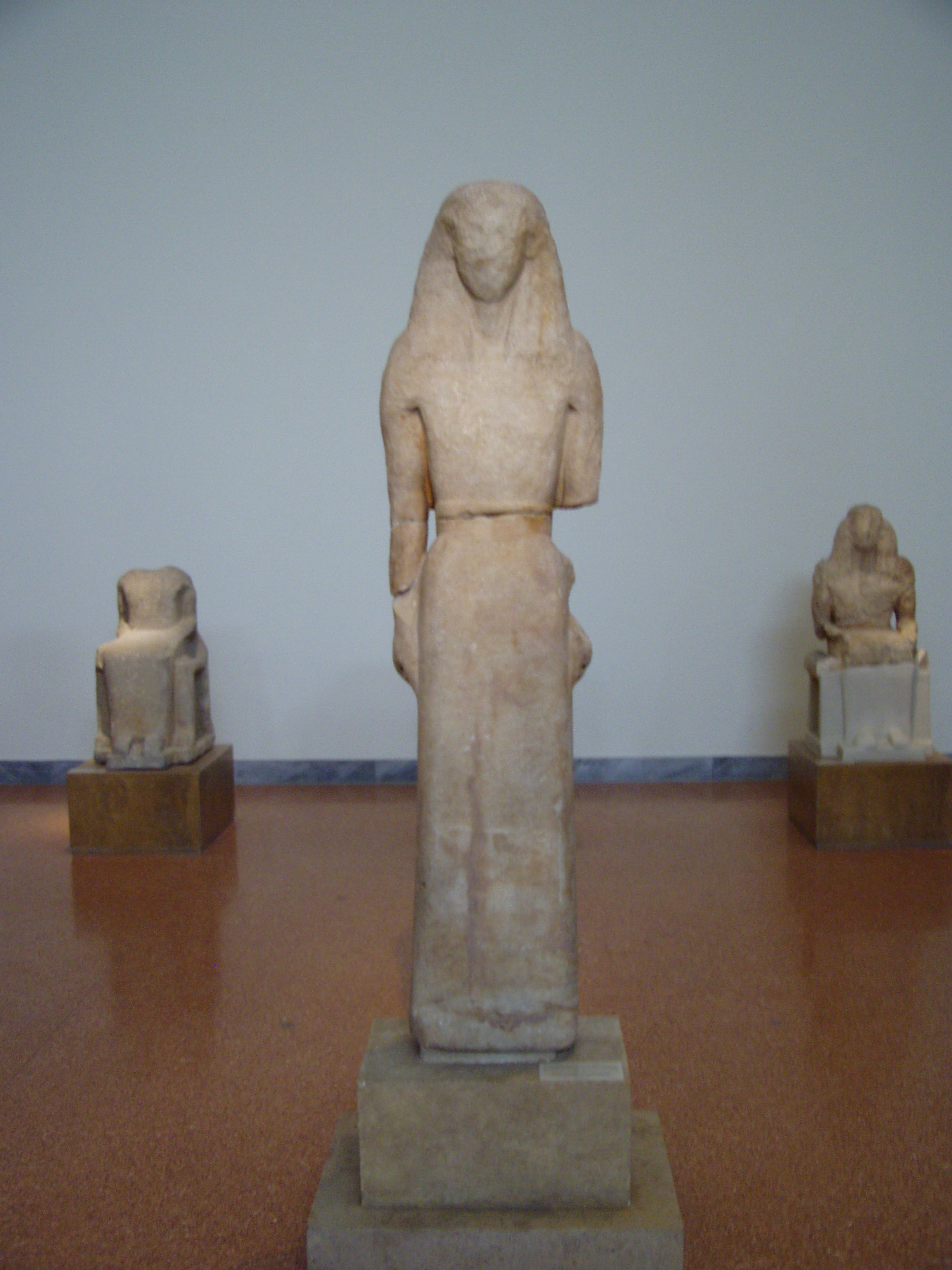
Korai (female) /Kouroi (male) Statues
Large scale statues
Lots of discussion about the statues and male counterparts that represent men
Couple of theories
Lots of these status
No writing/labels so we’re left to theorize why they’re set up
The one interpretation is that they represent maids (standard explanation for ambiguous figures)
Eg. Statue of Nikandre which is the earliest piece of evidence for large human artwork which is said to be dedicated to the Goddess who is the far-shooter of arrows (aka Artemis), daughter of Deinodikos of Naxos, sister of Deinomenes and wife of Phraxos
Whether it’s supposed to be Nikandre or Artemis is quite ambigous
Some depictions are much less ambiguous (the Grave Marker of Phrasikleia)
Signed by her which is rare cause it never happens
Could possibly be grave markers, or images of Goddesses
Always clothed = korai = female
Always naked = kouroi = male
Could be depicted from the worshippers
The differences within the statues when it comes to clothing hihglight clear double standard once again
Artistry is not considered a respectful profession within the times
Art is a technical professsion, not an aesthetic profession equivalent to blue collar work that doesn’t attract prestige so hence it’s not always signed
Known the names of artists important from literature, but they don’t put their names on works (aka prestige)
Korai (female) statues have very complex clothes
You can see the garments of her dress
Lots of ancient statues are most likely painted
the detailing of the outline being very simple, may be added with perishable materials that we don’t have evidence for

How Women were Perceived in Literary Elements
The attitude towards women and literary elements aren’t great
Any woman who dresses up is after your money, and it’s not in your best interest to marry that kind of woman - Hesiod
Advides that you marry a woman
“let your wife before you marry her grow up for four years and marry her in the fifth” so most likely very young like 17
Implied women don’t do anything helpful
Sappho (630 C to 570 BCE)
Seeing early female authors
Associated with the island of Lesbos (islands between greek land and islands of Anatolia)
Island itself associated with Myths of Ortheous and Aereon (musical talent)
Sappho is recognized for musical talent
Most of her poetry has some kind of musical accompaniment
Lots of myths about music proiciency coming from her
May have been exiled in Cicile but not the surest
Most of what we know about her stops with her gender
Everyone knows she’s a woman, but it’s unknown what kind of woman
May have been an official poet performance writer
May have written these poems to be recited by groups of female performers
Poems may have been private/public
How poetry was supposed to work socially at the time was unknown
Ancient scholarship talks about her alot, especially in literary criticism
Wrote nine books of lyric poems, discovered the plectrum, epigrams and elegiacs, and iambics and monodies according to Suda
By the 9th century we have good literary information regarding her
Work was considered high quality - she was a good poet to the men of Classical Athens
Number of references in Plutart equates Sappho with virtuous women, and many other diffferent references
Depicted/theorized that Sapphro was into girls when this isn’t the case, she just liked to talk to girls

Cannon of Female Poets
Antipater of Thessalonica
10 BCE to 38 CE
Epigrammatist
Proposed the canon of the different female poets
Praxilla, Moero, Anyte, Sappho, Erinna, Telesilla, Corinna, Nossis, Myrtis