Energy Flows and Balance
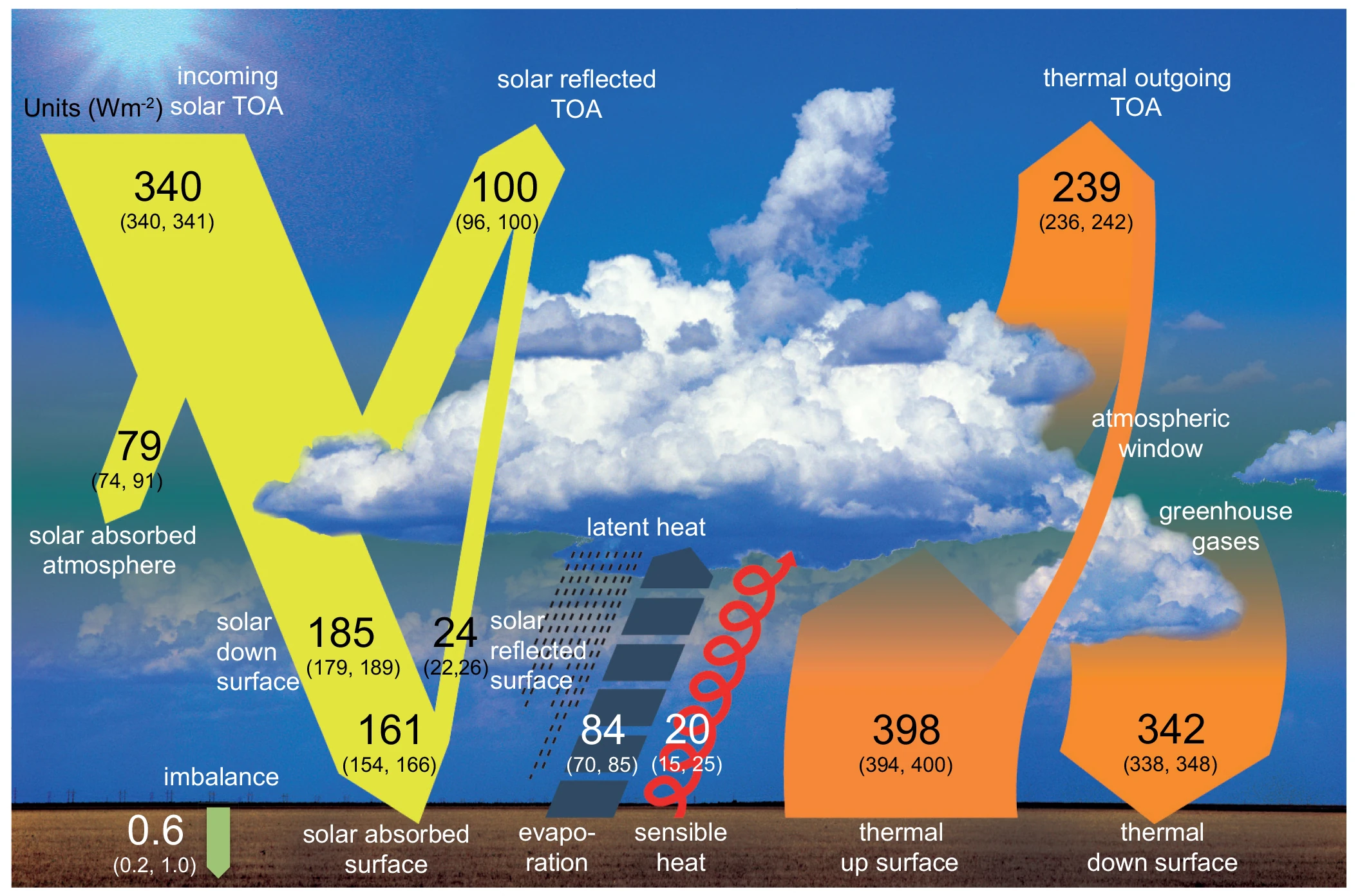
Climate is created by processes that move heat energy.
About Watts per meter squared: A watt is 1 Joule per second - a quantity of heat coming in or out per second. A Joule is the amount of heat required to raise the temperature of one gram of water by about a quarter of a degree centigrade. Watts measure energy over time. (Ex: a 60 watt light bulb emits 60 joules of energy per second.)
Heat is energy transferred spontaneously from a hotter to a colder body. Transferred through conduction (through solids), convection (liquids and gases), and by radiation (like when the sun shines).
Visible Light and Infrared Radiation are both light waves AKA electromagnetic radiation. You can feel infrared radiation as heat. Ultraviolet rays cause sunburns.
TOA: Top of Atmosphere - where space starts.
Rays from the sun don’t hit Earth perfectly every time. Average radiation each sq meter receives from the sun is 340 watts per meter squared. That can bring a liter of water from freezing to boiling in 20 minutes.
If temperatures are rising, then the amount of heat energy coming in is greater than the amount of heat energy leaving. Vice versa.
Earth loses heat energy as infrared radiation. This can be captured on an infrared camera!
Warmer bodies give off radiation at shorter wavelengths than cooler bodies. - Wien’s Law
λ = 2900/T → Temperature is in Kelvin. λ is in microns. It measures the wavelength of light emitted.
The temperature of the sun’s surface is 5527 degrees celsius. Average temperature of the Earth is 15 degrees celsius.
Warmer bodies give off more energy in watts per meter squared than cooler bodies. - Stefan-Boltzmann Law
Energy emitted in watts per meter squared = σ x T^4 (where σ is about 6×10^-8 watts per meter squared per Kelvin^4 and T is temperature in Kelvin).
Through the Stefan-Boltzmann Law, Earth emits about 400 watts per meter squared - seen on the graph in Orange.
Electromagnetic Radiation Key Points:
It travels through the vacuum of space
Everything gives off electromagnetic radiation all the time if temperature is greater than 0 Kelvin
Warmer bodies give off radiation at shorter wavelengths than cooler bodies (Wein’s Law)
Warmer bodies emit more energy in watts per meter squared than cooler bodies (Stefan-Boltzmann Law)
In the atmosphere we have Greenhouse Gases that absorb infrared radiation and send it out in all directions, including back down to Earth. This is called: Greenhouse Effect
Greenhouse Gases:
Water Vapor - Absorbs the most infrared wavelengths, the strongest greenhouse gas
Carbon dioxide
Methane
Nitrous Oxide
Ozone - Absorbs mostly ultraviolet radiation
Greenhouse Gases have three or more atoms per molecule.
Points
70-75% of the light from the sun is not absorbed by gases in the atmosphere and could reach earth unless intercepted by clouds or other objects.
70-85% of infrared radiation emitted from the earth is absorbed by gases in the atmosphere.
The absorbed radiation heats the gases in the atmosphere which then re-emits some of the radiation back to earth.
The downward amount of IR from the atmosphere is greater by almost double than that coming from the Sun reaching the Earth’s surface.