Possessives in Luganda
In Luganda the possessive particle is placed right after the noun and has to be adjusted in order to correspond to the class and number of the possessed.
The possessive prefix for ekitabo would be different then omuyembe.
Class 1 | Class 2 | Class 3 |
|---|---|---|
omu → w | omu → gw | en → y |
aba → b | emi → gy | en → z |
Class 4 | Class 5 | Class 6 |
|---|---|---|
eki → ky | eri → ly | aka → k |
ebi → by | ama → g | obu → bw |
Class 7 | Class 9 | Class 10 |
|---|---|---|
olu → lw | oku → kw | otu → tw |
en → z | ama → g |
Possessive Conjugations
My | -ange | Our | -affe |
Your | -o | Your | -ammwe |
His/Her | -e | Theirs | -aabwe |
Omulenzi ono muganda wange -. This boy (is) my brother
The independent possessive allows us to replace nouns with an altered form of possessives.
My shoes are nice, but yours are not → Engatto zange nungi, naye ezizo si nungi.
Rules
My | Stays the same, just add the first letter of the noun to the possessive. Omuntu → Owange | Our | Stays the same, just add the first letter of the noun to the possessive. Omuntu → Owaffe |
|---|---|---|---|
Your | Add the noun prefix to the front of the conjugated possessive in respect to its tense (singular/plural) | Your | Add first letter of noun to front |
His/Her | Add the noun prefix to the front of the conjugated possessive. | Their | Add first letter of noun to front |
Exceptions ( only applies to the singular second & third persons)
if their is an m in the noun prefix, change it to g.
For the en prefixes ( Class 3 and plural of class 6)
add E
then put the letter of the possessive prefix ( Y for singular Z for plural)
add i to the end
The irregular possessive ‘My Place’
When refering to somebody’s house, AMAKA, or country of residence, this noun has no set prefix, so when we are using possessives we use the prefix Ew-.
Ewange - My place
Ewo - Your place
Ewe - His/her place
Ewaffe - Our place
Ewammwe - Your place (p)
Ewaabwe - Their place
The impersonal possessive
The English ‘OF’ can be expressed using the possessive prefixes and adding ‘-a’ on the end.
classes 1 through 4
Omuntu
wa
Abantu
ba
Omutima
gwa
Emitima
gya
Engatto
ya
Engatto (p)
za
Ekitabo
kya
Ebitabo
bya
classes 5 through 10 (excluding 8)
Erinnya
lya
Amazzi
ga
Akaana
ka
Obwana
bwa
Olulimi
lwa
Enlimi
za
Okutu
kwa
Amatu
ga
Otulo
twa'
If a word, usually a noun, is added to the ‘of’ particle, you remove the a and replace it with an apostrophe.
Omwana w’omusajja → the child of the man
Erinnya ly’akaana. → the name of the baby
With & And
You can add the word Ne (with/and) to a possessive ending by dropping the e, therefore making ‘with (poss) or and (poss)
Nange → with me/and I
Nawe → With you/and you
Naye → with him/ and he
Naffe → with us/ and we
Nammwe → with you/ and you
Nabbo → with them/ and them
Possessives with Family & Friends
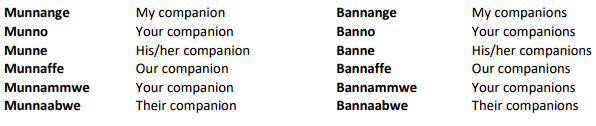
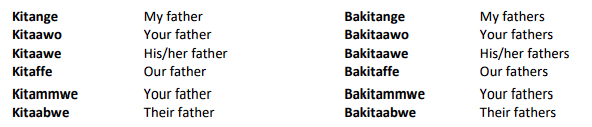
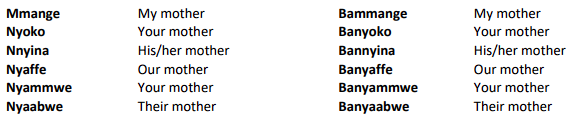
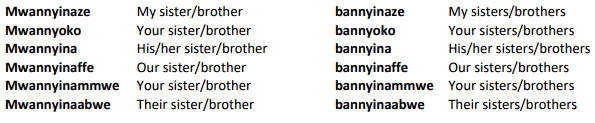
these words have special conjugations, but share similar features. For example, all of the plural forms with start with ‘Ba’
COMPANIONS (Munn- & Bann-)
Special way of saying “My Father” (Kit- and Bakit-)
Special way of saying “My Mother” (Mm/Nyok/Nyin/Ny- and Bamm/Banyok/Bannyin/Bany-)
Special way of saying “My Siblings” (Similar to mother, Mwann and Bann)
Special way of saying “My Husband” (Ba/Bb- and Baba/Babb)
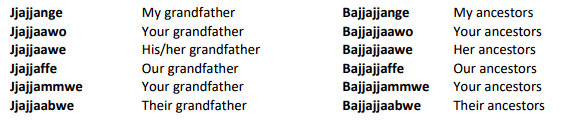
Special way of saying “My Grandparents” (Jjajja and Bajjajja-)