IGCSE PHYSICS
ELECTRICITY BASICS (CHARGE ETC)
Electric charge is a fundamental physical property of matter that causes particles to experience a force when placed in an electromagnetic field
v
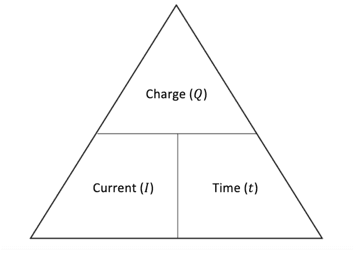
FORMULA FOR CHARGE: Charge=Current×Time
two fundamental types of electric charge: positive and negative. In nature, these charges originate from the subatomic particles within an atom: protons carry a positive charge, while electrons carry a negative charge
Neutral Atoms: Contain an equal number of protons and electrons, resulting in a net charge of zero.
Ions: Formed when an atom gains or loses electrons.
Positive Ion: Formed when an atom loses electrons, leaving it with more protons than electrons.
Negative Ion: Formed when an atom gains electrons, giving it a surplus of negative charge.
Atomic Components at a Glance
| Particle | Location | Charge |
| Proton | Nucleus | Positive (+) |
| Neutron | Nucleus | Neutral (0) |
| Electron | Orbits | Negative (-) |
⚠ Crucial Note: During any charging process, the nucleus remains unchanged. Only the electrons are mobile enough to be added or removed! ⚡
ATTRACTION/REPULSION
When two charged objects are brought near one another, they exert a non-contact electrostatic force on each other
Repulsion: Like charges (positive-positive or negative-negative) push away from each other. ⬅➡
Attraction: Unlike charges (positive-negative) pull toward each other. ➡⬅
The strength of this interaction is determined by the distance between the objects and the magnitude of their charges. As objects move closer together, the force of attraction or repulsion becomes significantly stronger.
REMEMBER

An electric field is a region of space surrounding a charged object where another charged particle will experience an electrostatic force
(think of it as an invisible "force field" that dictates how charges interact without touching)
The behavior of this field is represented by electric field lines, which follow specific rules:
Direction: Field lines always point away from positive charges and towards negative charges. 🧭
Strength: The density of the lines indicates the field's intensity. Where lines are close together, the field is strong; where they are far apart, the field is weak.
Force Vector: The direction of a field line at any point shows the direction of the force that would act on a positive test charge placed at that location.
an electric field line is simply a visual map of force.
IMPORTANT!!
By international scientific agreement, we always draw these arrows based on how a positive charge reacts.
So, if you see an arrow pointing to the right, it means a positive charge at that spot will be pushed to the right. If the arrow points left, a positive charge will be pushed to the left. It is essentially a "one-way street" sign for positive charges!
Key Properties
Field lines never cross each other. 🚫
The field exists in three dimensions around the charge, though we usually draw it in two.
A uniform electric field (created between two parallel plates) has parallel, equally spaced lines, meaning the field strength is constant at every point between the plates. 📏

Electric field patterns 🕸 provide a visual map of how charges interact in different configurations. By observing the arrangement of field lines, we can predict how a charged particle will move when placed in that space.
Opposite charges (+ and -): Lines go straight from positive to negative. They attract. ➡
Like charges (+ and + or - and -): Lines bend away from each other. The middle has no force — this is the neutral point. 🚫
Parallel plates: Lines are straight, parallel, and evenly spaced. The field is the same strength everywhere. 📏
Spheres: Lines spread out evenly in all directions, just like a single point charge🔴
Key Properties
Field lines never cross each other. 🚫
The field exists in three dimensions around the charge, though we usually draw it in two.
A uniform electric field (created between two parallel plates) has parallel, equally spaced lines, meaning the field strength is constant at every point between the plates. 📏

Conductor | Insulator |
Copper | Plastic |
Aluminium | Rubber |
iron | Glass |
steel | Wood |
gold | Ceramic |
silver | Dry Air |
graphite | Polystyrene |
Charging by friction occurs when two different insulating materials are rubbed together, causing a transfer of electrons from one surface to the other. Because insulators do not allow electrons to flow freely, the transferred charges remain trapped on the surface of the material, creating static electricity.
The process follows these specific rules:
Electron Transfer: One material loses electrons (becoming positively charged), while the other gains those same electrons (becoming negatively charged).
Conservation of Charge: No new charge is created; it is simply moved from one object to the other.
Example: When you rub a polythene rod with a woolen cloth
REMEMBER
Step 1: Take two different insulating materials and rub them together.
Step 2: Rubbing causes electrons to move from one material to the other.
Step 3: The material that loses electrons becomes positively charged (+).
Step 4: The material that gains electrons becomes negatively charged (−).
Step 5: Because they are insulators, the electrons cannot move around easily, so the charge stays on the surface.
Step 6: This build-up of charge is called static electricity.
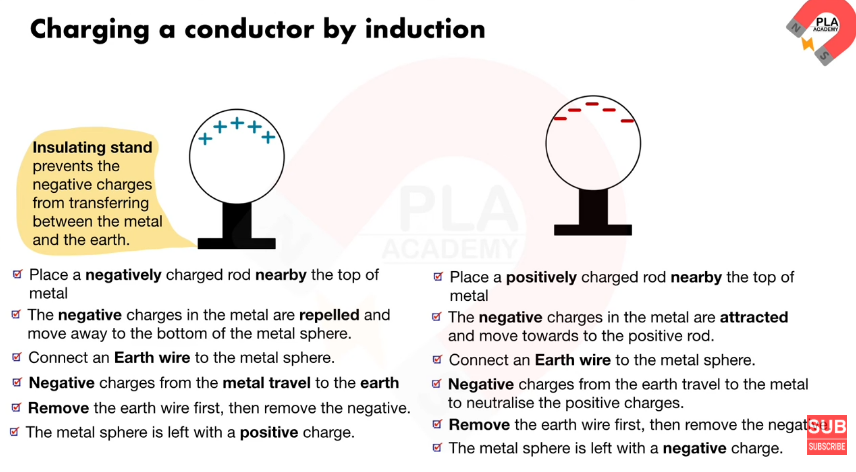
Charging by induction 🧲 is a method used to charge a conductor without actually touching it with a charged object so dosent need contact
The process involves four critical steps to ensure a permanent charge is left behind:
Polarization: Bring a charged rod (negative or positive) near a neutral metal sphere. The rod's field pushes the sphere's free electrons to the opposite side, leaving the near side positive OR negative depending on the case
Earthing: Connect an earth wire to the sphere. This provides a path for the repelled electrons to escape into the ground. 🌍
Break the Path: Remove the earth wire first while the charged rod is still in place. This traps the remaining charges on the sphere.
Remove the Rod: Once the rod is moved away, the remaining charges redistribute themselves evenly across the surface.

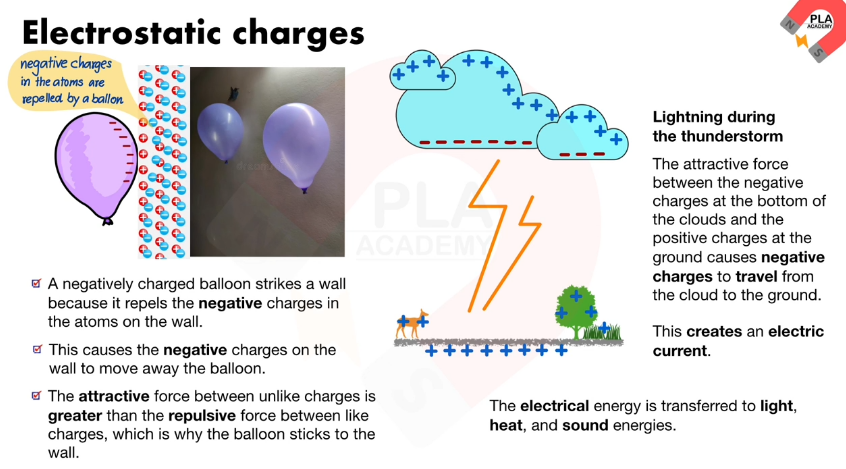
Electrostatic examples ⚡ occur in daily life when objects become charged through friction or induction, leading to noticeable forces of attraction or repulsion. These phenomena demonstrate that unlike charges attract, often with enough force to overcome gravity or move fluids.
Common real-world examples include:
Hair and Combs 💇: Brushing creates friction, transferring electrons between your hair and the comb. Because they end up with opposite charges, your hair is attracted to the comb, often resulting in "flyaway" strands.
Bending Water 💧: A negatively charged object (like a balloon) brought near a thin stream of water will attract the positive charges in the water molecules. This causes the entire stream to physically bend toward the object.
Sticking Balloons to Walls 🎈: When a negatively charged balloon is placed against a wall, it repels the electrons in the wall's atoms. This leaves the surface of the wall locally positive, creating an attractive force that holds the balloon in place.
Lightning ⚡ is a massive, naturally occurring electrostatic discharge that happens during thunderstorms
As clouds move, friction between ice particles and water droplets causes a massive buildup of negative charges at the bottom of the cloud. This negative charge induces a positive charge on the ground below by repelling the ground's electrons.
The process of energy transfer follows these steps:
Discharge: When the attractive force between the negative cloud base and the positive ground becomes strong enough, the air (normally an insulator) breaks down and allows electrons to flow rapidly.
Current: This flow of negative charges from the cloud to the ground creates a powerful electric current.
Energy Transformation: The electrical energy is not lost but is rapidly converted into other forms:
💡 Light energy (the visible flash).
🔊 Sound energy (thunder caused by the rapid expansion of heated air).
🔥 Thermal energy (extreme heat that can set fire to objects or split trees).
REMEMBER
When two different insulating materials are rubbed together, electrons can transfer from one material to the other.
Loses electrons → becomes positively charged (+)
Gains electrons → becomes negatively charged (−)
The charges stay on the surface because insulators don't allow electrons to move freely.
Safety Note 🛡
Lightning always seeks the path of least resistance to the ground. This is why it typically strikes tall, conductive objects like trees, poles, or lightning rods, which provide a direct route for the electrons to reach the Earth safely.
CORRECTIONS:
When you rub a polythene rod with a woolen cloth, which material ends up with a surplus of electrons?
The polythene rod
due to some materials have high affnity (electron greedy) while others have a low affinity meaning its easier to gain electrons from them and the material with higher affinity will take majortiy of the electrons meaning it will have a surplus of electrons by the end
What is the scientific reason a negatively charged balloon sticks to a wall?
Induction creates a local opposite charge on the wall
Even though the wall is neutral (it has an equal number of positive and negative charges), the balloon forces the charges inside the wall to move around
The negatively charged balloon pushes away the electrons (negative charges) in the wall's surface because like charges repel.
This leaves the surface of the wall with more protons (positive charges) than electrons.
Because the surface of the wall is now locally positive, it attracts the negative balloon. 🧲
When a balloon is rubbed on hair and then held near a thin stream of water, the water stream bends toward the balloon. What is the scientific reason for this bending?
Attractive force between unlike charges
Suggest why clothes dried in a tumble drier might stick to each other.
The clothes will rub against each other in a tumble drier. This could charge the clothes as electrons are lost when the clothes rub together. Some will lose electrons and become positively charged and others will gain electrons and become negatively charged. The clothes that are oppositely charged will attract each other and stick together.
In an electrostatic store, energy is stored due to the presence of:
a difference in charge between two objects
A negatively charged sphere is brought close to a neutral metal sphere.
Does the neutral sphere attract or repel the negatively charged sphere? and why
The negative sphere repels negative charge in the neutral metal sphere away from it. This leaves the side closest to the negative sphere relatively positive, so the two objects attract.
Explain why the charges remain on the surface of the polythene rod.
Polythene is an insulator, so electrons cannot move freely through it. The charge therefore remains on the surface.
Explain what is meant by an electric field
An electric field is a region of space where a charged object experiences an electrostatic force
What happens to the electrons in the metal sphere?
STARTER:
🧠 Quick-fire MCQs
12.
An atom has 11 protons and 10 electrons. What is its overall charge?
A. −1
B. 0
C. +1
D. +21
13.
Which particle moves from one material to another when two insulating materials are charged by friction?
A. proton
B. neutron
C. electron
D. nucleus
14.
Which statement about electric field lines is correct?
A. They point towards positive charges.
B. They point away from negative charges.
C. They point away from positive charges.
D. They always form closed circles.
15.
A current of 3 A flows for 20 seconds. What charge passes through the circuit?
A. 0.15 C
B. 17 C
C. 23 C
D. 60 C
16.
Which pair contains two insulators?
A. copper and aluminium
B. iron and steel
C. plastic and rubber
D. graphite and copper
17.
Two negative charges are brought close together. What happens?
A. They attract.
B. They repel.
C. They become neutral.
D. Nothing happens.
MAGNETISM
What is a magnet
an object or material that produces its own magnetic field
Forces between magnetic poles
The ends of a magnet are called poles
Magnets have two poles: a north and a south
Magnetic forces are strongest at the poles
Uses of magnets
Compasses: for thousands of years humans have used compasses for navigation, since the needle always points north
School lab experiments: the magnets used in school science demonstrations are permanent magnets
Toys: toy trains and trucks often have magnets which attach the carriages or trailers to the engine or cab
Fridge magnets: these are made either of flexible magnetic material or by sticking a magnet to the back of something
What is an electromagnet?
An electromagnet is a temporary magnet consisting of a current-carrying coil of wire wrapped around a magnetically soft iron core
Uses of electromagnets
MRI scanners: in hospitals, an MRI scanner is a large, cylindrical machine using powerful electromagnets to produce diagnostic images of the organs of the body
Speakers and earphones: the loudspeakers, microphones and earphones used in phones and laptops use electromagnets to sense or send soundwaves
Recycling: because steel is a magnetic material it can be easily separated from other metals and materials using electromagnets. Once recovered the steel is re-used and recycled, reducing mining for iron ore and processing ore into steel
Mag-Lev Trains: the ability of Mag-Lev trains to hover above the rails is due to them being repelled by large electromagnets on the train and track. This reduces friction and allows speeds of nearly 400 miles per hour
Magnetic materials
Iron
Steel
Cobalt
Nickel
Soft iron
Mu-metal
Silicon steel
Alnico
Neodymium
Ferrite
Non Magnetic materials
Aluminium
Copper
Brass
Lead
Zinc
Gold
Silver
Tin
Bronze
Titanium
Types of magnets
Permanent
Induced (Temporary) Magnet
An induced magnet is a material with a soft iron core that becomes a magnet temporarily when it is placed in a magnetic field