Evolution
Jean-Baptiste de LaMarck- theorized about acquired traits
thought it happened throughout their lifespan
Darwin’s Theory
Charles Darwin- “Descent with Modification”
proposed the idea of evolution by natural selection
said organisms descend with modification (survival of the fittest)
Adaptive Radiation
populations branch out to adapt their environment
Essence of Darwin’s Ideas
Variation exists in natural population
Many more offspring are born each season than can possibly survive maturity
As a result, there is a struggle for existence (competition)
Characteristics beneficial for competition
adaptions
Over long periods of time, and input of variation, a new species emerges
Wallace
forced Darwin to publish his book
Mechanics of microevolution
5 agents that act on Evolutionary change
mutation
biggest one
gene flow
Movement of individuals & alleles in & out of populations (immigration/ emigration)
causes genetic mixing
genetic drift
founder effect
When a new population is started by only a few individuals
happens when colonization
bottleneck effect
When large population is drastically reducedby a disaster
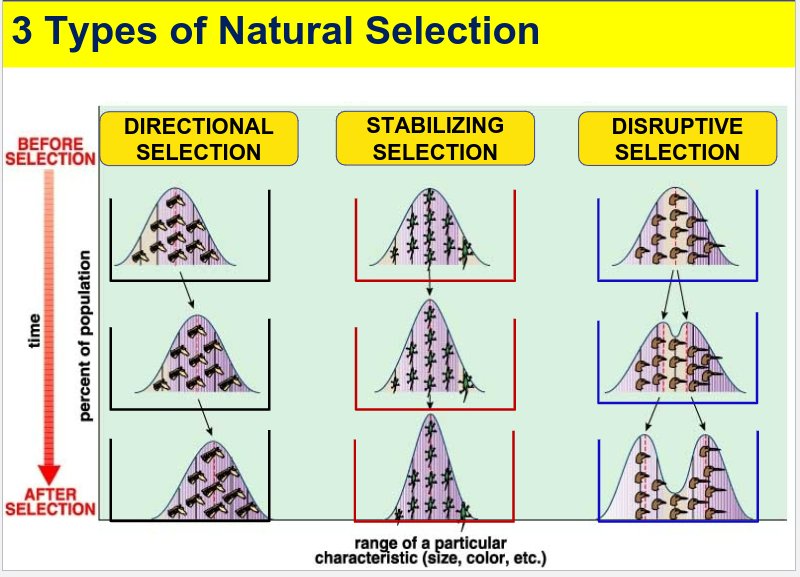
natural selection
Differential survival & reproduction due to changing environmental conditions
non-random mating
Sexual dimorphism
gender differences created by sexual selection
Evidence for Evolution
fossils- any sign of life existed at that point
examples:
1. Tiktaalik – “missing link” from sea to land
2. birds to dinosaurs
biogeography- wallace’s line
homology “homologous structure
divergents- shares
convergen- share same purpose
3structures
homzygous, anagolus
evolution of populations
population: group of individuals of the same species in the same place at the same time
hardy-weinberg principle
p²+2pq+q²=1
we count alleles
frequency of dominant alleles: f(A)=p
frequency of recessive alleles: f(a)=q
p+q=1
to know if a population is in hardy-weinberg equilibrium observe at least 2 generations and see if they are equal
conditions for a population to be in hardy-weinberg (meaning not example)
origin of species
Biological species concept- population whose members can interbreed & produce viable (healthy), fertile offspring
Microevolution – small changes with alleles (N.S.)
Macroevolution – origin of new species
how do new species originate? Speciation
Populations must become isolated
Isolated populations evolve independently
Isolation occurs 2 ways:
allopatric isolation
geographic separation (physical)
“other country”
sympatric isolation
still live in same area but don’t reproduce
“same country”
How does nature maintain the species boundaries?
1. Prezygotic barriers – prevents the physical act of mating or fertilization by sperm cell
examples:
geographical isolation- species occur in different places
(habitat isolation) sympatric speciation- Species occur in same region, but occupy different
habitats so rarely encounter each other
temporal isolation- breed during different seasons
behavioral isolation- Unique behavioral patterns & rituals isolate species
Mechanical Isolation (sympatric)- Morphological differences can prevent successful mating
2. Postzygotic barriers – barriers that form after hybrid zygote is formed
reduced hybrid viability- poor health
reduced hybrid fertility- sterile
speciation rate
gradualism- gradual accumulation of small changes over time
punctuated equilibrium- rapid burst of change mixed with long periods of little to no change
Classification, phylogeny and the tree of life
systematics- the discipline of biology that focuses on classifying organisms and determining their evolutionary relationships
taxonomy
binomial species- each species has two part name
genus and species
classification
domain
kingdom
phylum
order
family
genus
species
old 5 kingdom system
monera (prokaryotes), protists, plants, fungi, animals
new 3 domain system
prokaryote: bacteria
prokaryote:archaebacteria
eukaryotes
protists, plants, fungi, & animals
phylogeny
phylogeny- evolutionary history of species or group of species
phylogenies based on homologies reflect Evolutionary history (divergent evolution)
know how to read a phylogenetic tree (cladogram)
origin of life
origin of life is a hypothesis
special creation: where life was created by an otherworldy force (non testable)
extraterrestrial origin (panspermia): orginal source of organic materials comes form comets (testable)
abiogenesis: life evolve spontaneously from inorganic molecules (testable)
conditions on early earth
reducing atmosphere- lots of different gases, available H atoms, no free oxygen
1953 miller and urey test hypothesis- closed system that produced amino acids, hydrocarbons, nitrogen bases, ETC.
endosymbiotic theory- how did life get here
prokaryotic ancestor of eukaryotic cells, eukaryotic cells
eukaryotic cell: origin of mitochondria
macroevolution patterns
adaptive radiation – species migrate to new environment
convergent evolution – adaptations due to similar environment
NOT evolutionary relationships
Macroevolution – the quick,abrupt change to many
populations that happens
suddenly.