Chapter 5.1
Cell Membrane
Bio Membranes separate interior cell from external environment
Different sides of membranes have different properties
↑ determined by chem properties of lipids, proteins & carbs
consider polarity & H²O interactions
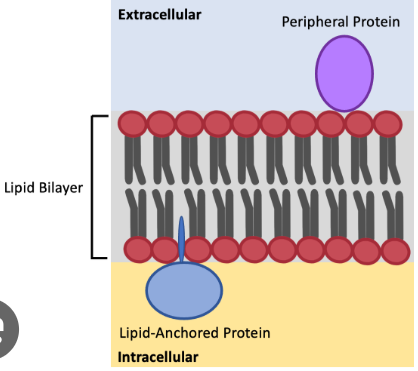
Constituents vary based on needed functions
8nm thick - 2x length of reg. phospholipid
Can be artificially made- small holes inside randomly seal
Differ based on: (L) compos., FA chain length, # of DB, kinds of polar groups
Lipids (L)
phospholipid nonpolar sides interact with proteins to form insoluble barrier
Proteins inside phospholipid bilayer
(P) & (L) interact
Move freely
interact noncovalently
Capability to interact & keep bilayer help fuse viscle format., phagocytosis etc.
many kinds
FA make Phos. somewhat fluid like olive oil
above makes mol. move side to side
Can travel from end to end in ~1 sec
Most common FA- 16-18 C & 0-2 DB
Unsat. makes less dense & more fluid packing
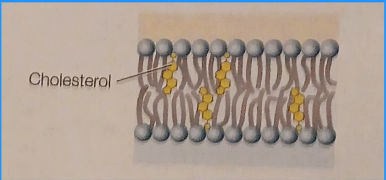
25% of lipids in animal membrane is steroid cholesterol
Cholestrol- regulate memb. fluidity & other steriods funct.
Ex. Horomones
Proteins (P)
noncov. in phos. bilayer
held by nonpolar domains
(P) & (L) int.
Uneven distribution
In phos. bilayer
Can:
move things through membrane
In cell recod. & adhesion
Get chem sig. from ext envir.
Usually 1 protein per 25 phos.
above Varies on mem. funct.
AA arrangement in mem. decides if (p) is in lipid tails & pos.
Peripheral Mem. (P)
no exp. nonpolar groups & not inside bilayer, have polar/charged reg. that int with exp. parts of integral mem. (P) or (L) heads
Some move freely - Ex. Cell Fusion ~ cont. membrane forms around, & protein distributed evenly
Some Contained- “fenced” - Ex. comp. of cytoskeleton attached to mem. (P). in cytoplasm. Cytoplasm restrict attached (P) movement
Carbs (C)
Attached to lipids or proteins
Usually on ext. of mem.
Interact w/ ext envir
Can recod. specific mol
Ex. Mol. on adjacent cell surf.
Can be linear or branched
Help cell comm. & adhesion
Adhere cuz sim. (C) int.——edge of two cells (outer surf., between (C) &(P). or 2 (P))
Fluidity (F)
deter. fluidity by using strong UV to make “hole”—how quick hole fills back up deter (F)
Affected by:
Liquid comp. - chol. & sat. FA (x less fluid), short chains (x more fluid)
some anesthetic nonpolar so when in cell memb. (x less fluid) reduce nerve activity
Temp. - cold (x less fluid), cuz move slower
Some org. change lipid comp. long to short FA when cold - makes plants, bacteria and sleep animals in winter
Cell Fusion - cont. membrane forms around, & protein distributed evenly