Applications of Genetics: Genetic Engineering, Biotechnology, and Gene Therapy Study Guide
Core Concepts and Definitions in Genetics Applications
Biotechnology: Defined as the use of living organisms to create a product or process with specific, useful applications.
Genetic Engineering: This involves the direct alteration of an organism's genome through various means:
Utilization of recombinant DNA techniques.
Creation of organisms with artificial genes, referred to as transgenics.
Generation of Genetically Modified Organisms (GMOs).
Gene Therapy: treating a genetic disease by providing a normal coy of a gene
Biological and Pharmaceutical Applications of Genetic Engineering
Bacterial and Cellular Production Systems: Bacteria and cells that make many biological and pharmaceutical products
Case Study: Human Insulin Production:
Physiological Importance: Insulin is secreted from the beta cells of the Islets of Langerhans in the pancreas. It is essential for regulating glucose metabolism.
Medical Context: Individuals with Type I Diabetes cannot produce insulin, a condition affecting millions worldwide. Historical sources for insulin were purified from cows and pigs, but human insulin produced via genetic engineering is now preferred.
Human Insulin production Process:
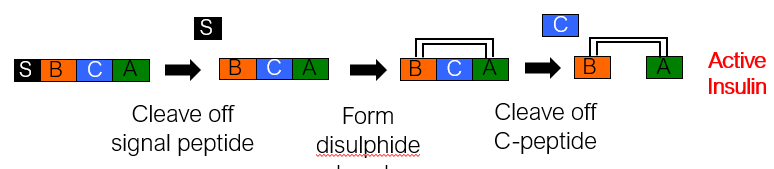
1. Encoded as a amino acid protein precursor called preproinsulin.
2. The signal peptide (S) is cleaved off the signal peptide
3. Disulfide bonds form between the A and B chains.
4. The C-peptide (C) is cleaved off to produce the active, functional insulin molecule consisting of A and B subunits joined by disulfide bonds.
the active insulin is secreted into the blood stream
Production in E. coli:
The process differs from human maturation but produces an identical hormone.
Genes for insulin subunit A and subunit B are inserted into separate plasmids next to a lacZ gene and a promoter.
These are transformed into , where they produce -gal/insulin fusion proteins that accumulate in the cells.
The fusion proteins are extracted and purified.
Treatment with cyanogen bromide cleaves the A and B chains from the -galactosidase.
Subunits are purified and mixed under an oxidizing environment to form functional disulfide bonds, resulting in active insulin (commercially known as Humulin R).
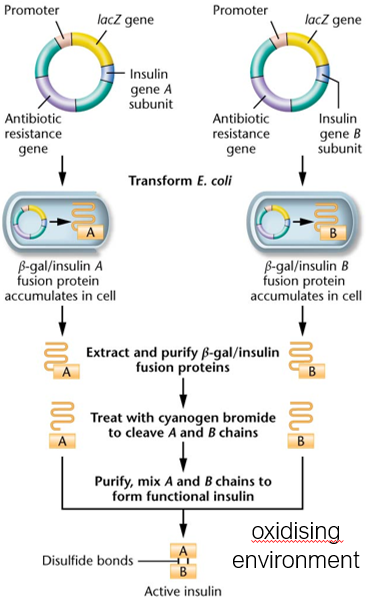
Table of Genetically Engineered Biopharmaceutical Products
Erythropoietin: Used for anemia; produced in or cultured mammalian cells.
Interferons: Used for multiple sclerosis and cancer; produced in or cultured mammalian cells.
Tissue Plasminogen Activator (tPA): Used for heart attacks and strokes; produced in cultured mammalian cells.
Human Growth Hormone: Used for dwarfism; produced in cultured mammalian cells.
Monoclonal Antibodies against VEGF: Used for cancers; produced in cultured mammalian cells.
Human Clotting Factor VIII: Used for Hemophilia A; produced in transgenic sheep or pigs.
C1 Inhibitor: Used for hereditary angioedema; produced in transgenic rabbits.
Recombinant Human Antithrombin: Used for hereditary antithrombin deficiency; produced in transgenic goats.
Hepatitis B Surface Protein Vaccine: Produced in cultured yeast cells or bananas.
Immunoglobulin IgG1 to HSV-2: Used for herpesvirus infections; produced in transgenic soybeans.
Recombinant Monoclonal Antibodies: Used for rabies diagnosis/passive immunization, cancer, and rheumatoid arthritis; produced in transgenic tobacco, soybeans, or mammalian cells.
Edible Vaccines (Norwalk virus capsid protein or E. coli heat-labile enterotoxin): Delivered via transgenic potatoes.
Genetic Engineering in Agriculture
Traditional Selective Breeding:
want crops with enhanced food production
Used historically to modify crops such as Brassica oleracea into diverse forms: Cabbage (terminal buds), Brussels sprouts (lateral buds), Kohlrabi (stem), Kale (leaves), Broccoli (stems and flowers), and Cauliflower (flower clusters).
Yield improvements involve significant changes, such as a increase in maize yield over the last years.
Modern Whole Genome Sequencing: identified genes selected during selective breeding
Genetically Modified (GM) Crops Statistics:
GM crops are planted on million hectares worldwide.
Over million farmers in both industrialized and developing countries use GM technology.
Herbicide Resistance (Glyphosate):
Problem: Weed infestation affects approximately of worldwide crops. herbicides that kill weeds also kill crops
The herbicide glyphosate kills plants by inhibiting EPSP synthase in the chloroplast, which is essential for amino acid synthesis.
Solution: Engineer herbicide resistant crops, can kill weeds without affecting crops (glyphosate resistant crops)
Process:
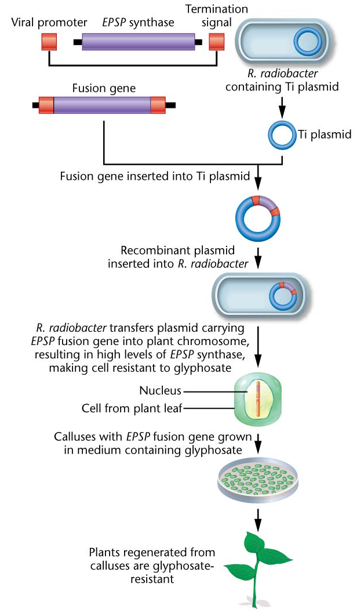
have plants make high levels of EPSP synthase that is resistant to glyphosate action
use a strong promoter from cauliflower mosaic virus to drive EPSP synthase (fusion gene)
insert fusion gene into Ti plasmid (contains genes that enable bacteria (R.radiobacter) to transfer DNA into plant cells and integrate into genome)
select for transgenic cells that are glyphosate resistant
grow plants from resistant cells
Pest Resistance (Bt Crops):
Problem: Insects like the European corn borer cause millions in damage.
Natural Insecticide: Cry toxin from Bacillus thuringiensis (Bt). When ingested by larvae, Cry proteins form pores in the gut, killing the insect.
Innovation: Instead of spraying bacteria on crops (common in organic farming), the crops are engineered to express the Cry toxin internally. Adopted extensively in corn (maize), cotton, soybean, and canola.
Adoption Rates (USA, 1996–2024):
HT (Herbicide Tolerant) soybeans and cotton have reached nearly adoption.
Bt (Insect resistant) varieties and HT corn also show extremely high adoption curves.
Global Distribution:
USA is the largest producer ( of global area).
Brazil is the top developing country producer.
Since , over billion hectares of biotech crops have been planted.
Nutritional Enhancement and Golden Rice
Problem: Vitamin A deficiency causes blindness in over children annually in Asia and Africa.
Golden Rice 2: Engineered to produce -carotene (a Vitamin A precursor) in the rice endosperm (seed).
The Engineering Challenge:
Rice seeds naturally contain geranylgeranyl diphosphate (GGPP), the starting material for -carotene, but lack the expression of 4 key enzymes to convert it.
Solution: Provide the missing enzymes with transgenes that are expressed in rice seeds
Initial conversion required transgenes. This was simplified to transgenes by using a bacterial enzyme CRTI (which replaces three plant enzymes: Phytoene Desaturase, -Carotene Isomerase, and -Carotene Desaturase) and phytoene synthase from maize.
express both transgenes using an endosperm specific promotor
increase carotene synthesis by using more efficient versions of the same enzyme
remove selectable marker during transgenesis
crossed transgenes into rice cultivars grown in the area od need
Success: Current lines provide of the estimated average requirement for Vitamin A.
Regulatory Status:
Declared safe in USA, Canada, New Zealand, and Australia.
Approved for cultivation in the Philippines in , but the decision was overturned by the court of appeals in due to Greenpeace's legal challenges. The Philippines government is challenging this as of .
Issues and Considerations in Biotechnology
Safety and perceived public safety concerns.
Gene Flow: The risk of transgenes moving from GMOs to wild plant relatives.
Ecological invasion and the reduction of biodiversity.
Off-target effects: Assessing if toxins like Bt toxin affect non-target species.
Development of resistance in pests.
importance of education, knowledge and research
Advanced Gene Therapy and Gene Editing
Gene Therapy Delivery:
Goal: cure genetic diseases
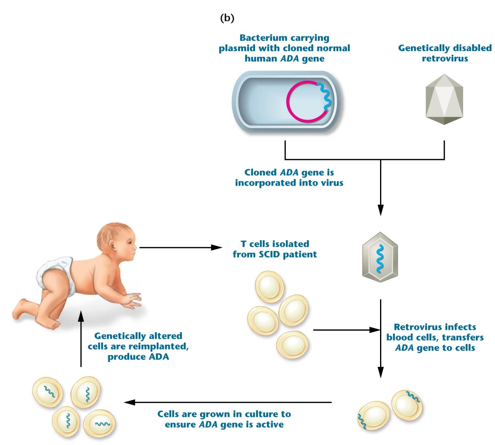
Viral Vectors: transfer normal genes into a patients cells. The virus can infect cells but cannot replicate because its essential genes are removed.
Method:
use recombinant DNA tech to replace viral genome in human gene
package into viral protein coat that can infect a cell (viruses can’ replicate inside the cell because the viral genes are replaced)
Liposomes: Delivery of plasmids via fusion with the cell membrane.
different viral vectors have different properties:
target different cell types
may or may not integrate into host genome
duration of transgene expression varies
different limits on transgene size
Severe Combined Immunodeficiency (SCID):
heritable disorder where individuals lack a functional immune system. Can die from minor infections and must be confined in a sterile environment
Ashanti DeSilva: A notable patient with an autosomal form of SCID caused by a mutation in gene encoding adenosine deaminase (ADA). Her T cells were isolated, infected with a retrovirus carrying the normal ADA gene, and reimplanted.
know which gene to fix
know that the gene is needed in immune system
Caveats of Gene Therapy:
Immune response: Jesse Gelsinger died from a massive inflammatory response during treatment for a liver disease.
Mutagenesis: Integration of retroviral vectors near the LMO2 gene caused leukemia in children during an X-linked SCID trial.
Limitations:
Integrates into host genome only in replicating cells
vectors can contain small genes
Gene Editing (CRISPR/Cas9):
Highly efficient technology that cuts the genome at specific sequences to generate double-stranded breaks which can be used to generate diverse types of changes in DNA sequence.
2020 Nobel Prize: Awarded to Emmanuelle Charpentier and Jennifer Doudna.
Sickle Cell Disease: gene editing treatment developed for sickle cell and beta thalassemia. uses CRISPR/Cas9 was approved in the UK in .