Motivation and Emotion (Ch. 10)
Motivation: a want or need towards a goal
Intrinsic: internal factors
this make me feel good, guilt
Extrinsic: external factors
rewards and punishment
Instinct: species-specific pattern of behavior that is unlearned.
Instinctive Behavior: something not learned that we do anyways.
infant rooting for the nipple
basically anything an infant does bc they don’t know anything yet still do things.
Overjustification effect: intrinsic motivation is diminished when extrinsic motivation is given.
you start hating what you (used to) love doing
burnout
Reminding yourself why you started
Theories
William James — incorrect/we don’t do this anymore
Drive Theory of Motion: the maintenance of homeostasis is important in directing behavior.
hunger
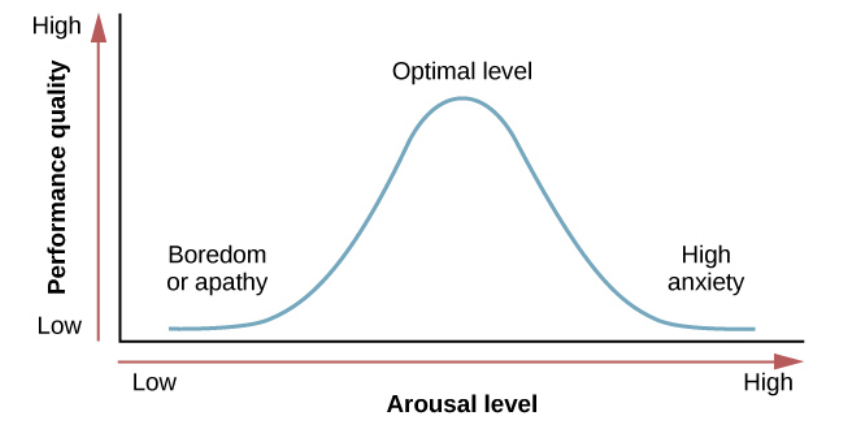
Arousal Theory of Motivation: we have to be at the highest level of arousal to accomplish something.
underaroused: bored, seek stimulation
overaroused: anxiety
Yerkes-Dodson Law: task performed best when arousal levels are in a middle range.
“a simple task is performed best when arousal levels are relatively high and complex tasks are best performed when arousal levels are lower”
Self-efficacy: are you motivated enough to due something; am I capable of doing this?
Bandura: self-efficacy plays a role in motivating behavior.
Social Motives:
Need for achievement: awards
Need for affiliation: positive interaction with people
Need for intimacy: meaningful relationships
Hunger and Eating
Before eating: empty stomach.
if we don’t eat for along period of time, smth happens idfk
After eating:
satiation: feeling of fullness and satisfaction causing eating behavior to stop.
release leptin: a satiety hormone
Metabolic rate: the amount of energy that is expended in a given period of time.
burn calories faster or slower
Set-Point Theory: each individual has an ideal body weight/set point, which is resistant to change.
genetically predetermined
Bariatric Surgery: gastric banding surgery creates a small pouch of stomach, reducing the size of the stomach that can be used for digestion.
Tato
Bulimia Nervosa: binge eating episodes then trying to compensate for the large amounts of food consumed.
Compensation: vomiting, laxatives, excessive exercise
Health consequences: bone loss, heart failure, kidney failure, amenorrhea (cessation of the menstrual period), reduced function of the gonads, and in extreme cases, death.
Psychological problems: anxiety disorders, mood disorders, and substance abuse
Anorexia Nervosa: not eating at all. Sometimes exercise on top of that as well.
Distorted body image: a type of body dysmorphia.
Health consequences: bone loss, heart failure, kidney failure, amenorrhea (cessation of the menstrual period), reduced function of the gonads, and in extreme cases, death.
Psychological problems: anxiety disorders, mood disorders, and substance abuse
Prader-Willi Syndrome (PWS): persistent feelings of intense hunger and reduced rates of metabolism.
people can eating 24 hrs/never feel satiated
Sexual Behavior (10.3 pg 346)
Hypothalamus: motivated behavior (including) for sex
Sexual disorders due to impurities to the hypothalamus
Hormones — endocrine secretion ☹ —i didnt write it down fast enough
Amygdala Nucleus Accumbens = also motivators
Kinsey: Published Sexual Behavior in the Human Male (1948) and Sexual Behavior in the Human Female (1953)
Findings: women and men are equally interested and experienced in sex, both masturbate without health consequences, homosexual acts are common/exist, and asexuals
Kinsley scale: used to categorize and individuals sexual orientation
Master’s and Johnson: observed ppl engaging in sexual acts
Blood pressure and respiration rate increase(?) during sex—rare ppl pass out during sex
Excitement; erection, lubrication
Plateau; increased swelling and blood flow to the labia minora/pre-ejaculation fluids
Orgasm; rhythmic contractions; ejaculaton
Resolution; come down
must be lubricated during entire process
Sexual orientation: emotional and erotic attraction toward another individual
Gender identity: an individual’s sense of being male, female, neither of these, both of these, or another gender
Gender dysphoria:
at least 6 months
significant distress
Transgender hormone therapy: use of hormones to make one’s body look more like the opposite sex.
Emotions
Mood: nothing conscious, kinda how you are wherever you are
Emotion: based on something that happens to bring it on, can be intentional brought out
Theories
James-Langue: emotions rise from physiological arousals
body is first thing that responds
then emotion
Cannon-Bard: having emotions alongside the physiological happenings
Singer: you must be aware something is happening
you label it = you are having it
i think therefor i am
Lazarus: you name it, then your physiological symptoms start
Thalamus: sensory relay center
what is making me nervous?
Hippocampus: logic and theories as why we feel the way we do
Amygdala—
Basolateral Complex: dense connections with different sensory areas of the brain
thing we do and don’t like; why we do or don’t
classical conditioning occurs here
Central Nucleus: endocrine and automatic nervous system
Cultural Display Rule: culturally specific standards that govern the types and frequencies of displays.
“be who you are~“
Japan subway behavior vs. New York subway behavior
Inside Out emotions = seven universal facial expressions of emotion
Happy
Sad
Contempt
Anger
Surprised
Fear
Disgust
Facial feedback hypothesis: facial expressions are capable of influencing our emotions.