1.1 In-depth about social sciences
AKA Behavioural Science —> UNDERSTANDING HUMAN EXPERIENCES, EXAMINING CULTURES, SOCIETIES AND BEHAVIOURS OF VARIOUS GROUPS OF PEOPLE THROUGH THEIR RESEARCH
Things that connect them all: their subject is human, and what it means to be human
September 9, 2025
Key Terms:
Ethnocentrism → The tendency to judge other cultures by one's own values. An ethnocentric view is to look at another culture as strange or inferior.
Power Dynamics → the way power is shared, used, or balanced between people or groups in a relationship or situation. It’s about who has more influence, control, or authority and how that affects interactions.
Social Science → Over the centuries, people have turned to science to explore human societies and social relationships. It includes branches such as history, civics, economics, and sociology
Ethnology → The comparative study of different cultures
Culture → The shared values, beliefs, behaviours and material objects of a group of people are shared. Rituals, traditions, symbols
Cultural Anthropology → The study of how culture shapes human ideas and learned behaviours
Ethnocentrism → The tendency to judge other cultures by one’s own values. This view is to look at another culture as strange or inferior. Old school anthro BAD (racism and prejudice)
Cultural relativism → The belief that all cultures should be respected for developing ways to survive and for meeting the challenges of their environment —> attitude of respect and acceptance —> striving to understand and record cultural ways as honestly and as accurately as possible
Social Psychology → The study of individuals within their social and cultural setting
Study of human behaviour and what happens to internal processes when people are in groups, what happens to perception and the brain
Linguistics → emojis and such, and what it reveals about languages and cultures
Physical Anthropology → how humans are similar to, and different from, other species; how humans developed biologically over time
Social diserability →
Anthropology: the study of human beings as a species and as members of different cultures, and how trends have evolved over time
Study of human development over time (history) → earliest humans → human ancestors (primates) Evolution → Darwin
More about physical (natural sciences) → fossil
Looking at different cultures
Based on observations → have to participate in it
“Ethnocentrism” → old school anthro BAD (racism and prejudice)
Linguistics → emojis and such, and what it reveals about languages and cultures
Culture → rituals, traditions, symbols
It examines what makes humans human
What’s the difference between the primates and us?
MACRO
Two branches → Cultural and Physical
Physical Anthropology→ the ways in which humans are similar to, and different from, other species; how humans developed biologically over time
Cultural Anthropology → explores how culture shapes the way people lived in the past and how they live in the world today. Ex: would be curious as to why the structure of families or how children are raised varies from one culture
///////////////////////////////////////////////////////////////////////////////////////////////////////////////////////////////////////////////////////
How was human culture developed?
What symbols do cultures share?
How did humans learn to manipulate the environment?
How was language established?
How are historical cultures similar/different to modern cultures?
How does this phenomenon reflect human culture, rituals, or traditions?
What symbols, language, or practices are associated with it?
How might people in different cultures experience it differently?
Sociology: The scientific study of people in groups. It examines the relationships between people and the social structures they develop. (mid-1800s)
Study of societies —> people in groups (interactions)
Relationship between people and social structure (capitalism)
Looking for patterns and trends of human behaviour
Groups: families, friends, ethnic, students, teenagers, females)
^—— What is a pattern in female teenagers’ behaviour?
Looking at how roles shape behaviour
Why do some groups have more power then other groups? POWER DYNAMICS
Why do humans gather and live in groups?
Why do you behave a certain way when you are in a certain group?
How do people in groups influence?
** Do you have the power to control/determine your life, or are you constrained by social forces
^—— Deviance is people who aren’t constrained
Big overarching question: Life is a play, where you are an actor in the play, but also the audience
**External forces
MACRO
///////////////////////////////////////////////////////////////////////////////////////////////////////////////////////////////////////////////////////
What function does society serve in lives of individuals?
What role do social institutions have in society?
How do groups work/interact with each other?
How do individuals learn/adapt to rules and modes of behavior that govern the group?
How do social structures influence/predict human behaviour?
How does this phenomenon shape group identity or relationships?
What social structures, inequalities, or norms are involved?
Who benefits and who is disadvantaged by it?
Psychology: the study of human mental processes and behaviour, and the factors that influence these processes and personality.(20th century)
Frued
The mind and mental process ((cognition)thinking, memory)
The brain’s impact on behaviour
feeling → emotions (joy, sadness, anger, disgust, anxiety, depression)
Become more prominent due to mental health
How the emotions get exhibited in behaviour —> conditioned
Interest in personality types (more pseudo-science)
DSM-5 manual type book for diagnosis
Motivation —> what motivates people?
Negative and positive reinforcement
Big overarching question: what makes humans tick?
Theoretical psychologists try to understand general rules that guide our thinking and behaviour. They examine overt actions (those that can be seen) and mental processes.
**Internal forces
///////////////////////////////////////////////////////////////////////////////////////////////////////////////////////////////////////////////////////
Why do humans behave as they do?
How does personality develop?
What is intelligence?
How can we control our emotions?
How does this phenomenon affect individual thoughts, feelings, or behaviors?
What psychological theories (e.g., motivation, attachment, learning, anxiety) might explain it?
What short- or long-term effects could it have on mental health or identity?
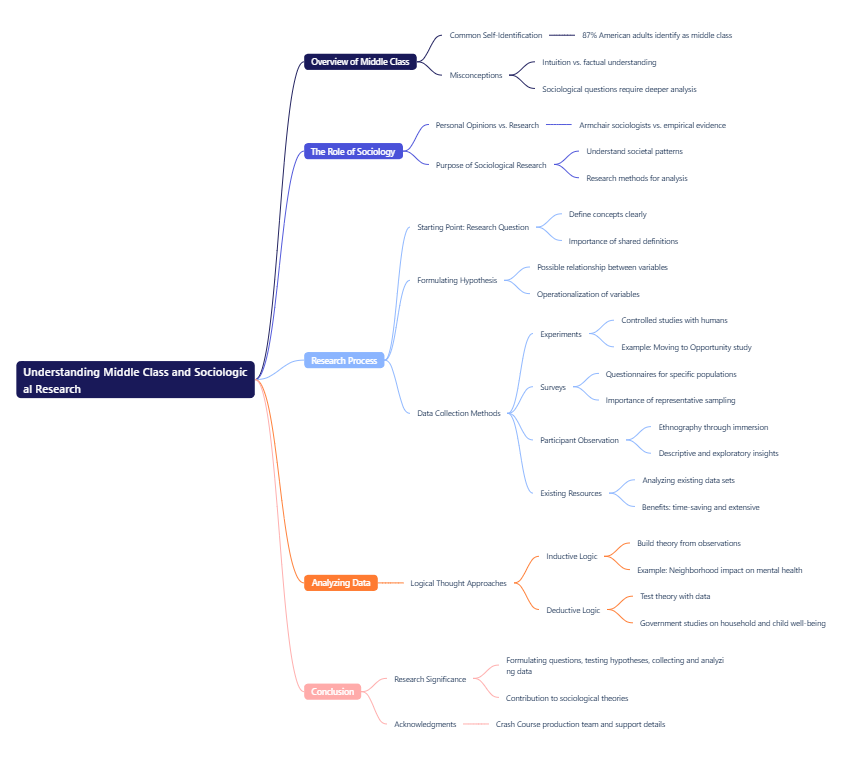
How do social scientists conduct research?
| Qualitative Data (about non-measurable qualities) | Quantitative Data (about quantities or numbers) |
Description |
|
|
Examples | Interviews Observations | Surveys Laboratory-based observation |
"Everything that can be counted does not necessarily count; everything that counts cannot necessarily be counted" —> quantitative vs qualitative | ||
Quantitative Research: A research method that uses statistics and numerical data to measure human experiences.
Like uses surveys, polls, and pre-existing institutional data (e.g., police records, census data).
Focuses on the "what, when, and where" of human behaviour.
Limitation: It's difficult to quantify the full richness of human experience, and easily measurable data points may not always be the best representation of reality.
Qualitative Research: A research method that uses in-depth observation and interviews to understand human behaviour.
Often involves conversations and prolonged observation.
Focuses on the "how and why" behind human actions and motivations.
Limitation: The findings can be more subjective and not easily generalizable to a larger population, but they provide a deeper understanding of individual experiences.
Social Desirability Bias: This is when people give answers on a survey that they think will make them look good, rather than telling the truth. It's a major problem for quantitative studies because it can mess up the data.
Mixed-Methods Studies: A research approach that combines both qualitative and quantitative methods.
This is an increasingly popular approach because it leverages the strengths of both methodologies, using quantitative data to measure broad patterns and qualitative data to provide deeper context and understanding.
basic research;
applied research;
pure research;
strategic research;
qualitative research;
quantitative research;
mixed research