Motivation and Emotion
Motivational Concepts
Motivations - a need or desire that energizes and directs behavior.
Our motivations drive our behavior
Arises from the interplay between nature and nurture
Drives and Incentives
Drive-Reduction Theory - the idea that a physiological need creates an aroused state (a drive) that motivates us to satisfy the need.
We have certain physiological needs
If the needs are not met, it creates a drive
the drive pushes us to reduce the need
Physiological need - a basic bodily requirement.
Homeostasis - a tendency to maintain a balanced or constant internal state; the regulation of any aspect of body chemistry, such as blood glucose, around a particular level. The goal of the Drive-Reduction Theory is to achieve homeostasis
Incentive - a positive or negative environmental stimulus that motivates (or pulls) behavior.
The more these impulses are satisfied, the stronger the desire becomes
How are we pushed by our inborn bodily needs and pulled by incentives in the environment?
Need (food) → Drive (Hunger) → Drive-Reducing Behavior (eating)
Arousal Theory
Arousal = physically energized
Some motivating behaviors increase arousal
When our biological needs are met, we become bored and seek stimulation to increase our arousal
Aroused Individuals are either physically energized or tense
Some motivated behaviors increase rather than decrease arousal
Too much stimulation or stress motivates us to look for ways to decrease arousal
Yerkes-Dodson Law - the principle that performance increases with arousal only up to a “just right” or moderate point, beyond which performance decreases.
Difficult tasks require lower arousal to provide the best performance
A Hierarchy of Needs
Some needs are more important than others
Hierarchy of Needs - Maslow’s five levels of human needs, beginning with physiological needs. Often visualized as a pyramid, with basic needs providing the foundation supporting higher-level needs.
Physiological needs - food, water, housing
Safety Needs - Feeling sate, secure, stable
Belongness and Love need - Need to love and be loved, feel belonging
Esteem Need - need for self esteem, achievement, competence, independence
Self-Actualization need - Need to live up to our fullest potential
Self-Transcendence need - Need to find meaning and identity beyond the self
We sense meaning when we experience our life as having purpose (goals), significance (value), and coherence (comprehensibility)
Exceptions to the hierarchy can make a statement (starving yourself as a form of protest)
Theory | Its Big Idea |
Drive-reduction theory | Physiological needs (such as hunger and thirst) create an aroused state that drives us to reduce the need (for example, by eating or drinking). |
Arousal theory | Our need to maintain an optimal level of arousal motivates behaviors that meet no physiological need (such as our yearning for stimulation and our hunger for information). |
Maslow’s hierarchy of needs | We prioritize survival-based needs, followed by social needs, and finally needs for esteem, purpose, and meaning. |
Hunger
Hunger - one of the basic bodily needs
The Physiology of Hunger
What triggers hunger?
A.L Washburn swallowed a balloon inflated his stomach. Inside of the balloon was a recording device. The balloon tracked his stomach movements. Whenever Washburn felt hungry, he would press a button.
When Washburn felt hungry, his stomach was having contractions
can hunger exist without stomach pains?
Some researchers removed rats stomachs, creating a direct path to the intestine. The rats still continued to eat
What else can trigger hunger?
Body Chemistry and the Brain
The body knows what energy it uses and what energy it takes in
allows us to maintain a steady weight
Glucose - the form of sugar that circulates in the blood and provides the major source of energy for body tissues. When its level is low, we feel hunger.
Increases in hormone insulin (secreted by pancreas) diminish blood glucose, partly by converting it to stored fat
Triggers a feeling of hunger when low
How does the brain sound the glucose alarm?
some neural areas do the work (hippocampus and hypothalamus)
In one hypothalamic neural network (the arcuate nucleus), a center pumps out appetite-stimulating hormones, and another center pumps out appetite-suppressing hormones.
When researchers stimulate the appetite-enhancing center, well-fed animals will begin to eat.
If they destroy the area, even starving animals lose interest in food
Blood vessels serve as pathways for the body’s chemical signals to reach the hypothalamus, which monitors appetite hormones.
If you lose weight and find it slowly returning, blame the body’s “weight thermostat”
appetite hormones, genetic expression, and brain activity that help maintain a steady weight
Basal Metabolic Rate - the body’s resting rate of energy output.
When we decrease food intake, our metabolic rate drops
In Keys experiment, They reduced the amount of energy they were using — partly by being less active, but partly because their basal metabolic rate dropped by 29 percent.
Set Point - the point at which the “weight thermostat” may be set. When the body falls below this weight, increased hunger and a lowered metabolic rate may combine to restore lost weight.
When provided with lots of food, people tend to overeat and gain weight
Settling Point - the level at which a person’s weight settles in response to caloric intake and energy use; influenced by both environment and biology.
The Psychology of Hunger
Our hunger is pushed by our brain activity and brain chemistry
Taste Preferences: Biology and Culture
Body cues and the environment shape what we are hungry for
More stress → bigger craving for high carb foods as they boost serotonin levels
Culture affects what we crave
People in Asia don’t crave cheese but people in North America do
People can learn some tastes because they are adaptive
Humans tend to avoid unfamiliar foods
Biologically to prevent us from getting sick
Tempting Situations
Situations control our eating:
People tend to eat more with friends
Larger serving size means people eat more
when offered more variety of food people eat more
When offered health food options first, people choose them more
Obesity - defined as a body mass index (BMI) measurement of 30 or higher, which is calculated from our weight-to-height ratio. (BMI provides general anchors and does not apply to all people equally.)
Currently increasing
The Need to Belong
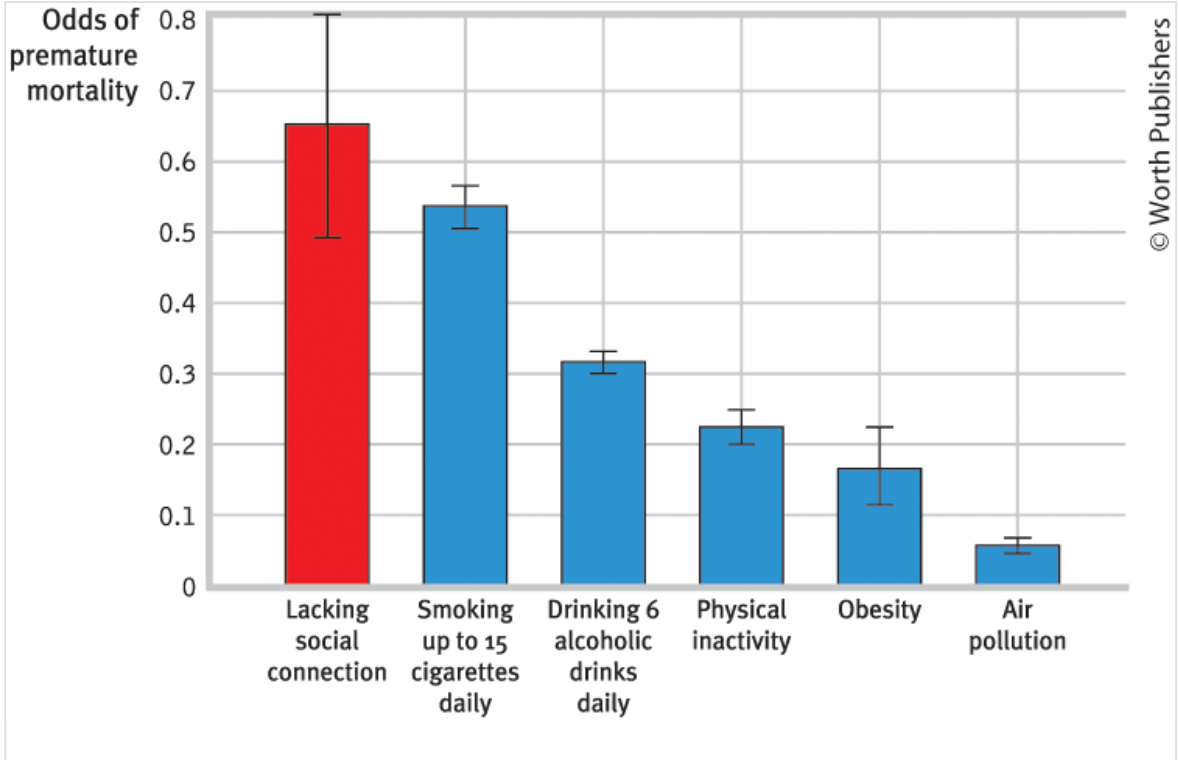
Humans are a social animal, they want to be with other people
Need to Belong - the need to build and maintain relationships and to feel connected to a group.
The Benefits of Belonging
Historically, being social increased our changes of survival
Protect people, form community
Survival is also increased when people cooperate together
its easier to kill something with 6 people than 1 dude
People in society belong to a group and prefer “us” vs “them”
Self-Determination Theory - the theory that we feel motivated to satisfy our needs for competence, autonomy, and relatedness.
Our social behavior seeks to increase our feeling that we belong
Studies show that separated/divorced people have earlier deaths than married people do
When an event or an individual threatens to dissolve social ties, people experience:
Anxiety, Loneliness, Jealousy, Guilt
The Pleasure of Micro-Friendships
Connecting while commuting
Bantering with a barista
Complementing a stranger
The Pain of Being Shut Out
Ostracism - deliberate social exclusion of individuals or groups.
Humans use this to “punish”
Threatens our need to belong
Brain scares depict increased activity in areas that activate the response to physical pain
Pain relievers can help to lessen social pain
People often respond to ostracism with initial efforts to restore their acceptance, followed by depressed mood, and, finally, withdrawal into solitude
May make people disagreeable, uncooperative, and hostile
Feeling loved activates brain areas associated with rewards and satisfaction and may temper pain of ostracism
People in different cultures use the same words to describe how ostracism feels “Hurt, crushed”
Solitary Confinement??
Connecting and Social Networking
“a person is a person through other persons.”
Mobile Networks and Social Media
Mobile Phones
Texting and Instant Messages
The Internet
Social Networking
The Net Result: Social Effects of Social Networking
Internet serves as a social amplifier
But social media also leads people to compare their lives with others.
If others have the “perfect life”, it can trigger envy and depression
People perceive that others’ social lives are more active than their own
1 in 4 people have a smartphone addiction
Often increases self-disclosure related to friendships
Teen depression, anxiety, self-harm, and suicide rates have mushroomed
Does social media affect teen depression? yeah
Can Aid in finding a romantic partner
Decreases face-to-face communication and sleep
Increase loneliness, depression, and suicide
Supports narcissistic behavior
Maintaining Balance and Focus
Monitor your time online
Monitor your feelings
Break the phone checking habit
Refocus by taking a nature walk
Hide from your more frequently online friends when necessary
Achievement Motivation
Some achievements seem to never be fulfilled
Achievement Motivation - the desire for significant accomplishment, for a command of skills or ideas, for control, and for attaining a high standard.
Grades, career, money
Motivational Impact
Self-discipline surpassed intelligence test scores in predicting school performance, attendance, and graduation honors.
Grit > Intelligence
When doing a project, people are more likely to be stuck in the middle (least amount of motivation)
Discipline focuses and refines talent
Individualist cultures encourage people to “follow their passion.”
Collectivist cultures focus less on personal passion and more on fulfilling one’s duty and obligations to family and friends.
Grit - in psychology, passion and perseverance in the pursuit of long-term goals.
Intrinsic and Extrinsic Motivation
Achievement is not a bell curve
Intrinsic Motivation - the desire to perform a behavior well for its own sake.
Offering people rewards for their achievement can harm their intrinsic motivation
Extrinsic Motivation - the desire to perform a behavior to receive promised rewards or avoid threatened punishment.
Kids with better intrinsic motivation for learning have better academic outcomes
Goal Setting
Make the Resolution
SMART Goals (specific, measurable, achievable, realistic, and timely)
Announce the goal to friends and family
Develop an action plan
Create short-term rewards that support long-term goals
Monitor and record progress
Create a supportive environment
Transform the hard-to-do behavior into a must-do habit
Emotion: Arousal, Behavior, and Cognition
Where do our emotions come from?
Emotions are our bodies way of ensuring we do what is best
Anger motivates fighting injustice. Gratitude strengthens relationships. Pride prompts hard work
Emotion - a response of the whole person, involving (1) bodily arousal, (2) expressive behaviors, and, most importantly, (3) conscious experience resulting from one’s interpretations.
Does your bodily arousal come before or after your emotional feelings? (big debate)
How do thinking (cognition) and feeling interact? Does cognition always come before emotion?
James-Lange Theory: Arousal Comes Before Emotion
Do we cry when we feel sad, or do we feel sad because we cry?
James-Lange Theory - the theory that our experience of emotion occurs when we become aware of our physiological responses to an emotion-arousing stimulus.
Physiological response → realize it → react → emotion!
Cannon-Bard Theory: Arousal and Emotion Happen at the Same Time
Cannon-Bard Theory - the theory that an emotion-arousing stimulus simultaneously triggers (1) physiological responses and (2) the subjective experience of emotion.
My pounding heart did not cause my feeling of fear, nor did my feeling of fear cause my pounding heart. So, according to Cannon-Bard theory, bodily responses and experienced emotions are separate.
Is the physical response and the emotion really separate?
In an experiment, people with lower spine injury (cannot feel their legs) had no change in their emotional intensity
People with upper spinal injury (cannot feel anything below their neck) had less emotional intensity
Other emotions that are expressed primarily above the neck were felt more intensely
Happen at the same time
Schachter-Singer Two-Factor Theory: Arousal + Label = Emotion
Two-Factor Theory - Schachter and Singer’s theory that to experience emotion we must (1) be physically aroused and (2) cognitively label the arousal.
Arousal can linger from one event to the next (Spillover effect)
One group of men was told to expect feelings of arousal from the injection. Others were told by the trickster researchers that it would help test their eyesight. As they observe this accomplice, they begin to feel their heart race, their body flush, and their breathing become more rapid. They “caught” the apparent emotion of the other person in the waiting room. They became happy if the accomplice was acting joyful, and testy if the accomplice was acting irritated.
Spillover Effect is when arousal “spills” over from one event to the next, influencing response
arousal fuels emotion, cognition channels it
Zajonc, LeDoux, and Lazarus: Emotion and the Two-Track Brain
Is the heart always subject to the mind?
According to Zajonc, we actually have many emotional reactions apart from, or even before, our interpretation of a situation
reflect the automatic processing that happens in our brain
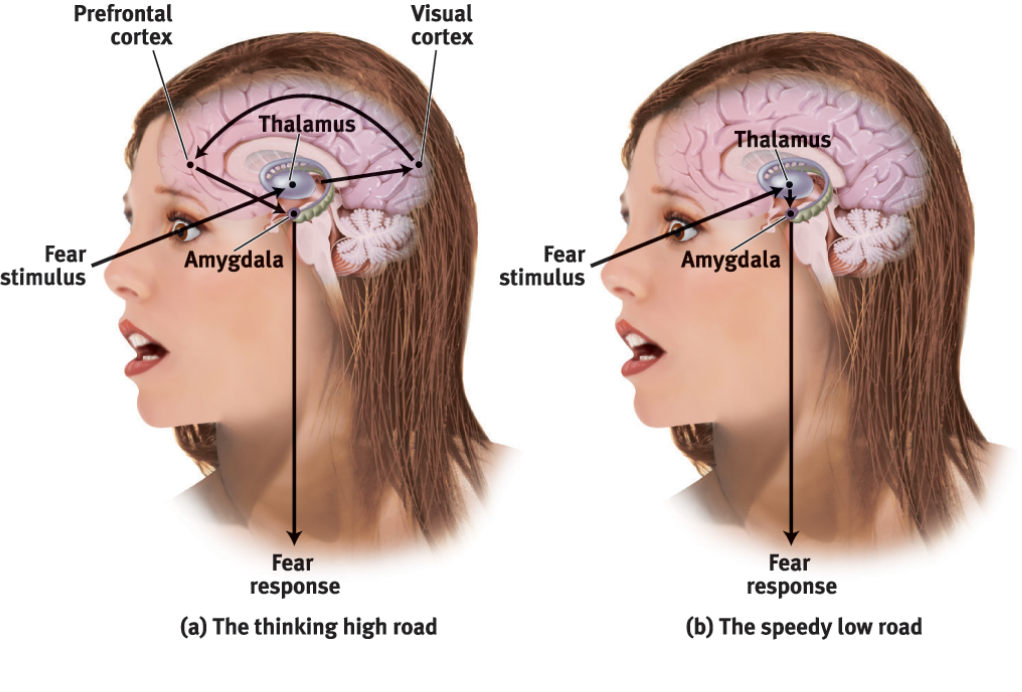
Some emotion travel the high road via the thalamus to the brain’s cortex
Complex feelings
Low road involves a neural shortcut that bypasses the cortex and go directly to the amygdala, enabling a lightning fast response
These emotions are processed without conscious awareness
The amygdala’s structure makes it easier for our feelings to hijack our thinking than for our thinking to rule our feelings
Theory | Explanation of Emotions | Example |
James-Lange | Our awareness of our specific bodily responses to emotion-arousing stimuli. | We observe our heart racing after a threat and then feel afraid. |
Cannon-Bard | Bodily responses and simultaneous subjective experience. | Our heart races at the same time that we feel afraid. |
Schachter-Singer Two-Factor | Two factors: general arousal and a conscious cognitive label. | We may interpret our arousal as fear or excitement, depending on the context. |
Zajonc; LeDoux | Some embodied responses happen instantly, without conscious appraisal. | We automatically feel startled by a sound in the forest before labeling it as a threat. |
Lazarus | Cognitive appraisal (“Is it dangerous or not?”) — sometimes without our awareness — defines emotion. | We feel frightened when we believe the rustling in the bushes is a wild animal; we feel relieved when we realize it’s “just the wind.” |
Embodied Emotion
Emotions involve the body
Some physical responses are easy to notice; others happen without your awareness.
The Basic Emotions
There are six basic emotions that a majority of scientists agree on:
Anger
Fear
Disgust
Sadness
Surprise
Happiness
Carroll Izard found four more
Contempt
Interest/Excitement
Shame
guilt
Other researchers recognize as many as 28, including different flavors of happiness like awe, love and pride
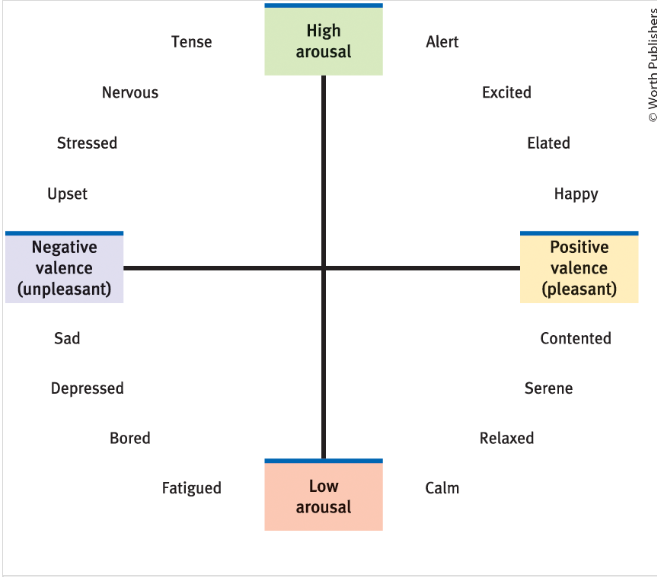
Emotions are categorized by their Valance (Positive vs Negative) and their Arousal (low vs high)
Emotions and the Autonomic Nervous System
In a crisis, the sympathetic division of your autonomic nervous system (ANS) mobilizes your body for action
It triggers your adrenal glands to release stress hormones.
To provide energy, your liver pours extra sugar (glucose) into your bloodstream
. To help burn the sugar, your breathing rate increases to supply needed oxygen.
Your heart rate and blood pressure increase.
Your digestion slows, allowing blood to move away from your internal organs and toward your muscles
The Physiology of Emotions
When you are watching different movies, your body reacts (horror movie, sexually arousing, vs boring movie)
Different emotions can share common biological signatures.
Despite similar bodily responses, sexual arousal, fear, and anger feel different to us, and they often look different to others.
Brain scans and EEGs reveal that some emotions also have distinct brain circuits
People who are prone to depression, or who have generally negative perspectives, also show more activity in their right frontal lobe
When you experience positive moods — when you are enthusiastic, energized, and happy — your left frontal lobe will be more active.
Polygraph - a machine often used in attempts to detect lies; it actually measures emotion-linked changes in perspiration, heart rate, and breathing, which are not always tied to lying.
Humans have similar bodily arousal in response to anxiety, irritation, and guilty
Many innocent people do get tense and nervous when accused of a bad act
Guilty Knowledge Test is more effective
Use of facts that only a guilty person would know (info not released to the public)
Expressed and Experienced Emotion
Our facial expressions can give clues as to what people are feeling
Detecting Emotion in Others
People communicate without words
People who are in love often look into each others eyes.
Can looking into someone’s eyes jump start love?
researchers asked straight male-female stranger pairs to gaze intently for 2 minutes either at each other’s hands, or into each other’s eyes. After separating, the eye gazers reported feeling a tingle of attraction and affection
Our brain is great at detecting subtle emotions and non-verbal threats
Non-threatening cues are more easily detected than deceiving emotions (Duchenne smile)
Despite our brain’s emotion-detecting skill, we find it difficult to detect deceiving expressions.
Computer programs outperform` humans when detecting deception from images or videos, because liars’ and truth-tellers’ behavioral differences are often too subtle for the human eye
Gender and Emotion
Women’s skill at decoding emotions may help explain why women tend to respond with and express greater emotion, especially positive emotions
All of this has led to the extremely strong perception (nearly all U.S. 18- to 29-year-olds in one survey) that emotionality is “more true of women”
Researchers also manipulated a computer-generated, gender-neutral face to display different emotions. People were more likely to perceive the face as male when it wore an angry expression and as female when it wore a smile
Is anger a masculine emotion?
Women who express “male-typed” anger pay a penalty in the workplace, such as being labeled “out of control”
Gender differences in empathy?
If you have empathy, you identify with others and imagine being in their skin.
Women are far more likely to consider themselves empathetic than men
And are more likely to express empathy
Are gender differences nature vs nurture?
Evolutionary biologists and neuroscientists note that similar female-male empathy differences occur in nonhuman animals
People with high power and privilege are less motivated to empathize (men are more likely to have power)
Culture and Emotion
In the US, people often smile, say hi and make eye contact with a stranger walking in the street.
this is super weird people non-Americans
The meaning of gestures also change throughout cultures
. In 1968, North Korea publicized photos of supposedly happy officers from a captured U.S. Navy spy ship. In the photo, three men had raised their middle fingers, telling their captors — who didn’t recognize the cultural gesture — it was a “Hawaiian good luck sign”
Do facial expressions have different meanings in different cultures
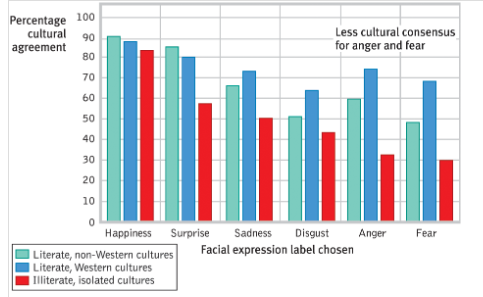
Researchers travel around the world, showing people pictures of humans making different faces and asking them to guess the emotion
One analysis of 6 million videos from 144 countries found reliable associations between facial expressions and social contexts
Smiles and laughter are the same in every culture
Anger and Fear are different in cultures
But people differ on other expressions, especially anger and fear, even when matching exaggerated poses to a limited set of emotion words
Facial expressions are not crystal balls into our emotions
we control our facial expressions to fit in, influence, or lie to others
Facial expressions are also culturally shaped, with display rules guiding when to express an emotion, which emotion is appropriate, and how much of an emotion to express.
The Effects of Facial Expressions
William James struggled with feelings of depression and grief, he came to believe that we can control our emotions by going “through the outward movements” of any emotion we want to experience. “To feel cheerful,” he advised, “sit up cheerfully, look around cheerfully, and act as if cheerfulness were already there.”
That’s what mom tells me to do
Can outward expressions trigger our inward emotions and feelings
Facial Feedback Effect - the tendency of facial muscle activation, alone, to trigger corresponding feelings such as fear, anger, or happiness.
Some people with depression or borderline personality disorder have reported feeling better after between-the-eyebrows Botox injections that freeze their facial frown muscles. However, Botox paralysis of the frowning muscles also slows activity in emotion-related brain circuits and weakens emotional experiences
Behavior Feedback Effect - Going through the motions awakens the emotions