Module 4
4.1: Consumer Behavior (Utility Analysis)
Utility
satisfying power of a commodity (capacity to satisfy human wants)
2 Principal Theories on Utility
Cardinal Utility - can be measured quantitatively, like length, height, or weight.
Ordinal Utility - works with a ranking of preferences.
2 Types of Utility
Total utility (TU) - refers to the entire amount of satisfaction a consumer receives at various consumption levels.
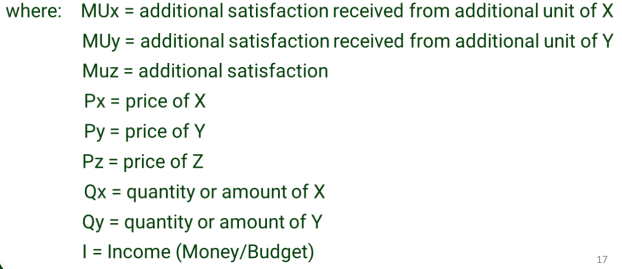
Marginal utility (MU) - extra utility received from consuming one additional unit of the good per unit of time.
Law of Diminishing Marginal Utility
desirability of a given commodity tends to diminish as an additional unit is acquired.
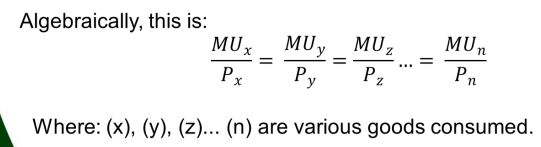
Law of Equi-Marginal Utility
the consumer will be maximizing his total utility when he allocates his fixed money income.
Assumptions of the Law of Equi-Marginal Utility:
Independent utilities - marginal utilities of various goods and services available in the market, reduce as the consumer adds more to his purchases.
The marginal utility of money is constant - A constant marginal utility of money will be realized by the consumer as he purchases more and more of the goods.
Utility is cardinally measurable.
Each consumer is rational in the purchase of goods.
Achieving Consumer Equilibrium
stability of consumer purchasing patterns in which an individual has attained maximum utility from spending his income.