RM 3
Merchandise Management
Definition: A process by which a retailer offers the right merchandise in the right place at the right time, aligning with financial goals.
Key objectives:
Sense market trends
Analyze sales data
Adjust pricing and inventory levels accordingly
Investment Portfolio Management
Traders on the stock exchange floor manage a portfolio of stocks, and retail buyers manage a portfolio of merchandise inventory.
Continuous assessment of purchase-related risks takes place.
Buying Organization
Merchandise Classifications in an organisation: Illustrated transitions from general merchandise management to specific categories.
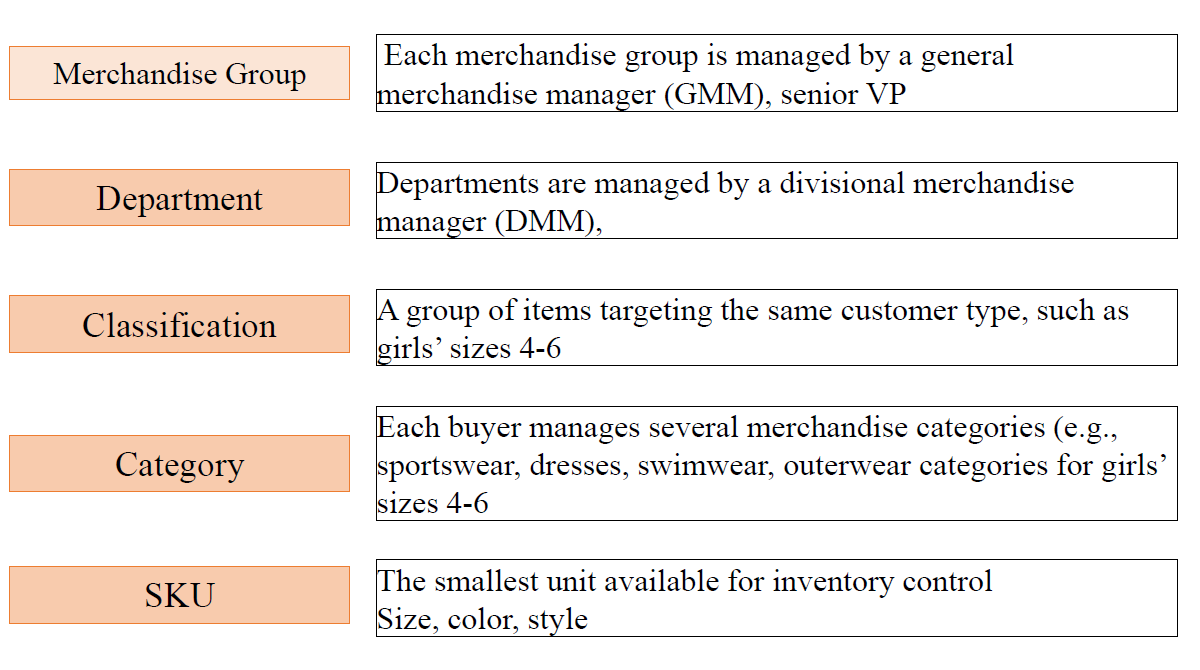
Merchandise Category Management (the planning unit)
Definition: A distinct, manageable group of products/services perceived as interrelated by consumers.
The merchandise category is the basic unit of analysis for making merchandising management decisions.
Managing by category rather than by individual brands enhances efficiency and fosters improved product assortment (category by brands can lead to inefficiencies because it fails to consider the interdependencies between SKUs in the category).
Category Captain: A preferred vendor that assists retailers in managing a category, improving consumer insight and profitability.
Category Management
Objective: Maximize sales and profits of an entire category rather than individual brands.
Examples:
Breakfast cereal category vs. specific brands like Kellogg Corn Flakes.
Department stores often manage at the category level, while other retailers like superstores may organize around brands.
The category management business process is a structured, measured set of activities designed to produce a specified output for the suppliers, retailers and consumers.
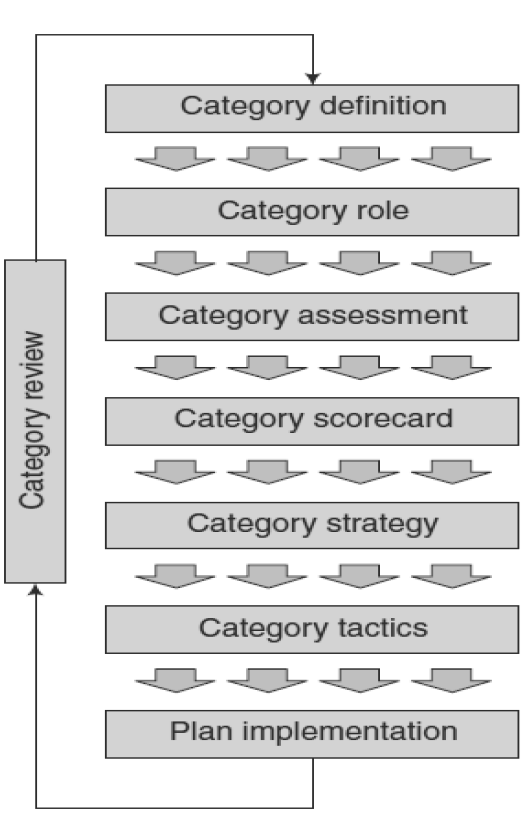
Step 1: CATEGORY DEFINITION
A distinct, manageable group of products/ services that consumers perceive to be interrelated and/or substitutable in meeting a consumer need.
Step 2: DEFINING THE CATEGORY ROLE
Determines the priority and importance of various categories in the overall business; and essentially serves as the basis for resource allocation.
CUSTOMER-BASED CATEGORY ROLES
Destination, Prefered, Occasional, Convenience
Step 3: CATEGORY ASSESSMENT
the current performance of the category is evaluated with respect to turnover, profits, and return on assets in the category.
Matrix:
Step 4: CATEGORY PERFORMANCE MEASURES
Category performance measures involve setting measurable targets in terms of sales, margins, and Gross Margin Return on Investment (GMROI). Category performance measures determine the target objectives that will be set by the retailer and supplier for achievement from the implementation of the Category Business Plan.
Sale→profit→market share→inventory turnover→changes in assortment→comsumer transaction
Step 5: CATEGORY STRATEGIES
seven most typical category marketing strategies are as follows:
Tariff Building
Transaction Building
Turf Defending
Profit Generating
Cash Generating
Excitement Creating
Image Enhancing
Step 6: CATEGORY TACTICS
Category tactics work towards the determination of optimal category pricing, promotion, assortment, and shelf management that are necessary to achieve the agreed-on-role, scorecard, and strategies.
Step 7: CATEGORY PLAN IMPLEMENTATION
The implementation plan includes what specific tasks need to be done when each task should be completed, and who is to accomplish each task. Kye components:
The Plan Approval Process
Assigning Responsibilities
Scheduling
Step 8: CATEGORY REVIEW
The final step in the business process is the review of the progress and the actual achievement of the targets set for the category. Review aids the taking of decisions at the right point of time.
Evaluating Merchandise Management Performance
Key Metrics: Return on Investment (ROI) and GMROI (Gross Margin Return on Inventory Investment).
Merchandise managers control:
The merchandise they buy
The price at which the merchandise is sold
The cost of the merchandise
They do not control operations and resource allocations affecting total expenses.
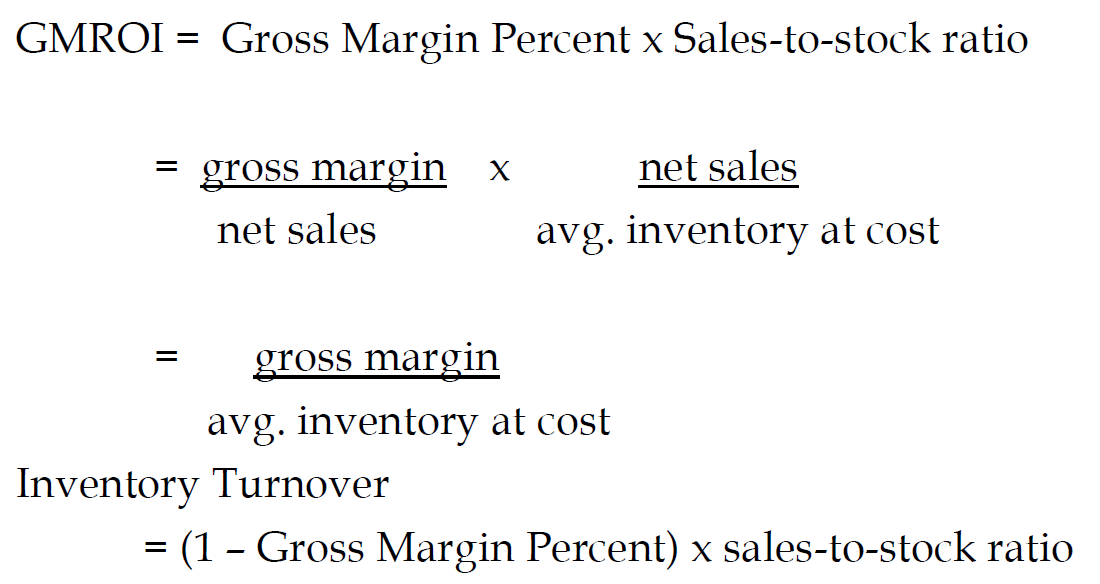
GMROI Calculation (return on investment measure)
An important financial metric that reflects the gross margin earned on every dollar of inventory investment (its components are under the control of the buyer rather than other managers).
Formula:
Merchandise Planning Process
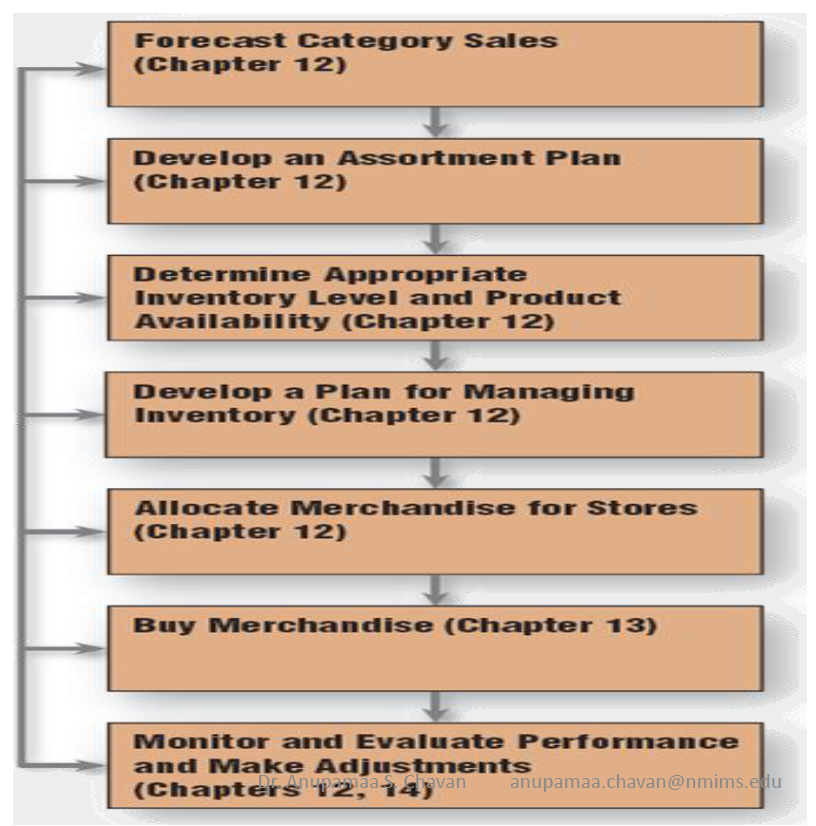
The merchandise planning process includes several key steps: 1. Buyers forecast category sales, create an assortment plan, and determine inventory needs.
2. They outline monthly sales expectations, needed inventory, and budget for replenishing and purchasing new merchandise while deciding on allocation per store.
3. After planning, buyers negotiate with vendors and acquire merchandise. They continually monitor sales and make necessary adjustments, with decisions often occurring simultaneously rather than sequentially.
Types of Merchandise Management Planning Systems
Staple (basic) Merchandise Categories: There is continuous demand for these products and limited new product introductions (e.g., casual apparel).
Fashion Merchandise Categories: Short-lived demand, frequent new product introductions (e.g., clothing trends).
Seasonal merchandise categories: Consist of items whose sales fluctuate dramatically depending on the time of year. Both staple and fashion merchandise can be seasonal categories.
1. Forecast Category sales
Forecasting Staple Merchandise Categories:
• Use of Historical Sales
• Adjustments for Controllable & Uncontrollable factors;
Controllable Factors: Promotions, store locations, merchandise placement.
Uncontrollable Factors: Seasonality, weather, competitive activities.
Forecasting Fashion Merchandise Categories:
Forecasting sales for fashion merchandise are difficult due to the novelty of items, as they often differ from previous offerings.
Previous Sales Data
Market Research:
• The depth interview is an unstructured personal interview in which the interviewer uses extensive probing to get individual respondents to talk in detail about a subject.
• A focus group is a small group of respondents interviewed by a moderator using a loosely structured format
Fashion & Trend Services
Vendors
Sales Forecasting for Service Retailers:
Due to the perishable nature of services, service retailers face a more extreme problem than fashion retailers. Their offering perishes at the end of the day.
Some service retailers attempt to match supply and demand by taking reservations or making appointments.
2. Developing an Assortment Plan
An assortment plan is a list of the SKUs that a retailer will offer in a merchandise category.
Category Variety and Assortment
Determining Variety and Assortment:
Retail Strategy
The number of SKUs offered in a merchandise category is a strategic decision. The breadth and depth of the assortment in a merchandise category can also affect the retailer's brand image, so retailers might increase the assortment in categories that are closely associated with their image.
GMROI
Reducing inventory turnover and GMROI because of the increased inventory investment. Increasing assortment breadth and depth also can decrease gross margin. For example, the more SKUs offered, the greater the chance of breaking sizes- that is, stocking out of a specific size or colour SKU.
Physical characteristics of the store
Buyers need to consider how much space to devote to a category. More space is needed to display categories with large assortments. In addition, a lot of space is needed to display individual items in some categories, and this limits the number of SKUs that can be offered in stores.
Complementary merchandise
But customers who buy a 3-D Blu-ray player might also buy complementary products and services such as accessories, cables, and warranties that have a high GMROI.
Effects of Assortment Size on Buying Behavior
a. increases the chance they will find the product that best satisfies their needs.
b. provide a more informative and stimulating shopping experience.
c. customers who seek variety - those who want to try new things.
d. However, offering a large assortment can make the purchase decision more complex and time-consuming and potentially overwhelm the consumer, which could reduce sales.
e. Many retailers have initiated SKU rationalization programs in their efforts to analyze the benefits they might gain from deleting, adding, or keeping certain items in their assortments.3. Setting Inventory and Product Availability Levels
3. Setting Inventory and Product Availability Levels
Model Stock Plan
The model stock plan is the number of each SKU in the assortment plan that the buyer wants to have available for purchase in each store. Retailers typically have model stock plans for the different store sizes in a chain.
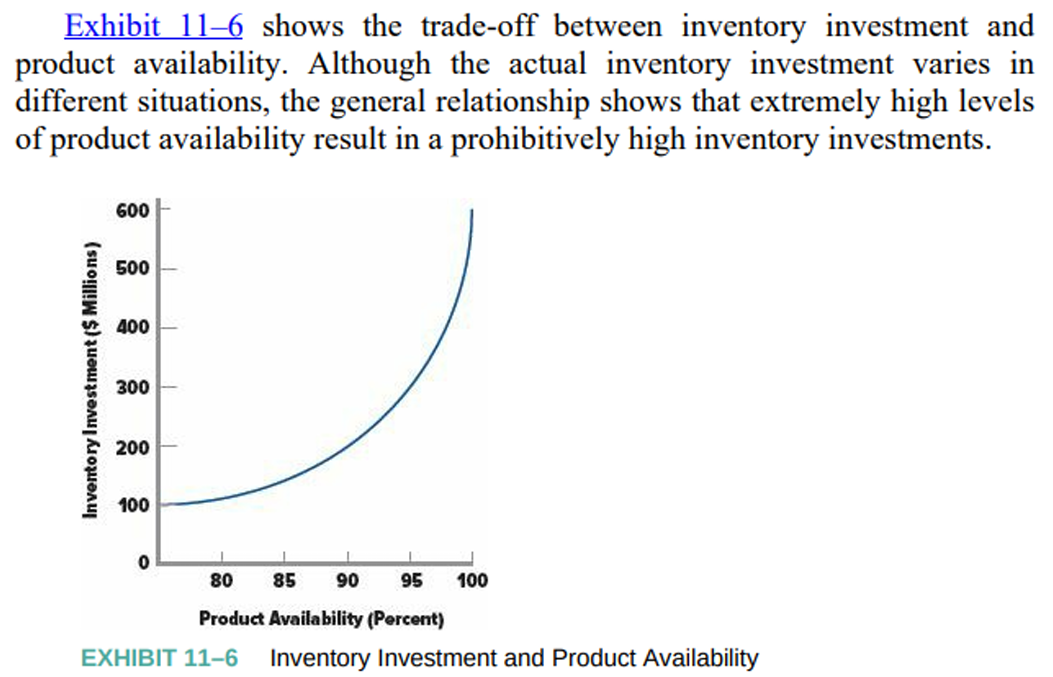
Product Availability
The number of units of backup stock in the model stock plan determines product availability. Product availability is defined as the percentage of the demand for a particular SKU that is satisfied. Choosing an appropriate amount of backup stock is critical to successful assortment planning.
4. Establishing A Control System For Managing Inventory
Establish a control system for how the orders, deliveries, inventory levels, and merchandise sales will evolve over time. The objective of this control system is to manage the flow of merchandise into the stores so that the amount of inventory in a category is minimized but the merchandise will still be available when customers want to buy it. Basic stock - Indicates the Desired Inventory Level for Each SKU
Managing Inventory of Staple Merchandise Categories:
Staple merchandise planning systems provide the information needed to determine how much to order and when to place orders for SKUs. These systems assist buyers by performing three functions:
monitoring and measuring current SKU sales,
forecasting future SKU demand, and
developing ordering decision rules for optimum restocking
Inventory Levels for Staple Merchandise:
Cycle (base) stock:
Inventory that goes up and down due to the replenishment process
Backup (buffer, safety) stock:
Inventory needed to avoid stockout
Determining the Level of Backup Stock:
Higher product availability (service level) retailer wishes to provide to customers
Greater the fluctuation in demand
Longer lead time from the vendor
More fluctuations in lead time
Lower vendor’s Fill rate (% of complete orders received from a vendor)
Managing Inventory of Fashion Merchandise Categories
The system for managing fashion merchandise categories is typically called a Merchandise Budget Plan.
The Merchandise Budget Plan Specifies how much money can be spent each month to achieve the sales, margin, inventory turnover, and GMROI objectives. Not a complete buying plan-- doesn’t indicate what specific SKUs to buy or in what quantities.
To evaluate this plan we see:
Inventory turnover GMROI and sales forecast are used for both planning and control
After the selling season, the actual performance is compared with the plan
Automated Continuous Replenishment
An automated continuous replenishment control system is used to manage the flow of staple merchandise SKUs and categories. The continuous replenishment system monitors the inventory level of each SKU in a store and automatically triggers the reorder of an SKU when the inventory falls below a predetermined level.
The Inventory Management Report
The inventory management report provides information about the current sales rate or velocity, sales forecasts, inventory availability, the amount on order, decision variables such as product availability, etc. The combination of having a prespecified schedule based on the trade-off between inventory carrying and ordering costs, and the flexibility to react to demand fluctuations, helps to ensure a profitable ordering strategy.
Order Point → The point at which inventory available should not go below or else we will run out of stock before the next order arrives.
Order point = sales/day or week (lead time + review time) + buffer stock
Order Quantity → When inventory reaches the order point, the buyer needs to order enough units so the stock isn’t depleted and sales dip into backup stock before the next order arrives.
Order Quantity = quantity available - order point
5. Allocating Merchandise to Stores
Allocating merchandise to stores involves three decisions:
How much merchandise to allocate to each store
What type of merchandise to allocate
Retailers classify stores according to the characteristics of the stores’ trading area. ex→ The assortment offered in a ready-to-eat cereal aisle should match the demands of the demographics of shoppers in a local area 5-minute noodle in flights or lattes at 9-5 working environment.
When to allocate the merchandise to different stores
Timing of Merchandise Allocation to Stores
Seasonality impacts fashion merchandise demand, prompting buyers to ship products to regions where customers are ready to purchase. Retailers also adjust inventory based on the pay-check cycle, offering larger sizes at the beginning of the month when consumers tend to spend more, and smaller sizes towards the end of the month.
6. Buying Merchandise
Options:
National Brands:
National brands, also known as manufacturer's brands, are products designed, produced, and marketed by a vendor and sold to many different retailers. In some cases, vendors use an umbrella or family brand associated with their company and a subbrand associated with the product, such as Kellogg's (family brand) Raisin Bran (subbrand)
National-Brands Buying Process:
Developing store brands
Sourcing Store Brand Merchandise
Reverse Auctions:
One buyer (the retailer), multiple sellers→Sellers bid for the buyer’s business→Price falls→No strategic relationships with vendors
Global Sourcing:
—Costs Associated with Global Sourcing Decisions
—Managerial Issues Associated with Global Sourcing Decisions
Tips for effective communications
• Insist on objective Information • Invent options for mutual gain • Let the other party do the talking • Know how far to go • Don’t burn bridges • Don’t assume
Store brands:
Store brands, also called private-label brands, house brands, or own brands, are products developed by retailers.
Premium store brands
Exclusive brands
copy-cat brands
Developing and Sourcing Private Label Merchandise:
In-House
Acquisition
Outsource
Generic brands:
Generic brands are labelled with the name of the commodity and thus actually have no brand name distinguishing them. They are used typically for prescription drugs and commodities like milk or eggs.
National brand or store brand?
Assortment
Profitability
Flexibility
NOTE: PRICING STRATEGIES AND RETAIL COMMUNICATION MIX COMES AFTER BUYING BEHAVIOUR PROCESS
7. Analyzing Merchandise Management Performance
Three types of analyses related to the monitoring and adjustment step are:
Sell-Through Analysis: Compares actual sales with planned sales to adjust inventory orders.
ABC Analysis: Ranks goods based on sales contribution, informing stock decisions, and identifying critical SKUs.
Multi-attribute analysis of vendors: Uses a weighted average score for each vendor.
Emphasize communication, objective criteria, and mutual benefits during vendor negotiations.
Retail Pricing Strategies
High/Low pricing
Retailers using a high/low pricing strategy frequently often weekly- discount the initial prices for merchandise through sales promotions.
Advantages:
Increase Profit
Create Excitement
Sells Slow-moving merchandise
EDLP
This strategy emphasizes the continuity of retail prices at a level somewhere between the regular non-sale price and the deep-discount sale price of high/low retailers.
Advantages:
Assures customers of low prices
Reduces advertising and operating expenses
Reduces stockouts and improves inventory management
Markdown→A markdown pricing strategy involves systematically reducing the selling price of products to stimulate sales, manage inventory, and maintain profitability
Coupons→Coupons offer a discount on the price of specific items when they're purchased
Price Bundling→Price bundling is the practice of offering two or more different products or services for sale at one price
Quantity Discounts→Quantity discounts, also called multiple-unit pricing, refers to the practice of offering two or more similar products or services for sale at one lower total price
Zone Pricing→Zone pricing is the practice of charging different prices in different stores, markets, regions, or zones.
Leader Pricing→Leader pricing is the practice of pricing certain items lower than normal to increase customers' traffic flow or boost sales of complementary products. Some retailers call these products loss leaders.
Price Lining→Retailers frequently offer a limited number of predetermined price points within a merchandise category, a practice known as price lining
Odd Pricing→ Pricing that ends with an odd number like 9.
Setting Retail Prices
Customer Price Sensitivity
Competition
Pricing of Services
Using Analytical tools to set prices
Retail Brand Management
Building brand equity:
Create a high level of brand awareness
Develop favourable associations with brand name
Consistently reinforce the image of the brand
Retail Communication Mix
Methods of Communicating with Customers:
Direct Marketing
Online Media: Website, Emails, Mobile Marketing, Blogs, Social Media: YouTube, Facebook, Twitter
Mass Media Advertising: Newspapers, Magazines, Direct mail, Television, Billboards, Radio
Sales Promotion: Coupons, Rebates, Premiums, Samples, POP Displays, Special Events, Pop-Up stores, Personal Selling
Public relations
Planning a Retail Communication Program:
Establish objectives
Communicate Objectives
Determine Communication Budget
Allocate Promotional Budget
Plan, Implement and Evaluate Communication Programs