Uses of Esters
^^Fats and Oils^^
- Animals and vegetable fats and oils are esters of propane- 1,2,3- triol (glycerol)
- Differ by melting points of mixture of esters they contain
- Melting points < room temperature then it’s a liquid- an oil
- Melting points > room temperature then t’s an solid- a fat
- Contain three molecules of long chain carboxylic acids, fatty acids
- Since they are based on glycerol, they are referred to as triglycerides
- Can be hydrolysed in acidic conditions to give a mixture of glycerol and fatty acids
- Also hydrolysed by boiling with sodium hydroxide
- Both products are useful- glycerol and mixture of sodium salts of three acids which formed parts of ester (soaps)
- Soap can be mixture containing many different salts and its type depends on the fatty acids initially present in the ester
- These sodium salts are ionic and dissociate to form Na+ and RCOO-
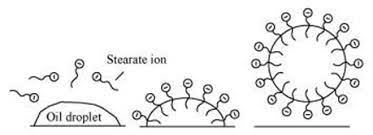
- RCOO- has two distinct ends: long hydrocarbon chain (non-polar) and COO- group (polar and ionic)
- Hydrocarbon will mix with grease, will COO- mixes with water
- Tadpole-shaped molecules allows grease and water to mix so used as cleaning agents
| Name | Formula | Details |
|---|---|---|
| steric acid | CH3(CH2)16C02H | present in most animal fats |
| palmitic acid | CH3(CH2)14C02H | used in making soaps |
| oleic acid | CH3(CH2)7CH=CH(CH2)7C02H | monounsaturated- it has one double bond, present in most fats and in olive oil |
| linoleic acid | CH3(CH2)4(CH=CHCH2)2(CH2)6CO2H | polyunsaturated, present in many vegetable oils |
^^Glycerol^^
- Three O-H bonds so forms H-bonds and is v. soluble in water
- Used in pharmaceutical and cosmetic preparations
- Because it attracts water, it is used to prevent ointment and creams drying out
- Used as a solvent in medicines, and is present in toothpaste
- Used as a solvent in food industry, e.g. food colourings
- Used to plasticise various materials like sheets and gaskets, cellophane, and special quality papers
- Plasticisers introduced between molecules of polymer which makes up material
- Allows molecules to slide over each other, material becomes flexible and smooth
- PVC may contain 50% plasticiser, such as asters of hexanedioc acid. Over time plasticiser leaks away, leaving the plastic brittle and inflexible
^^Biodiesel^^
- Possible solution to over-reliance on crude oil as a source of fuel to power motor vehicles
- Renewable fuel as it’s made from oils derived from crops such as rape seed
- Rape seed oil is a triglyceride ester
- To make biodiesel the oil is reacted with methanol (with a strong alkali as a catalyst) to form a mixture of methyl esters which can be used as a fuel in diesel vehicles with little/ no modification
- Process being introduced commercially , but as chemistry is relatively simple, some people are making their own biodiesel at home with used chip shop oil
- For example, Germany has thousands of filling stations supplying biodiesel, and it is cheaper than ordinary diesel fuel. All fossil diesel fuel in France contains between 2% and 5% biodiesel