Unit 4 - Introduction to Dynamics
#510988
#e4f1f5
#648db4
(Notes for Newton’s 1st and 2nd Laws, Gravitational Force, and Normal Force)
Dynamics
Introduction
Up until now, we have only been concerned with how things move (how fast, how far, etc.). The study of how things move is called kinematics. The study of why objects move is called dynamics.
A force is sometimes described as a push or a pull. Gravity is an attractive force which governs the shape of the universe. It is exerted by all bodies on all bodies in the universe. Gravity depends on the mass and separation between bodies, and can act over very long distances. It acts through fields.
Newton’s Laws of Motion
In 1687, at the age of 23, Sir Isaac Newton published perhaps the most important book in math or physics: the Principia Mathematica. The book contained (among other things) three laws that governed all motion in the universe. Although these ideas are over 300 years old, they still hold up as a good basis for understanding dynamics.
Newton’s First Law
An object continues in a state of rest or in a state of motion at a constant speed along a straight path unless acted on by a net force.
Net Force
Net force is the overall force. It is the sum of all forces acting on a body from all directions.
Inertia
Inertia is a scientific idea, a property of matter, the natural tendency of an object at rest to stay at rest and an object moving to stay moving. Inertia cannot be measured, but can be thought of in qualitative ways.
Inertia is related to mass. More massive objects have more inertia. Mass (symbol: ,
unit: ) is difficult to define at this stage, but it can be roughly described as the amount of space an object occupies.
It is not to be confused with weight. Weight (symbol: , unit: kg m/s2 or ) is the amount of force due to gravity acting on an object, or the amount of pull. Weight is a force! It can very from planet to planet. Mass is an intrinsic property of matter, it remains the same everywhere in the universe.
So what happens when an object is acted on by force? Newton knows!
Normal Force
The normal (perpendicular) force is the force exerted by a surface on an object. There is no universal formula to calculate the normal force (it depends on what other forces are acting). Normal force isn’t always downwards!
Newton’s Second Law
Any net force produces an acceleration in the direction of the force. The magnitude of the acceleration is directly proportional to the force, and inversely proportional to the mass of the object. (Qualitative definition— quantitative data is numbers-based, countable, or measurable, qualitative data is interpretation-based, descriptive, and relating to language).
Simply put:
Where:
= force (unit: kg m/s2 or )
= acceleration (m/s2)
= kg
Where do the units come from?

These are directly proportional, because:
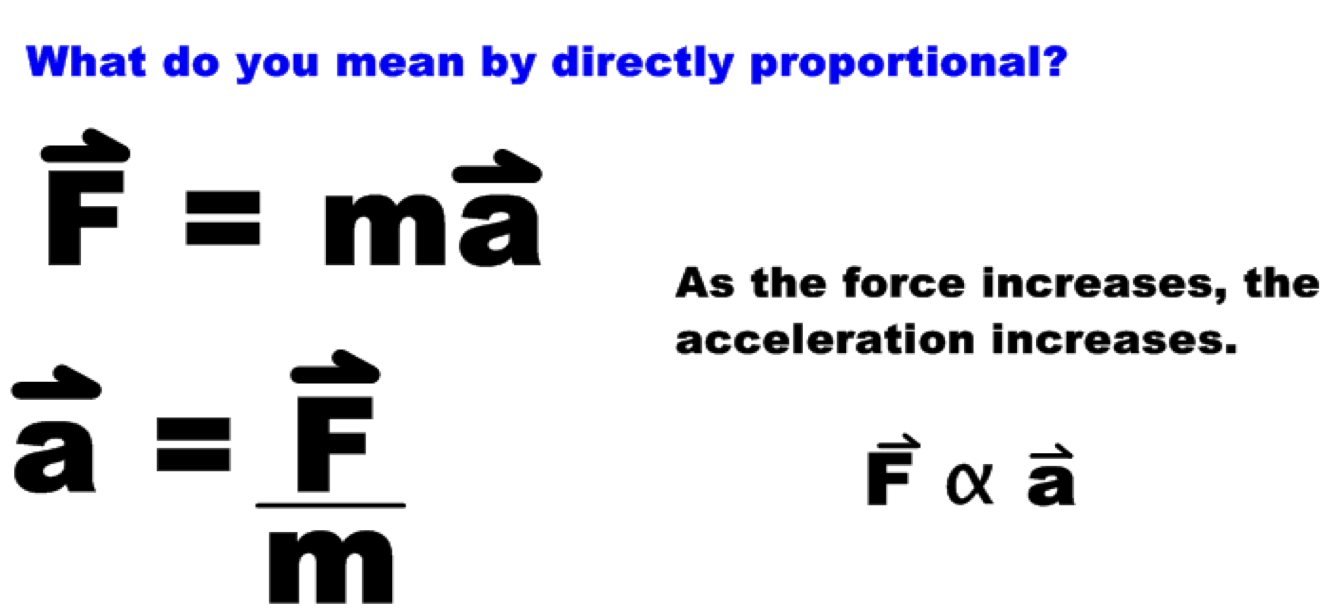
It’s also inversely proportional:

Vector Addition Diagram
Add vectors tip to tail
Net (resultant) force is a single vector going from start to finish.
Advantage:
Can graphically determine magnitude of
Disadvantages:
Forces do not act sequentially
Not a good representation of what is happening
Can look confusing if many forces are involved
Free Body Diagram
Show all forces acting on an object
All force vectors originate at the object’s centre of mass.
Advantage:
Better representation of what is happening (All forces act on the object at the same time)
Disadvantage:
Difficult to determine Fnet graphically from free body diagram
Balanced and Unbalanced Forces

Unit Analysis
Using Newton’s 2nd Law to write the Newton (unit of force) in terms of fundamental (base) SI units (m, kg, s)