20.5 pH and strong bases
The ionisation of water
Water ionises very slightly, acting as both an acid and as a base, setting up the acid-base equilibrium.
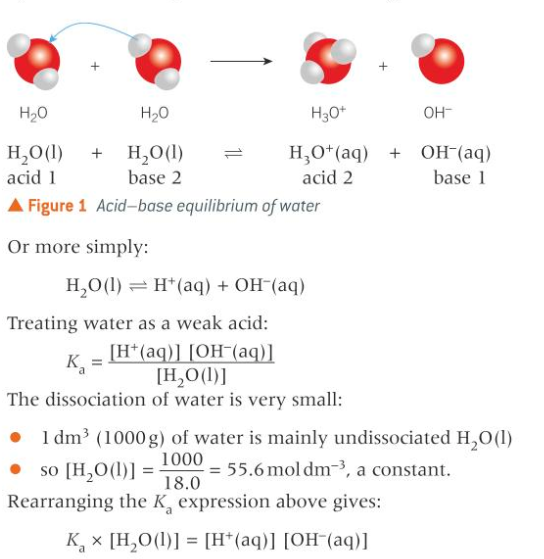
Kw is called the ionic product of water - the ions in water (H+ and OH-) multiplied together.
Kw = [H+(aq)] [OH-(aq)]
As with all equilibrium constants, Kw varies with temperature.
The value of Kw at 298 K (25’c) is 1.00 × 10^14 mol2dm-6.
The importance of Kw
The significance of Kw having a value of 1 × 10-14 mol2dm-6 at 25’c is huge, the value sets up the neutral point in the pH scale. Examples below apply to 298 K.
Kw controls the concentration of H+ (aq) and OH-(aq) ions in aqueous solutions.
The pH of pure water at 25’c
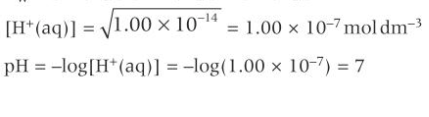
On dissociation, water is neutral, it produces the same number of H+(aq) and OH-(aq) ions.
So [H+(aq)] = [OH-(aq)]
Kw = [H+(aq)][OH-(aq)] = [H+(aq)]² = 1.00 × 10^14 mol2dm-6 at 25’c.
What about solutions of acids and alkalis?
The ionic product of water Kw is essentially and equilibrium constant that controls the concentration of H+(aq) and OH-(aq) in aqueous solutions.
In any aqueous solutions, there will always be both H+(aq) and OH-(aq) ions present such that [H+(aq)][OH-(aq)] = Kw
A solution is acidic when [H+(aq)] > [OH-(aq)]
A solution is neutral when [H+(aq)] = [OH-(aq)]
A solution is alkaline when [H+(aq)] < [OH-(aq)]
A solution that is acidic still contains OH-(aq) ions, it is just that there are more H+(aq) ions and vice versa for an alkaline solution.
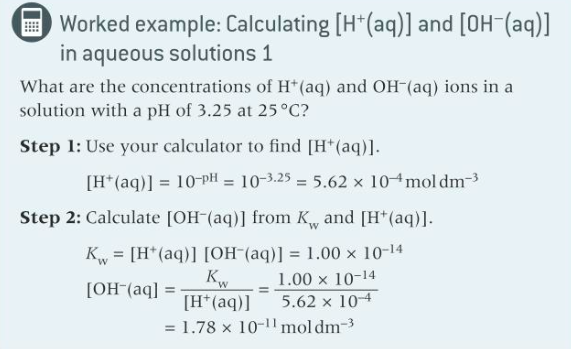
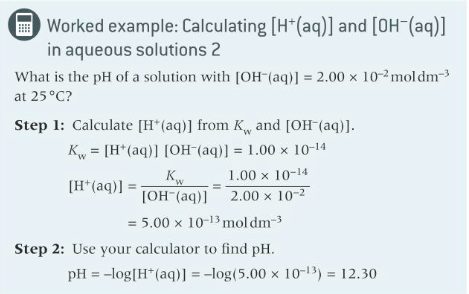
The value of Kw 1 × 10-14 mol2dm-6 at 298 K (25’c), controls the concentration of H+(aq) and OH-(aq).
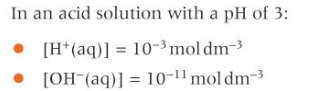
For pH values that are whole numbers, it is easy to work out the H+ (aq) and OH-(aq) concentrations as the indices for [H+(aq)] and [OH-(aq)] add up to -14