Module 5 - Projectile Motion
These notes are from atomi…
Inquiry Question: How can models that are used to explain projectile motion be used to analyse and make predictions?
Analyse the motion of projectiles by resolving the motion into horizontal and vertical components, making the following assumptions:
- a constant vertical acceleration due to gravity
- zero air resistance
- Resolving Vectors;
- Split the vector into it’s horizontal and vertical components
- Add the perpendicular vectors to find the resultant vector
- Horizontal and Vertical Components;
- The vertical component can be treated as an object traveling straight down
- Assumptions:
- The only force acting on something moving and falling is gravity
- Gravity is a constant force acting downwards on all objects
Apply the modelling of projectile motion to quantitatively derive the relationships between the following variables:
- initial velocity
- launch angle
- max. height
- time of flight
- final velocity
- launch
- height
- horizontal range of the projectile
Start by decomposing velocity into horizontal and vertical components
Finish by combining the horizontal and vertical components together
If starting from ground level:
Maximum Height

Time of flight
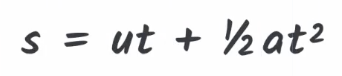
Horizontal Range
d = s x t
If not at ground level, set vertical displacement to zero at the start point
Conduct a practical investigation to collect primary data in order to validate the relationships derived above.
Practical Investigation into Projectile Motion