Unit 2- The Competitive Market
2.1- Consumers and demands
- Competitive market- no one person can control prices or stop someone from entering a market
- Demand (D)- the quantity of goods and services consumers are willing and able to purchase at various prices
- What changes demand:
- Market size- if the number of consumers increases so does demand
- Expectations by the consumer- if the price in the future is expected to increase, today's buyers’ demand will increase
- Related prices-
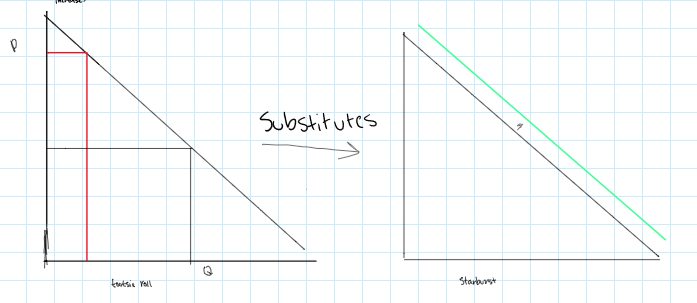
- if two items are substitutes and the demand for one increases so will the demand for the other
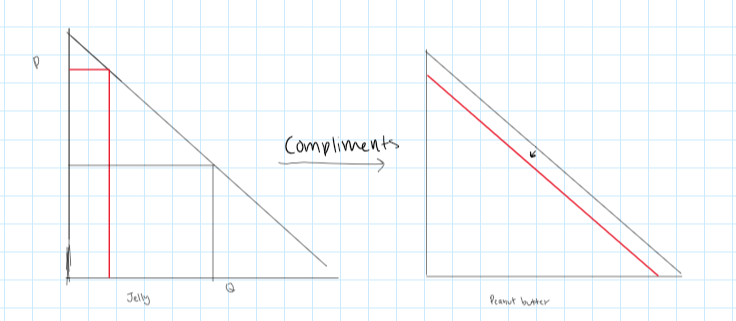
- if two items are complements if the demand for one increases then the demand for another will fall
- Income of consumers- if income decreases the demand for the expensive good will fall and the demand for the cheaper product will increase
- Tastes and preferences- if the taste for a good falls so will the demand
- Quantity demanded (QD)- the quantity of goods and services consumers are willing and able to purchase at a specific price
- Demand Schedule- in a table format, show how much a person would purchase
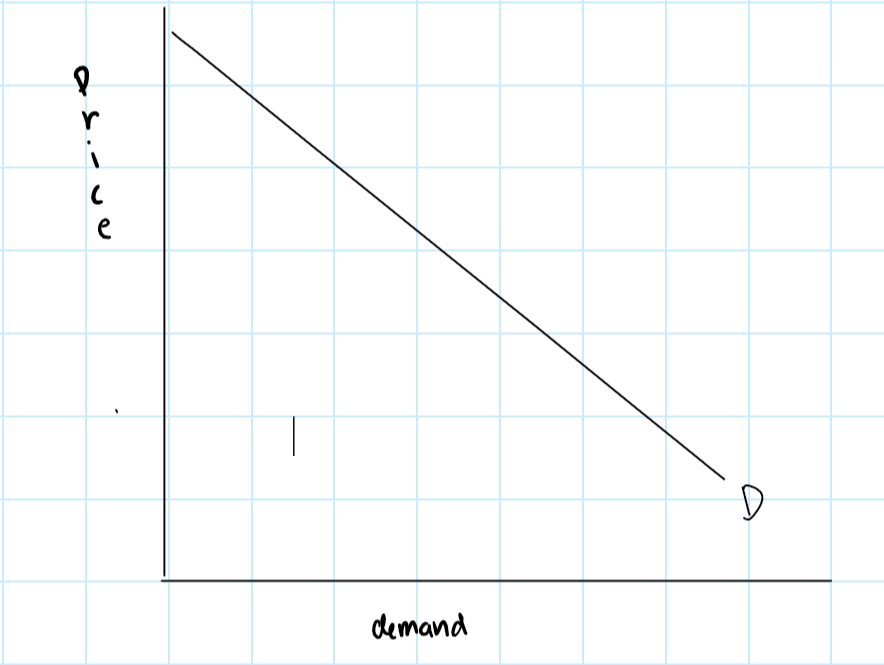
- Demand Curve- a graph showing the trend of prices and what quantity a person would buy
- Example curve:
- Things that affect a demand curve:
- Substitution effect- when consumers notice a price change and change their behavior by substitution one good for another
- Income effect- when price changes lead consumers to feel like they have a different amount of income than they actually have and purchase a different quantity
- The Law of Demand- When the price increases then the quantity demanded goes down, or when the price decreases then the quantity demanded goes up
- Normal goods- regular goods, name brand
- Inferior goods- generic brand, less expensive
- Substitutes and complements in demand- two or more items that consumers will substitute for each other
- Substitutes and complement in consumption- two or more items consumers will purchase together
- Elasticity- how responsive consumers are to price changes
- % change of quantity demanded/% change of the price
- Elastic- the price changes and consumers change, greater than the absolute value of 1
- Inelastic- the price changes and consumers don’t, less than the absolute value of 1
- Unit elastic- right in the middle between elastic and inelastic, the value of 1
2.2- Producers and Supply
- Supply (S)- the quantity of goods and services producers are willing and able to sell at various prices
- What changes supply:
- Technology- if technology improves the supply will increase
- Competition- when there are more producers the supply increase
- Producer expectations- if producers think the price of the product will go up in the future they will probably hold off on production
- Input prices- items (labor) producers buy to produce their final goods, if the input prices rise the supply will fall
- Related pries (Substitutes and Compliments)-
- Substitutes of production- two or more goods and services that can be produced using the same resources
- if the price and quantity supplied increase the supply of another product will fall
- Compliments in production- two or more goods and services that can be jointly produced given the same resources
- price and supply increase which also makes the supply of another product goes up
- Quantity supplied (QS)- quantity producers are willing and able to sell at a specific price
- showed in a supply schedule (table format) or a supply curve (graph)
- Law of Supply- when the price goes up the quantity supplied will also move up or when the price goes down the quantity supplied would go down
- Supply curve:
- supply increases when the line moves right
- supply decreases when the line moves left
2.4- Types of business A
Sole proprietorship
- Sole proprietorship- a business firm owned by one person or the proprietor
- common in small firms in health care, real estate, retail trade, agriculture, and the arts
- sole proprietors are usually doctors, dentists, lawyers, and accountants
- How to start a sole proprietorship:
- register business name
- check and conform to regulations
- obtain necessary licenses and permits
- keep records and prepare tax forms
- Advantages:
- easy start-up
- ease of decision making
- ownership of profits
- tax benefits
- intrinsic rewards
- Disadvantages
- the burden of responsibility difficulty raising funds
- unlimited liability
Partnerships
- Partnership- a for-profit business firm owned by two or more people or partners who have a financial interest in the business
- many small and large firms are partnerships
- Partnership agreement- a written document that identifies the roles, responsibilities, and obligations of partners
- General partners- share full financial and decision-making responsibility
- Limited partners- invests money in the partnership but does not share decision-making or financial responsibility
- Advantages of partnerships:
- a larger pool of financing
- shared decision making
- Disadvantages of partnerships
- unlimited liability for general partners
- disagreement among partners
Corporations
- Corporation- a business firm that is itself a legal entity
- a corporation can own things like a person does
- property, enter into contracts and other businesses, and bring lawsuits
- owned by stockholders who buy shares of stock
- Private corporation- a corporation that’s stocks are owned by a small group of people
- Public corporation- shares are held by many people and can be freely bought and sold
- a corporation can be high risk so there are rules in place
- corporate charter or certificate of incorporation- states how a corporation will raise money to finance the start-up costs
- Structure: stockholders, board ‘of directors, top corporate officers, vice presidents, supervisors/ department heads, and finally rank and file employees
- Advantages:
- limited liability for stockholders
- ability to raise funds by using shares
- ability to raise funds by issuing bonds
- rapid growth
- Disadvantages
- expensive start-up costs
- delays in decision making
- low nonmonetary rewards
- divided ownership of profits
- tax treatment
Other business types
- Limited Liability Company- a hybrid business organization that combines features of corporations, partnerships, and sole proprietorships
- have limited liability
- easier to form than a corporation
- avoid double taxation of profit
- Business Franchises- consists of a parent company and numerous associated businesses that sell a standardized good or service
- the franchisor owns the rights to the goods
- Cooperative- a business owned by members and operated to supply members and others with goods and services
- Nonprofit Organizations- a legal entity formed to carry out a not-for-profit mission
How businesses grow
- Income investment- lists a business revenue, expenses, and profit over some time period
- selling stocks
- Merger- two firms legally join together to form a single large firm
- Acquisition- purchase by one firm of a controlling interest in another firm
- Horizontal merger- combines two firms that produce the same type of product
- Vertical merger- combines firms that operate at different stages in the production of a good
- Conglomerates- a single business enterprise formed by combining firms from unrelated industries
- Multi-national corporation- a company that operated in more than one country
2.4- Types of Business B
Competitive markets
- everyone has jobs
- central planning can lead to shortages of consumer goods
- Productive efficiency- products are produced at the lowest price
- Allocative efficiency- production represents consumer preferences
- Price signals- how producers see what to make and who to distribute them to
- producers can’t be better off if consumers aren’t better off
- Public economics- regulations of products by the government
- Price gouging- a raise of the price of necessary goods in times of prices
- some regulations
- can increase import
- Below-cost pricing- when producers can sell things for a such low price it takes other businesses out of the market
- can later increase prices when no other producers are producing
Monopolies
- Pure monopoly- a market controlled by one seller with a good or service that has no close substitutes
- Crony capitalism- limiting the number of producers so people are forced to buy from one seller
- high start-up costs and a lack of resources can start monopolies
- Anti-trust laws- increase competition and limit the ability to have complete control
- Vertical integration- when a company directly owns its supply chain, can also prevent companies from making anti-competitive deals with supplies
- Patents- allow a monopoly for a limited amount of time
- Natural monopoly- where it is more helpful to have one group own all production, often regulated by the government
- Deregulation- the process of removing some regulations
- Price discrimination- charging different rates to different consumers, can charge consumers of producers
Competition or game theory
- Perfect competition- easy to get in the market, no one has control over the price
- Monopoly- complete control over price because it is difficult to enter the market
- Monopolistic competition- a market with many producers and relatively low barriers, their products are similar but not identical
- Oligopoly- a market that has high barriers to entry and is controlled by a few large companies
Oligopoly
- sell products that are similar but not identical
- Non-price competition- distinguish their product but not by price, design, look, service
- oligopoly use game theory to stand out from their competitors
- hard to use self-interest while outdoing competitors
- need to differentiate
- Cartel- producers cell for the same high price, split customers
- Collusion- a secret agreement or cooperation especially for an illegal or deceitful purpose
- Price leadership- when one producer changes their price and other producers have to decide to change prices as well
- Pay-off matrix- shows how much producers would make based on other producers’ prices
2.3 Price determination
- Price determination- the price a product is sold for
- there is no single person that can control the market
- Equilibrium- the point at which quantity demanded = quantity supplied
- when the price is higher than the equilibrium, there is a surplus
- when the price is lower than the equilibrium, there is a shortage
- Controls- when the government sets up situations or imposes controls where things are not at equilibrium
- Quantity controls- times where the government imposes how much of something there can be (aka a quota)
- by implementing controls, we run the risk of shortages/surpluses, because there
are always tradeoffs