Digital Forensics Lecture 1 Notes
Introduction to Digital Investigations and Forensics
Objectives of Lecture
Explain how to prepare computer investigations and summarize the difference between public-sector and private-sector investigations
Explain the importance of maintaining professional conduct
Describe how to prepare a digital forensics investigation by taking a systematic approach
Describe procedures for private-sector digital investigations
Explain requirements for data recovery workstations and software
Summarize how to conduct an investigation, including critiquing a case
Overview of Digital Forensics
Digital Forensics:
Branch of forensic science that involves recovery and investigation of material from digital devices, mainly in relation to computer crimes.
Evolution:
Originated in the 1970s with the Federal Rules of Evidence (FRE) to standardize federal procedures, signed into law in 1973.
FBI established the Computer Analysis and Response Team (CAAT) in 1984 for handling digital evidence.
Collaboration between CAAT and the Department of Defense Computer Forensics Laboratory in late 1990s.
In October 2012, the ISO 27037 standard was introduced to ensure best practices for digital evidence.
Modern Context:
Increasing importance of digital forensics due to rise in cybercrimes and threats.
Evolved definition to include cybersecurity incident response, maintaining data integrity and a strict chain of custody.
Scope of Digital Forensics Investigations
Investigation Digital Devices Include:
Collecting data securely
Examining suspect data to determine details such as origin and content
presenting digital information to courts
applying laws to digital device practices and ensuring compliance with regulations regarding data protection and privacy.
Types of Investigations:
Digital Forensics:
retrieves data from computers for legal evidence.
Network Forensics:
Analyzes logs to trace attack methods and user interactions.
Important for understanding breaches and securing networks.
Difference between Digital Forensics and Data Recovery:
Digital forensics focuses on recovering hidden or deleted evidence for legal purposes, while data recovery deals with retrieving lost files without specific evidential concerns.
Forensic tasks involve piecing together ambiguous data in unknown contexts.
Investigation Triads in Digital Forensics
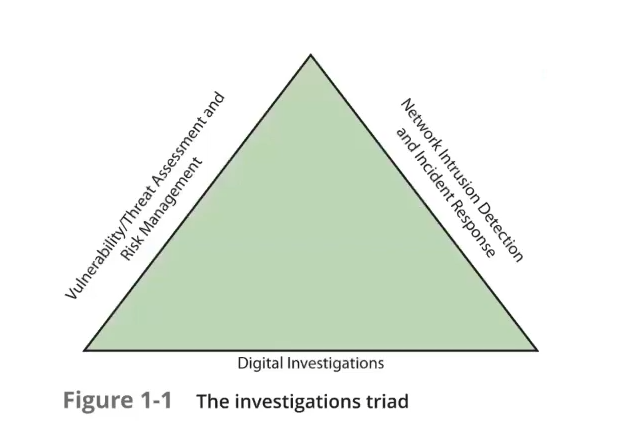
Three Investigative Triads:
Vulnerability Assessment and Risk Management
test and verifies the integrity of standalone workstations and network servers
Network Intrusion Detection and Incident Response
detects intruders attacks by using automated tools and monitoring for eg. network file logs, firewall logs
Digital Investigations
manages investigations and conducts forensic analysis of systems suspected of containing evidence related to the incident or crime. (resolves or terminates investigations)
Roles & Responsibilities:
Detect and mitigate network threats.
Conduct forensic analysis of systems.
Collaboration: All triads must work together for effective cybersecurity and evidence gathering.
Preparing Investigations: Public vs Private Sector
Public Sector Investigations:
Conducted by government agencies (e.g., police, FBI) focused on criminal prosecution.
Must follow strict legal processes for evidence handling.
How to build a criminal case
Private Sector Investigations: (eg. wrongful terminations)
Focus on company policy violations, minimizing corporate risks, and maintaining operations while investigating.
Businesses strive to minimize or eliminate litigation
Examples include employee misconduct, fraud cases, and insider threats
Eg. Internet Abuse Investigation
to conduct an investigation for this case you need:
organizations internet proxy and server logs
suspect computers IP address
Suspects computers disk drive
your preferred computer forensics analysis tool
Professional Conduct in Digital Investigation
Importance of Professionalism: - (ethics, morals and standards of behavior)
Credibility depends on maintaining high ethical standards.
Must maintain objectivity and confidentiality.
conduct investigation with integrity
Ethical Responsibilities:
Avoid bias, thoroughly investigate all leads, and only divulge information to authorized parties.
investigators should also attend training to stay current with the latest technical changes in computer hardware and software, networking and forensic tools.
Systematic Approach to Digital Forensics Investigation
Role of an DF Professional:
gather evidence to prove that a suspect commuted a crime or violated a company policy
collect evidence that can be offered in court or at a cooperate inquiry
investigate the suspects computer
preserve the evidence on a different computer
Chain of custody
route the evidence takes from the time you find it until the case is closed or goes to court
Preparation Steps:
Initial assessment of the case you are investigating.
determine a preliminary design or approach to the case
Create a detailed checklist of investigative steps.
Determine necessary resources, software, and personnel for analysis.
Maintain a complete chain of custody for evidential integrity e.g. evidence drive. (from the time you find it until the case is closed)
Further steps
identify the risks
mitigate or minimize the risks
test the design
analyze and recover the digital evidence
investigate the data you recover
complete the case report
critique the case
Risk Assessment: (Identify potential risks and mitigation strategies during evidence collection.)
identify the risks
mitigate or minimize the risks
test the design
analyze and recover the digital evidence
investigate the data you recover
complete the case report
critique the case
Steps in Digital Evidence Gathering
Assessing the Case - Systemically outline the case details:
situation
nature of the case
specifics of the case
type of evidence
known disk format
location of evidence
Planning the investigation - Investigation plan includes the following activities:
acquire the evidence
complete an evidence form and establish a chain of custody
transport the evidence to a computer forensics lab
secure the evidence in an approved secure container
prepare your forensics workstation
retrieve the evidence from the secure container
make a forensic copy of the evidence
return the evidence to the secure container
process the copied evidence with computer forensic tools
Securing your Evidence:
use evidence bags to secure the evidence
Use computer safe products when collecting computer evidence (antistatic bags or pads)
use well padded containers
use evidence tape to seal all openings — cd drive bays, insertion slots.
Investigative Procedures:
Assess and document the evidence.
Utilize forensic acquisition tools.
Perform thorough analysis on secured copy of evidence.
Respond to unexpected challenges that arise during investigation.
Reporting and Evaluating Cases
Final Steps in Investigation:
Create comprehensive case reports documenting findings.
Critique case outcomes to improve future investigations.
Documentation:
Maintain a detailed journal of all actions taken and their outcomes.
Conclusion
Summary of Best Practices:
Always ensure maintaining evidence integrity through rigorous procedures.
Recognize the differences and roles within public and private sectors.
Critique and reflect on personal practices to enhance digital forensic skills.