AP Microeconomics Unit 2 Notes
2.1 - Demand
2.2 - Supply
2.3 - Price Elasticity of Demand
2.4 - Price Elasticity of Supply
2.5 - Other Elasticities
2.6 - Market Equilibrium and Consumer and Producer Surplus
2.7 - Market Disequilibrium and Changes in Equilibrium
2.8 - The Effects of Government Intervention in Markets
2.9 - International Trade and Public Policy
Some info/photos taken from Jacob Clifford and ReviewEcon on youtube.
2.1 - Demand
When discussing demand, there is an assumption that there is a competitive market, meaning that multiple suppliers of a certain good/service exist and consumers can choose which to buy.
The Law of Demand
Demand - The different quantities of goods that consumers are willing and able to buy at different prices
Law of Demand - A law that states there is a negative relationship between the price of a good and the quantity demanded, ceteris paribus. (Microeconomics doesn’t cover exceptions to this rule, ignore them!)
The Law of Demand states that as price increases, quantity demanded decreases, ceteris paribus.
If the price is high, demand is low
If the price is low, demand is high
This can be visualized by auctions, the higher the price gets, the less bidders are there.
Ceteris Paribus - Assuming all things remain the same; no other factor has changed.
The law of demand results from the income effect and submission effect
Substitution Effect- When price increases, people are more likely to buy substitutes of a product because they are now relatively less expensive, so less units of the original good are sold
Income Effect - People buy fewer units of goods when the price is high because they cannot afford it, and more when the price is low because they can afford it.
Demand Curve
The negative relationship between demand and price can be represented on a demand schedule (table) or demand curve. Something can move along the curve and the curve can be shifted. A change in price causes a change in quantity demanded, moving along the curve, while non-price Determinants of Demand, also known as shifters of demand, cause a change in demand and shift the entire curve. (more below)
Demand Schedule - A table showing how much of a food or service a consumer is willing and able to buy at different prices (ceteris paribus - all things equal) This data can be used to graph a demand curve
Demand Curve - A graph showing the data from the demand schedule which shows the relationship between demand and price.
A change in demand - A change in the demand at all prices, shifts the demand curve as the overall demand at all prices changes.
A change in quantity demanded - Following the law of demand, a supplier changes the price of a product along the demand curve, often due to lack of consumption. This does not shift the demand curve as the overall demand at all prices does not change, the price changes to a point of higher demand on the curve
Determinants (Shifters) of Demand - The 5 factors, not including price, that affect the demand of a product/service. Remember TRIBE
Taste or Trends
‘Trendy’ goods/services are in higher demand
Related goods’ prices
Substitutes: Prices of competitor goods/services.
If the price of cow milk increases, the demand for almond milk increases. If the price of cow milk decreases, the demand for almond milk decreases.
Complements: Price of items sold together, like gas and cars.
If gas prices go up, people are less likely to buy a large car, even though nothing about the car has changed.
Income
How much money do consumers have to spend on a product?
The more money consumers have, the more money they will spend. The more money consumers have, the more likely high-end goods are to be sold.
Buyers
How many potential consumers are there?
Expectations
If prices are expected to go up soon, the more people will consume. If the price is expected to go down, the less people will consume.
:max_bytes(150000):strip_icc()/demand_elasticity2-d3a1d4574aeb4c5ebf5cc7b5594d6afe.PNG)
2.2 - Supply
Supply - The different quantities producers are willing and able to sell at different prices
The Law of Supply states as the quantity’s supplied increases, the price increases. A producer will charge more for more goods. Supply schedules (tables) and supply curves can represent the positive relationship between goods supplied and price, ceteris paribus.
The Supply Curve
Determinants of the Curve (supply curve shifters) TIGERS
Technology
New technology is invented to allow goods to be produced more efficiency
Input Costs
Cost of resources that the seller much consider
Labor costs
Government
Taxes or incentives
Environmental shock or expectation
Is the price expected to go up soon? Sellers may sell less (or only for higher prices) to be able to sell with high profits, if they think the price is going to drop, they’ll try to sell quickly before the price drops.
Famine or sickness that makes it harder to produce a good, the good is more scarce and therefore more valuable.
Related goods’ prices
What is the most money-making thing you can make with the resources you have?
If someone can make more money with the same resources producing a different product, they will, shifting the supply for the original product left, and the new product right
Sellers
The more sellers, the market supply increases, so prices decrease.
Change in supply - change in the available supply regardless of a seller’s price, there is just less supply available. Shifts the supply curve.
Change in quantity supplied - A change in the quantity supplied at a certain price, the amount of supply the seller owns did not change, just the amount they will sell. Moves along the supply curve.
:max_bytes(150000):strip_icc()/supplycurve2-102d446740e14584bc355228d72bfd44.png)
2.3 - Price Elasticity of Demand
Price Elasticity of Demand
Price Elasticity of Demand shows how responsive consumers are to price change. It is expressed as a graph or as a change in quantity demanded at a change to price.
Factors of Elasticity
Substitutes
Proportion of income
Luxury vs necessity
Addictiveness
Time (need it in a hurry?)
Elastic Demand
Goods with a lot of alternatives
Luxuries
Inelastic Demand
Goods with few/no alternatives
Necessities
PED Coefficient/Equation
Remember NOOOO! and Queens are above princesses
NO/O (New-old/old)
Percent change equations are all NO/O
Queens over princesses (quantity/price)
For the answer/elasticity coefficient: Inelastic demand < 1 < elastic demand
PED > 1 - Elastic Demand
PED < 1 - Inelastic Demand
PED = 1 - Unit Elastic
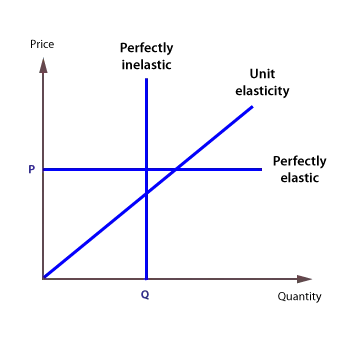
PED Curve
Elastic Demand - Flatter Curve
Perfectly Elastic Demand - Horizontal Curve
Inelastic Demand - Steeper Curve
Perfectly Inelastic Demand - Vertical Curve
2.4 - Price Elasticity of Supply
Price Elasticity of Supply (PES)
Measures the responsiveness of quantity supplied with a change in price
Shows if a good is elastic or inelastic
Determinates
Length of time to make (more time = inelastic)
Availability of inputs (easy to get = elastic)
Ease of adjusting Factors of Production
PES Coefficient/Equation
Remember NOOOO and Queens are above princesses
NO/O (New-old/old)
Percent change equations are all NO/O
Queens over princesses (quantity/price)
For the answer/elasticity coefficient - Inelastic supply < 1 < elastic supply
PES > 1 - elastic
PES < 1 - inelastic
PES = 1 - Unit Elastic
PES Graph
Inelastic supply - Steeper
Elastic Supply - Flatter
Perfectly Inelastic - Vertical
Perfectly Inelastic - Horizontal
2.5 - Other Elasticities
Cross Price Elasticity of Demand (XED)
Measures the responsiveness of quantity demanded for one product to a change of price in the other
Shows if products are complements or substitutes
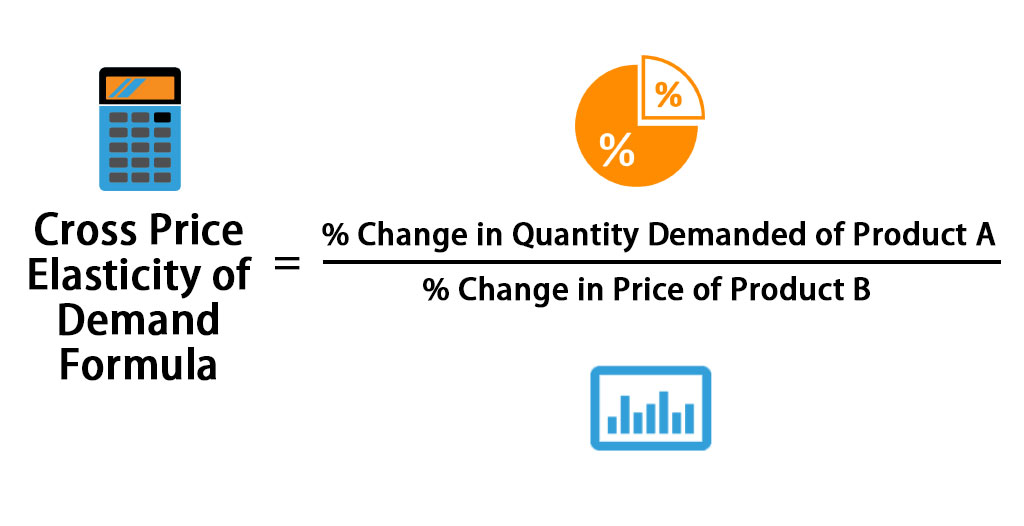
(Remember, percent change is always (N-O/O)
If… the goods are…
XED is positive - substitutes
XED is negative - compliments
Income Elasticity of Demand
Normal Good - A good that is purchased less when income decreases; most goods
Inferior Good - A good that increases as income decreases (ex: microwave meals, things more often purchased by those in a tight financial spot)

(Remember, percent change is always (N-O/O) If the coefficient answer is positive, it is a normal good. If the coefficient answer is negative, it is an inferior good.
Positive - Normal Good
Negative - Inferior Good
Total Revenue Test (Demand Only)
If Price ↑ and Total Revenue (TR) ↑, demand is relatively inelastic
If Price ↑ and TR ↓, demand is relatively elastic
If Price ↓ and TR ↑, demand is relatively elastic
If Price ↓ and TR ↓, demand is relatively inelastic
2.6 - Market Equilibrium and Consumer and Producer Surplus
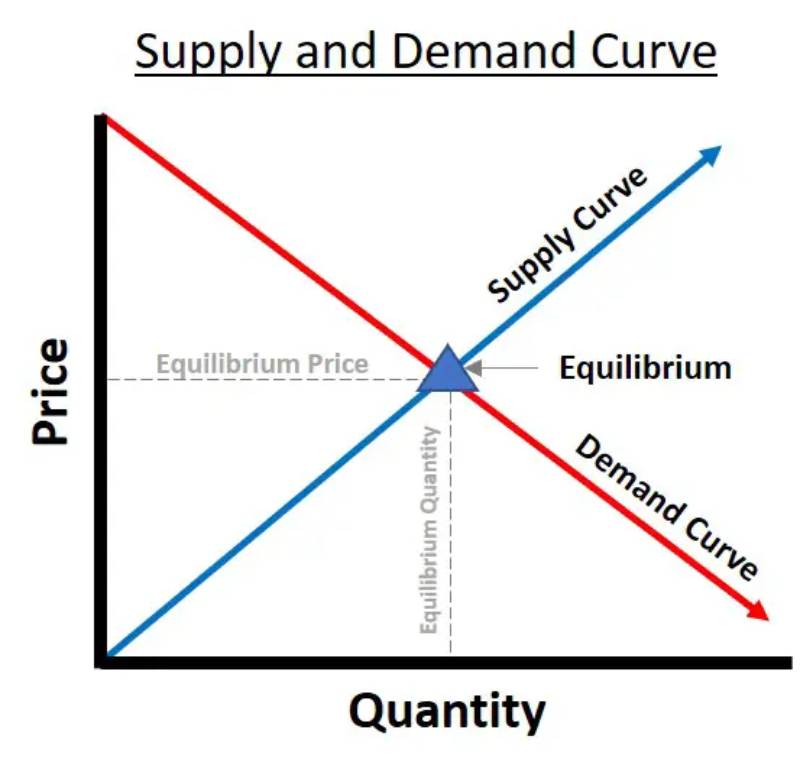
Market Equilibrium is the point where the supply curve and the demand curve meet. Always assume a market is at equilibrium unless stated otherwise, because over time, free markets will always return to the equilibrium point If the price is too high, there will be a surplus of goods, so sellers will lower the price so they sell, returning to equilibrium. If the price is too low, there will be a shortage, and sellers will increase their price to make more money, returning to equilibrium
Consumer surplus - the difference between what consumers are willing to pay vs what theyre actually paying (the equilibrium price)
If a consumer is willing to spent 5$ on a good, but the equilibrium price means that the good is only being sold for 3$, that extra 2$ is the consumer’s surplus.**
Producer Surplus - the difference between what producers are willing to sell their goods for, vs what they’re actually selling their goods for (the equilibrium price)
If a producer is wiling to sell their produce for 7$, but the equilibrium price means they are able to sell their good at 10$, the extra 3$ is there surplus.**
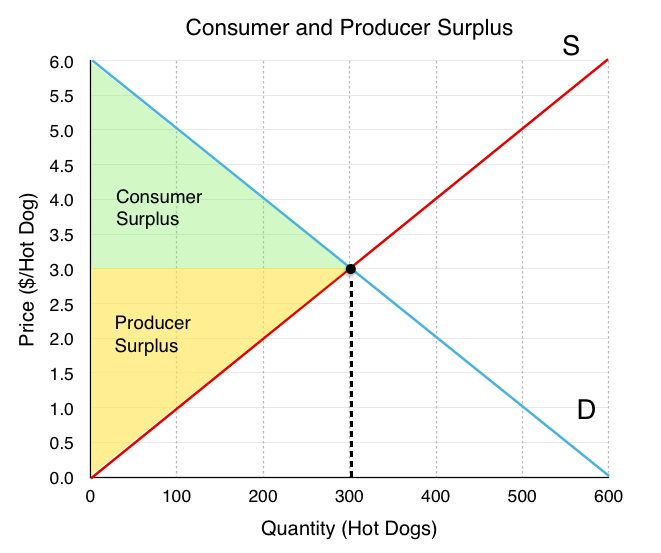
**However, calculating the total consumer or producer surplus is more complicated. It is calculated using the formula for the area of a triangle, A = (1/2)BH (B=base H=height).
In the graph above, the consumer surplus is (1/2)(300)(3) = 450
In the graph above, the producer surplus is (1/2)(300)(3) = 450
The consumer and producer surplus will always be equal at equilibrium.
2.7 - Market Disequilibrium and Changes in Equilibrium
Whenever a market is not at equilibrium, it is an inefficient market. In inefficient markets, there is deadweight loss (DWL) DWL decreases the consumer and producer surplus
In this graph, the price is put at P2, and red shows the deadweight loss.

When the demand or supply curve shifts, the equilibrium point changes. On the AP Tets, you will likely need to determine the equilibrium price on a supply/demand graph, how a change will impact the supply and demand curves, find the new equilibrium price/quantity, and compare it to the original.
In this example, there is a new Tax shifting the supply curve left/up
There is now DWL
The new equilibrium price, Pb, is greater than the original, Pe
The new equilibrium quantity, Qt is less than the original, Qe

When both demand and supply shift, either the price or the quantity will become indeterminate
In the graph below, price appears to not change, but depending on how you draw the graph (how far you shift each curve), that will change, making it indeterminate. The change in price may change depending on how much you move the curves, which is why it is indeterminate, but quantity will always increase.
The second graph shows how, with the same shifts, the price will appear lower, because price is indeterminate.
2.8 - The Effects of Government Intervention in Markets
The government may intervene in free markets:
To ensure equity (ex:make sure people can afford their medication)
As a result of to political pressure (lobbying, corruption)
To promote a certain agenda
There are two kinds of price controls
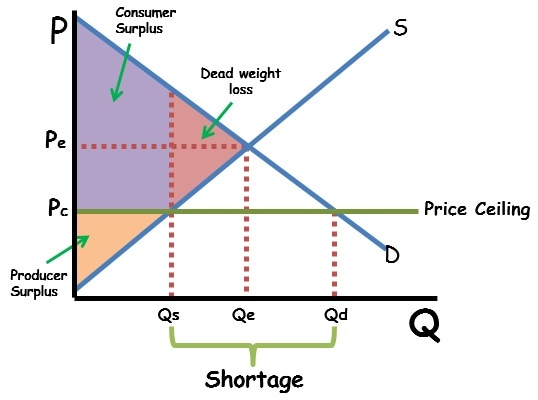
Price ceiling/cap
A maximum price sellers can charge for a good
Only effective if put below the current market equilibrium
If not, its a non-binding price ceiling
Creates a shortage of goods
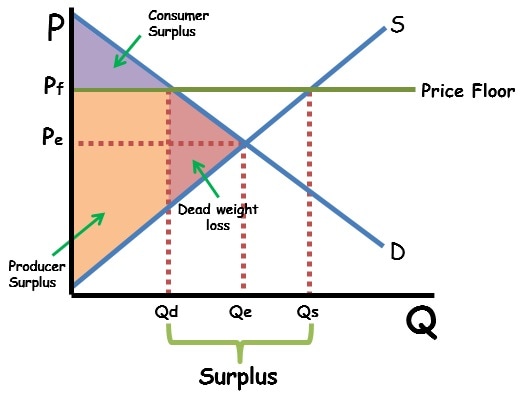
Price floor
The minimum price a seller can charge for a good
Only effective if put above the current market equilibrium
If not, its a non-binding price floor
Creates a surplus, which the government generally must buy up the shortage (ex: the cheese caves. google it, its fun)
May be done to support farmers, protect fair wages
Price Ceiling
Price Floor
Potential consequences of price caps
Wasted resources - rationing causes people to have to wait in lines for get the good, looses opportunity costs
Inefficient allocation - people who need/want the good can’t get it
Inefficiently low quantity - Seller can’t afford to improve the product. (Ex, rent so cheap repairs can’t be made)
Black markets - dangerous and government loses tax revenue
Potential consequences of price floors
Inefficient allocation - sales at a lower price cannot occur
wasted resources - the government must buy the surplus, a company may have to fire people as they have to pay them more so people are left jobless
Inefficiently high quantity - if the government will always buy the product, there is no incentive to improve.
Black market - Paying people under the table, government loses tax money
2.9 - International Trade and Public Policy
Public Policy - The rules and regulations that govern international trade
Quota - A government-imposed maximum of goods that can be imported. Protects/encourages domestic manufacturing
Quota graphs are NOT on the AP Exam
Tariff - A tax on foreign-made goods. The price is often shared by producers and consumers. Protects/encourages domestic manufacturing
This graph shows the domestic supply and demand curve, and the World Price for the same good.
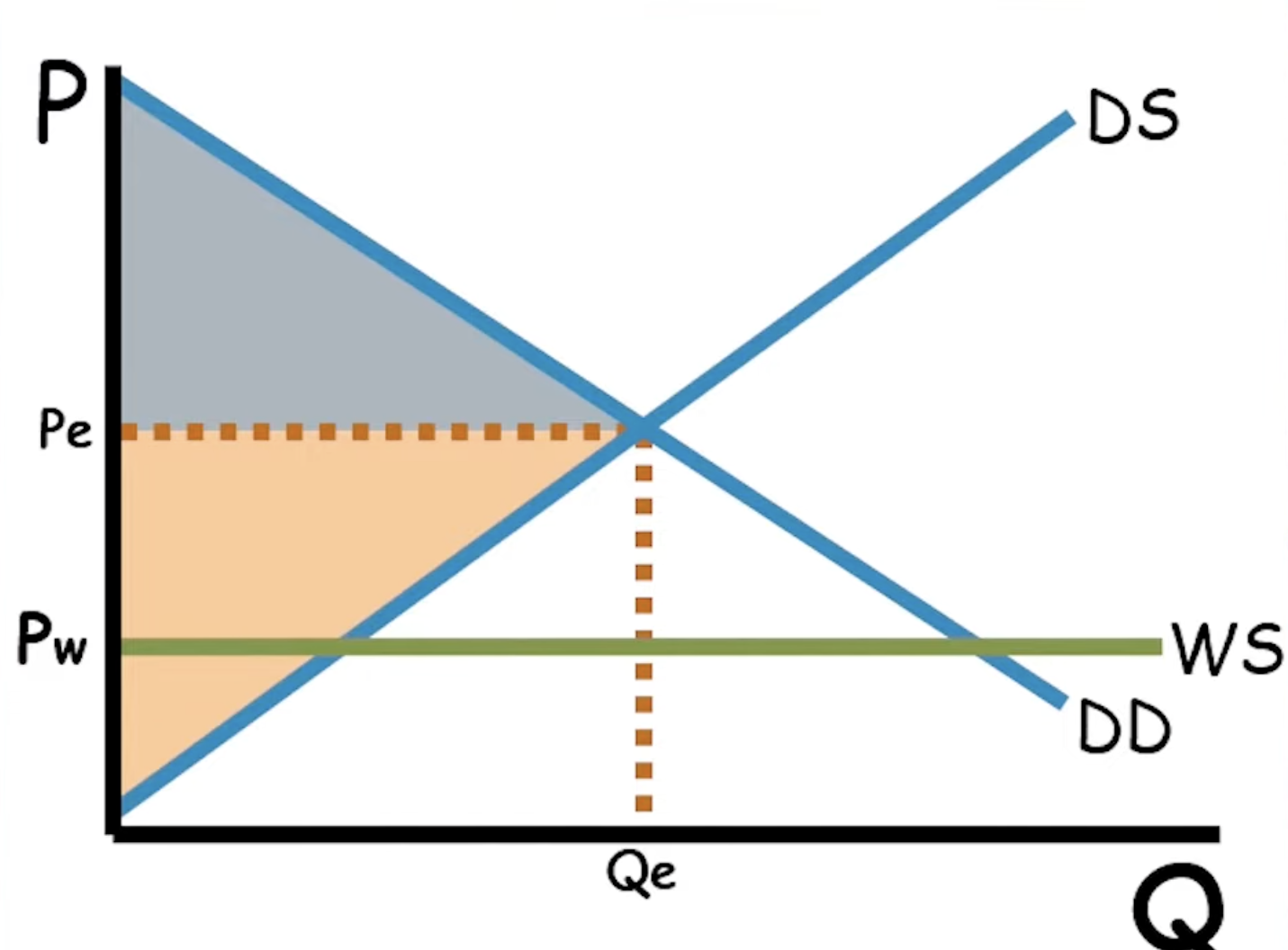
If this country opens itself up to world trade, the price will lower to the world price, causing domestic sellers to only produce at Qs, but consumers will demand at Qd. The difference will be supplied by foreign producers.
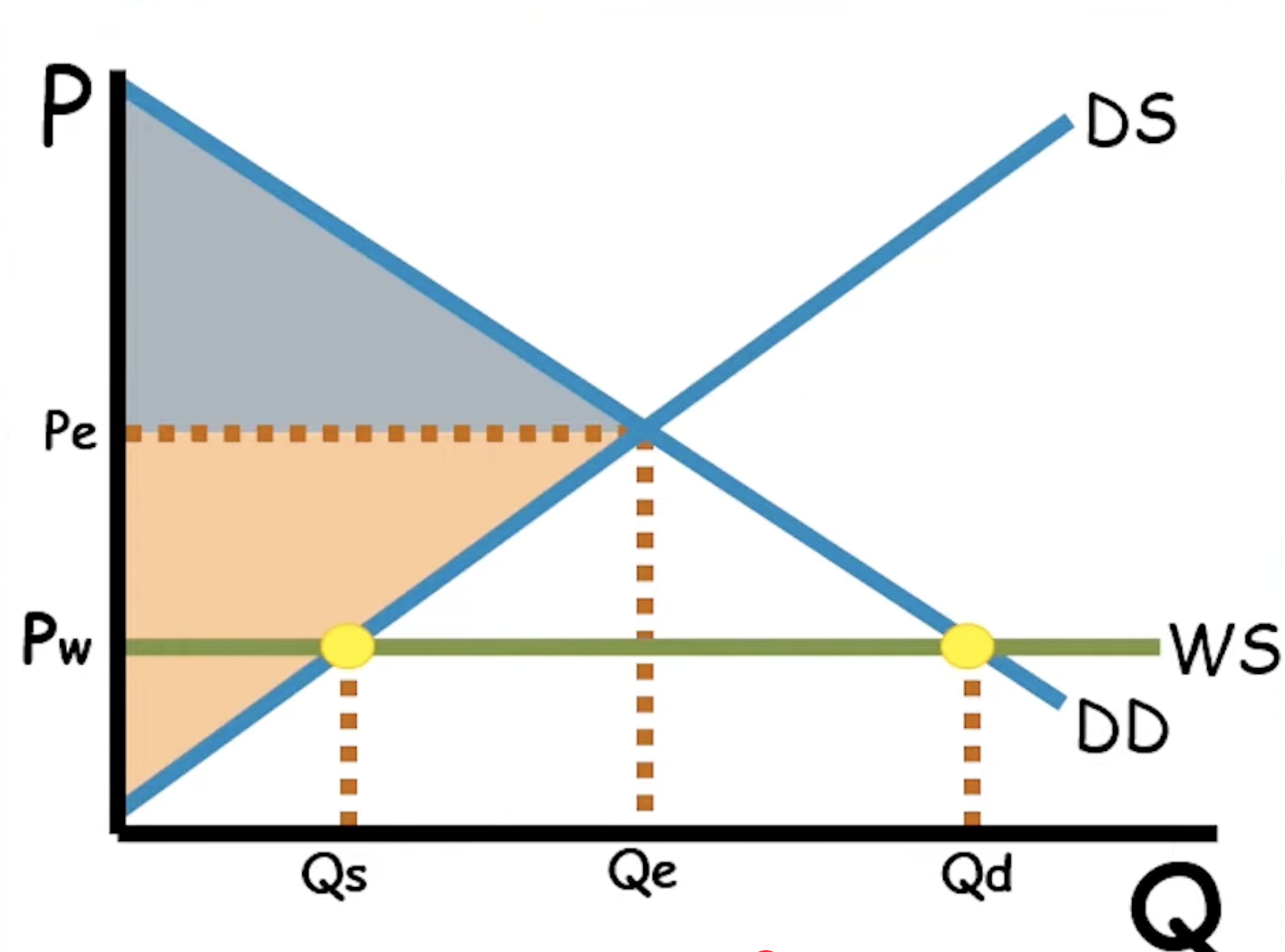
This significantly increases the consumer surplus (gray), but reduces the producer surplus (orange)
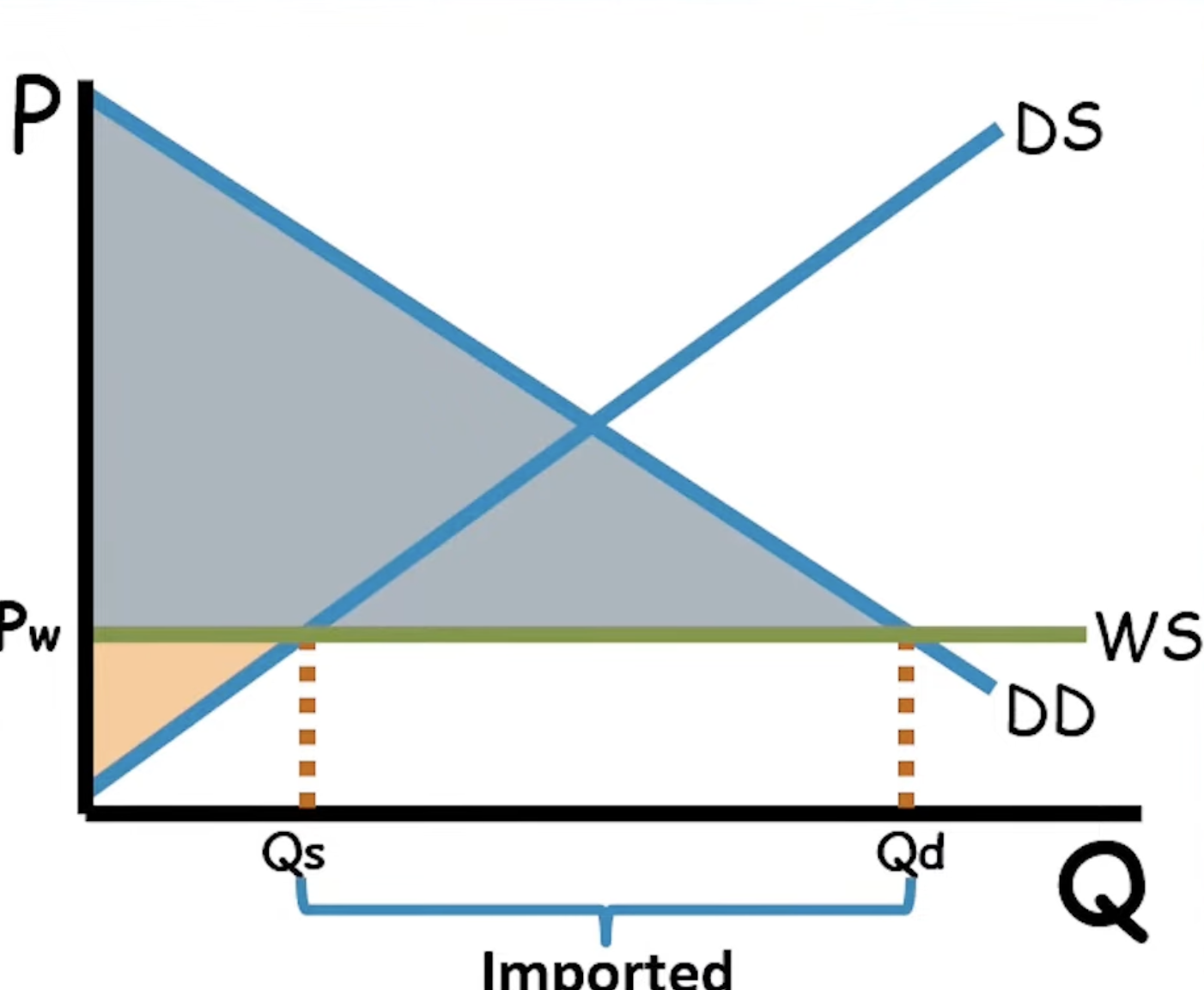
In short, if the world price is below equilibrium
Consumers will demand more
Domestic suppliers will produce less
The difference will be imported
There is more consumer surplus
There is less producer surplus
increase total economic surplus
In contrast, if the world price is above market equilibrium, consumers will demand less, and suppliers will produce more, and export all that isnt bought by domestic consumers (the different).
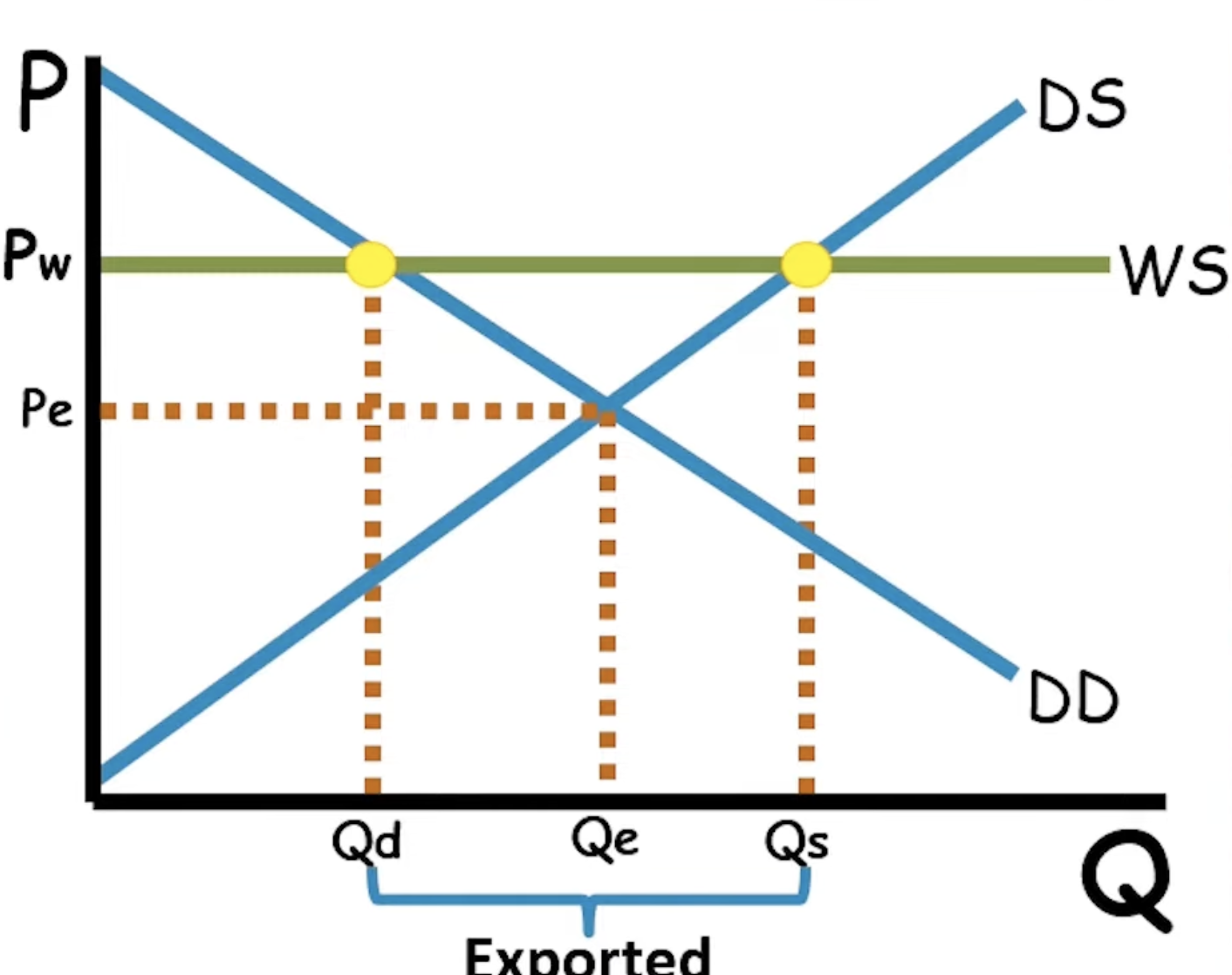
Consumer surplus decreases, and producer surplus increases
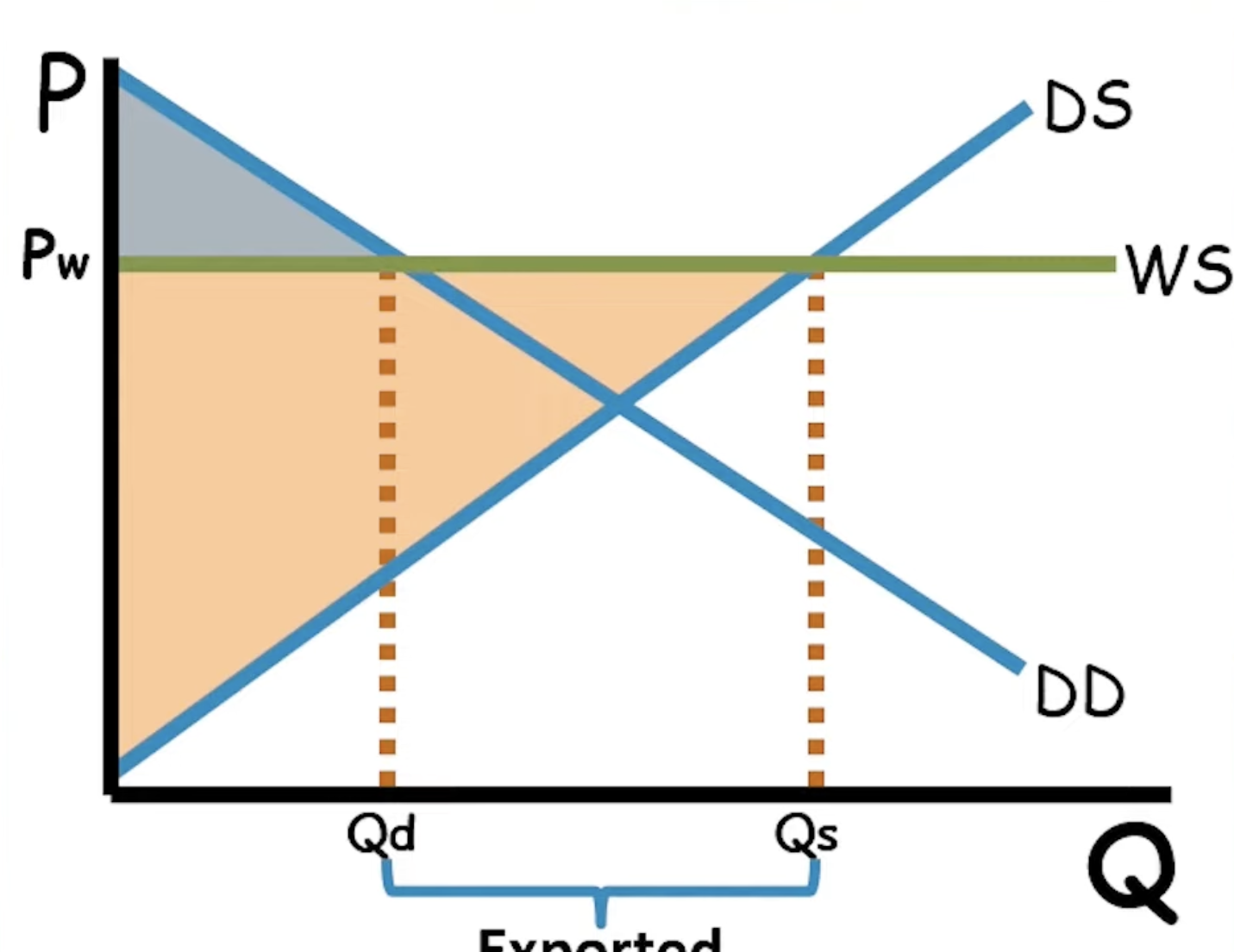
In short, if the world price is above equilibrium
Consumers will demand less
Domestic suppliers will produce more
The difference will be exported
There is less consumer surplus
There is more producer surplus
increase total economic surplus
Tariffs
If a tariff is imposed, the world price will be higher. Quantity supplied and demanded move along their respective curves to meet the new WS. Qs → Qs1 and Qd → Qd1
Producer surplus will increase, Consumer surplus will decrease, there will be dead-weight loss, and tariff revenue for the government.
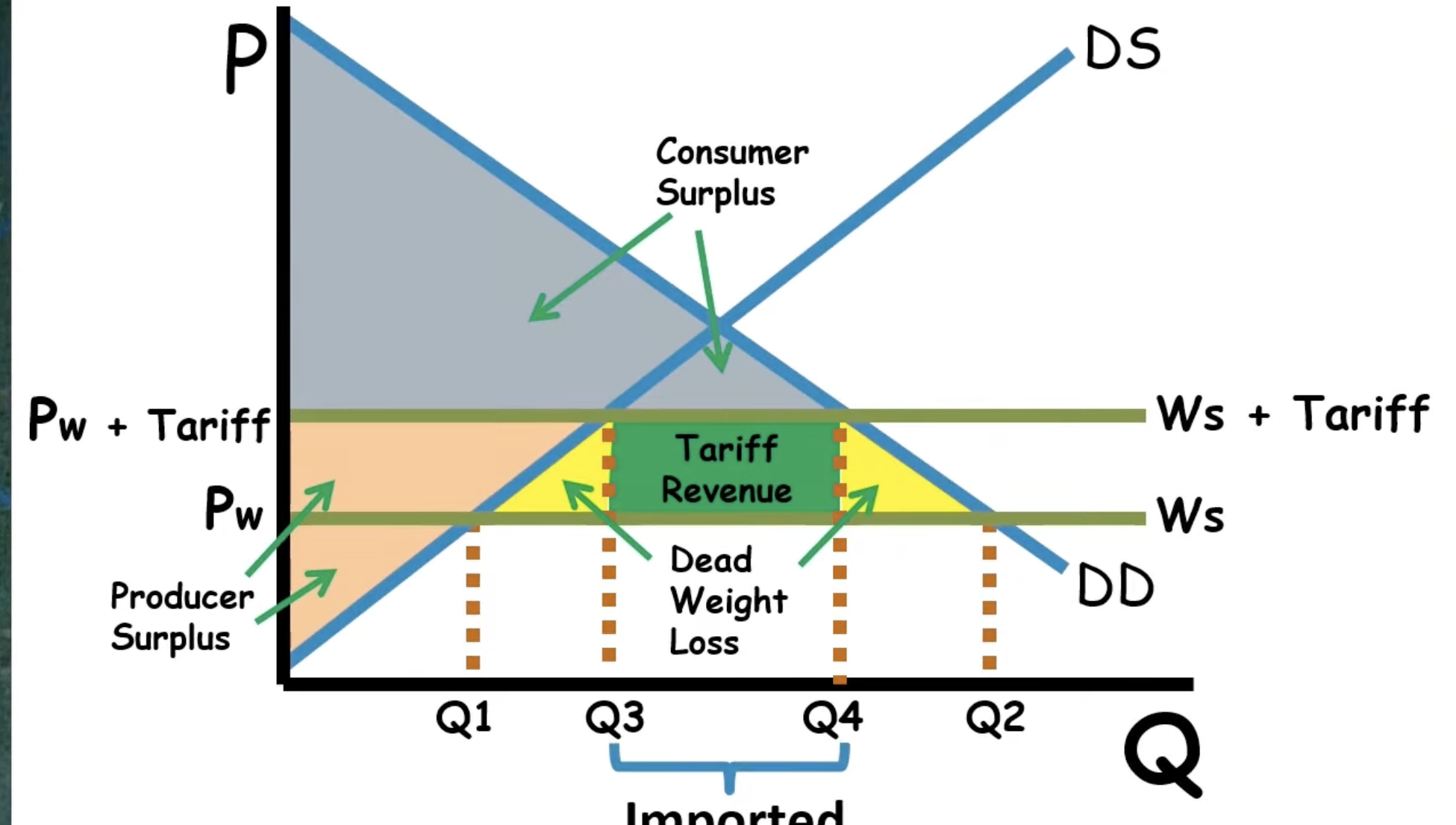
Tariffs
Decrease trade
Decrease total economic surplus
Create DWL