Interest Groups
What are Interest Groups?
Organization of people with shared policy goals entering policy process at one of several points
How is it different from a Political Party?
Political Parties run candidates to win control of Government Offices
Interest Groups seek to influence officials to adopt their policy preferences
Interest Groups may endorse candidates, but do not run their own people
Types of Interest Groups
Membership Interest Groups
Social or Civil advocacy groups
Usually made up of groups of motivated citizens
Have high levels of sympathetic supporters, most do not actually join or pay dues
support the group but do not participate
Corporate/Industry Interest Groups
Corporations contribute dues to be members of these groups
These lawyers and PR specialists make up the core of special interest lobbying groups
Members are companies, not citizens
Groups hire lawyers and politicians to lobby on company behalfs
Why Do Interest Groups Have a Bad Reputation?
Writers of the Constitution disliked organized factions - Federalist 10
Dishonest lobbyists get more press than honest ones
“Lobbying” in general has negative connotations
Theory Connection - Pluralism
Many centers of power and many diverse, competing groups
No group wins or loses all the time
Interest groups are a linkage institution between people and government
Theory Connection - Elitism
Societies are divided along class lines and the upper-class elite will rule
Power is not equally divided among groups, some have much more.
Lobbying is a problem because it benefits few at the expense of many
Characteristics of Successful Interest Groups
A successful Interest Group immensely grows when it first starts, then comes to a plateau and maintains this
Leadership Accountability
Transparency
Membership Feedback
Stability
Large or small, they attract and keep members over time
Selective Benefits
Solidarity Benefits
Expressive Benefits
The Challenge of Large Groups
Free-Rider problem: people that benefit from a group’s activities without officially joining.
The bigger group, large the free-rider problem
Large groups are difficult to keep organized
Small break-away groups can give the large group a bad reputation
Ways Groups Influence Policy
Lobbying
Educating government decisions makers on your policy in hopes of influencing them.
Pro: can help legislatures craft effective laws
Con: can also act as a barrier to entry for average voters
Electioneering
Direct group involvement in election process
Forming PACs, 527s, and Super PACs
Groups may give to both sides
Political Cues and Ratings
Interest Groups promote parties and candidates that benefit them
They rate candidates for their membership to promote officials that are friendly to their cause
Will rate candidates on their site on how friendly they are, how in align with their groups’ interest(s) they are, etc
Litigation
litigation = sue
Interest groups can file amicus curiae briefs in court cases to support position
Class Action Lawsuits on behalf of citizens/members/voters
they go to court on your behalf, you sign that they can speak on your behalf and you can be compensated
Going Public
public marketing campaign about their issue to influence normal citizens to possibly join the group but mostly call congress about the issue
Groups use marketing strategies to influence public opinion of group and its issues
Use advertising to motivate the public about an issue
Grassroots lobbying to get members to advocate on behalf of their interest
“Astroturfing”
Corporate interest group created “grassroots” movements
Usually contain regular citizens, but all organization and funding come from corporate/industry sources
Can use very sophisticated online and “IRL” organization to spread their message
Iron Triangles
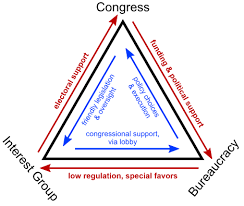
Strong relationship between an interest group
A Congressional committee,
and bureaucratic Agency
Issue Networks
Complex interactions between interest groups,
multiple committees,
and bureaucratic agencies